Premium Spinach Seeds
Leafy spinach varieties developed for healthy foliage growth and excellent leaf quality.
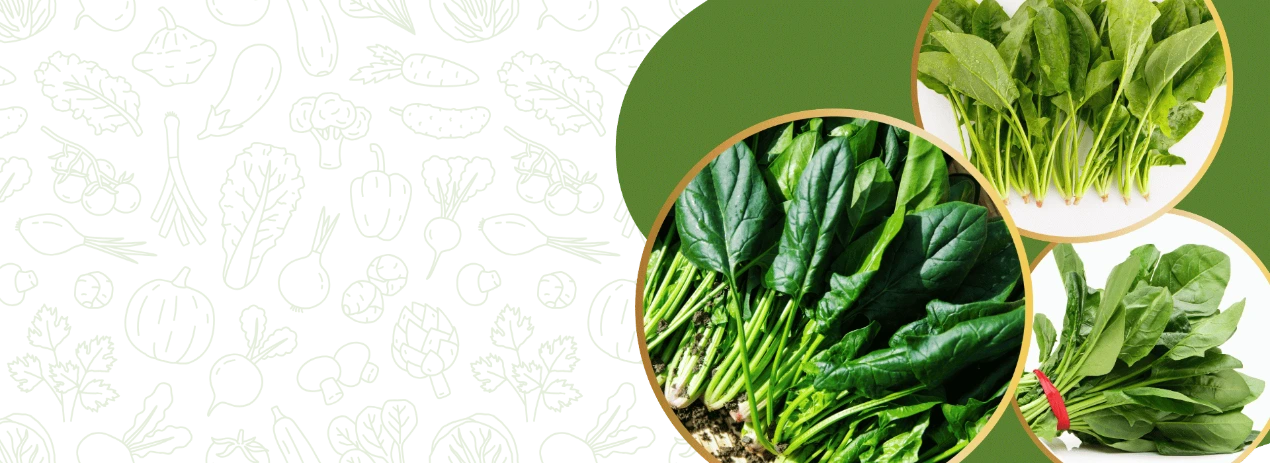
Spinach Varieties
These spinach varieties are suitable for fresh market cultivation with uniform leaf growth, rich green color, and strong adaptability.
Complete Package of Practices for Spinach Cultivation
Spinach (palak) is a quick, cool-season leafy vegetable grown for its tender, nutritious green leaves, with strong fresh-market and processing demand. It is one of the fastest crops to harvest and is often cut several times from a single sowing. The key to a good crop is keeping it in cool weather to prevent bolting (running to seed), feeding it well with nitrogen for soft leaves, and sowing in succession for a steady supply. This guide covers full technical practice plus a country-wise climate and sowing calendar for farmers worldwide.
Quick Navigation
- 01 Crop Overview & Types
- 02 Climatic Requirements
- 03 Soil & Field Preparation
- 04 Seed Rate & Seed Treatment
- 05 Sowing & Succession Sowing
- 06 Spacing & Thinning
- 07 Nutrient Management
- 08 Irrigation
- 09 Weed & Intercultural Care
- 10 Bolting Management
- 11 Pest Management
- 12 Disease Management
- 13 Harvesting (Multi-Cut)
- 14 Yield & Post-Harvest
- 15 Country-Wise Climate & Sowing Guide
- 16 Frequently Asked Questions
1. Crop Overview & Types
- Common names: Spinach, palak
- Scientific name: Spinacia oleracea L.
- Crop type: Quick-growing, cool-season leafy annual
- Leaf types: Smooth (flat) leaf, semi-savoy and savoy (crinkled) leaf; broad-leaf palak types are popular in South Asia.
- Uses: Fresh cooking and salad, processing, freezing, dehydration
- Nutritional value: Rich in iron, folate, vitamins A, C and K, and antioxidants
2. Climatic Requirements
- Temperature: 15–25 °C is ideal; spinach is a cool-season crop and tolerates light frost. Above about 26–28 °C growth suffers and bolting is triggered.
- Day length: spinach is a long-day plant — long days combined with heat make it bolt (run to seed), so it is best grown in the cooler, shorter-day part of the year.
- Soil: Well-drained fertile loam rich in organic matter; pH 6.0–7.0. Spinach is sensitive to acidic soils.
- Rainfall: Performs best under controlled irrigation; very wet conditions raise leaf diseases.
3. Soil & Field Preparation
- Plough to a fine, firm tilth — small seed needs a level, fine seedbed.
- Incorporate 20–25 t/ha of well-decomposed FYM / compost during land preparation.
- Prepare flat beds or raised beds with good drainage for clean, easy harvesting.
4. Seed Rate & Seed Treatment
Seed rate
- Line sowing: 20–25 kg/ha
- Broadcast: 25–30 kg/ha (spinach is sown thickly for leaf)
Seed treatment & soaking
- Soaking the seed in water for 12–24 hours before sowing speeds up and evens out germination.
- Treat seed with Thiram / Captan @ 2–3 g/kg, or Trichoderma viride @ 4 g/kg, against damping-off.
5. Sowing & Succession Sowing
- Sow seed directly in the field in lines or by broadcasting; cover lightly and irrigate.
- Germination is quick in warm-cool soil (about 5–10 days).
- Succession sowing: sow a fresh patch every 2–3 weeks through the cool season for a continuous, steady supply rather than one big flush.
6. Spacing & Thinning
- Spacing: lines 20–30 cm apart; thin or sow so plants stand about 5–10 cm apart.
- Thin overcrowded seedlings early — crowding gives small, weak, disease-prone plants.
- For multi-cut crops, slightly wider spacing helps regrowth after each cut.
7. Nutrient Management (per hectare)
Spinach is a leaf crop, so it responds strongly to nitrogen — indicative dose, adjust to soil test:
| Nutrient | Dose | Application timing |
|---|---|---|
| Nitrogen (N) | 80–120 kg | Part basal; top-dress after each cut for fresh leaf growth |
| Phosphorus (P2O5) | 40–60 kg | Full basal at sowing |
| Potassium (K2O) | 40–60 kg | Full basal at sowing |
| Micronutrients | As recommended | Support dark-green, healthy leaves |
8. Irrigation
- Keep soil consistently moist with frequent light irrigation — even moisture gives soft, tender, fast-growing leaves.
- Moisture stress makes leaves tough and hastens bolting.
- Avoid waterlogging, which causes root rot and leaf disease.
- Drip or light sprinkler irrigation works well; avoid prolonged leaf wetness in disease-prone weather.
9. Weed & Intercultural Care
- Keep the crop weed-free early, as spinach is a poor competitor — do light hand weeding.
- Avoid deep cultivation that damages the shallow roots.
- Keep beds clean to reduce pest and disease build-up.
10. Bolting Management
- Bolting (premature flowering and seed-stalk formation) makes leaves bitter and unsaleable. It is triggered by heat and long days.
- Grow spinach in the cool season and harvest before the weather warms.
- Choose slow-bolting / bolt-resistant varieties for warmer areas or late sowings.
- Keep moisture and nutrition steady — stress speeds up bolting.
- Harvest promptly; once a plant starts to bolt, cut and clear it.
11. Plant Protection — Pests
| Pest | Symptom | Management |
|---|---|---|
| Leaf miner | Serpentine mines / blotches in leaves | Remove affected leaves; need-based control; clean cultivation |
| Aphids | Sap-sucking; curled leaves; spread virus | Yellow sticky traps; manage early; need-based control |
| Caterpillars / leaf-eaters | Holes in leaves | Hand-pick; bio-pesticides; need-based control |
12. Plant Protection — Diseases
| Disease | Symptom | Management |
|---|---|---|
| Downy mildew (major) | Yellow patches on top of leaves, grey-purple growth beneath, in cool humid weather | Resistant varieties; airflow; avoid leaf wetness; preventive fungicide |
| White rust | White blister-like pustules on the underside of leaves | Crop rotation; resistant varieties; recommended fungicide |
| Cercospora leaf spot | Round spots on leaves | Crop rotation; field sanitation; protectant fungicide |
| Damping-off | Seedling collapse in wet soil | Seed treatment; good drainage; avoid over-watering |
13. Harvesting (Multi-Cut)
- First harvest is ready about 25–40 days after sowing, when leaves are tender and of good size.
- Multi-cut method: cut the leaves about 3–5 cm above the ground, leaving the crown to regrow; take successive cuts every 15–20 days (typically 3–5 cuts) with a nitrogen top-dress after each.
- Single harvest method: alternatively, uproot or cut the whole plant once at full leaf size.
- Harvest in the cool morning; the leaves are soft and wilt fast in heat.
14. Yield & Post-Harvest
- Yield: 10–20 t/ha over the cuttings, depending on variety, season and management.
- Spinach is highly perishable — cool immediately, keep moist, and market quickly.
- Wash gently, bunch or pack loosely in ventilated crates, and keep cold in transit.
15. Country-Wise Climate & Sowing Guide
Spinach is a cool-season crop, so the aim everywhere is to grow it in the cool, shorter-day months and harvest before heat triggers bolting. Windows below are indicative — adjust to local altitude and micro-climate.
| Country / Region | Climate | Best sowing / season | Bolting & heat caution |
|---|---|---|---|
| TROPICAL & SUBTROPICAL (cool-season crop) | |||
| India | Subtropical | Main: Oct–Feb (cool season); succession sowings through winter | Summer sowing bolts quickly — use slow-bolting palak |
| Pakistan / Bangladesh | Subtropical | Autumn–winter | Avoid the hot months |
| Egypt / N. Africa | Arid subtropical | Autumn–winter and early spring | Harvest before spring heat |
| Gulf (Saudi / UAE) | Hot arid | Oct–Mar (cool season) | Summer is far too hot in the open |
| Kenya / E. Africa highlands | Tropical highland | Cool highland window, much of the year | Lowland heat causes fast bolting |
| SE Asia | Humid tropical | Cool / dry season or highlands | Lowland heat and humidity limit it |
| MEDITERRANEAN & TEMPERATE | |||
| Spain / Italy / Turkey | Mediterranean | Autumn and early spring | Avoid mid-summer bolting |
| USA / N. Europe | Temperate | Early spring and autumn; overwintered in mild areas | Long summer days cause rapid bolting |
| China | Wide range (major producer) | Autumn, winter and spring | Protected cultivation extends the cool window |
16. Frequently Asked Questions
Why does my spinach run to seed (bolt) so quickly?
Bolting is triggered by heat and long days. Grow spinach in the cool season, harvest before it warms up, keep moisture and nutrition steady, and use slow-bolting (bolt-resistant) varieties for warmer areas.
Can I cut spinach more than once?
Yes. With the multi-cut method, cut the leaves a few centimetres above the ground and leave the crown to regrow; you can take several cuts every 15–20 days, with a light nitrogen top-dress after each cut.
What temperature does spinach need?
About 15–25 °C. It is a cool-season crop that tolerates light frost but suffers and bolts above roughly 26–28 °C.
How much spinach seed is needed per hectare?
About 20–25 kg/ha for line sowing and 25–30 kg/ha when broadcast — spinach is sown fairly thickly for leaf.
Why should I sow in succession?
Spinach matures fast and bolts as it warms, so sowing a fresh patch every 2–3 weeks gives a steady, continuous supply instead of one large flush that quickly passes.
How do I keep leaves dark green and tender?
Feed nitrogen (including a top-dress after each cut), keep soil evenly moist, and harvest young. Avoid moisture stress, which toughens leaves and speeds bolting.
Why are my spinach leaves yellow with grey growth underneath?
That is downy mildew, common in cool, humid weather. Use resistant varieties, improve airflow, avoid prolonged leaf wetness, and apply a preventive fungicide where needed.
Explore More Farmson Crop Guides
Beetroot Carrot Radish Onion Cultivation Tomato Cultivation View All Vegetable SeedsGrow with Farmson Biotech Spinach Seeds
High-yield, slow-bolting spinach & palak varieties for tender, dark-green, multi-cut leaves.
Send Export InquiryComplete Package of Practices for Spinach Cultivation
Spinach (palak) is a quick, cool-season leafy vegetable grown for its tender, nutritious green leaves, with strong fresh-market and processing demand. It is one of the fastest crops to harvest and is often cut several times from a single sowing. The key to a good crop is keeping it in cool weather to prevent bolting (running to seed), feeding it well with nitrogen for soft leaves, and sowing in succession for a steady supply. This guide covers full technical practice plus a country-wise climate and sowing calendar for farmers worldwide.
Quick Navigation
- 01 Crop Overview & Types
- 02 Climatic Requirements
- 03 Soil & Field Preparation
- 04 Seed Rate & Seed Treatment
- 05 Sowing & Succession Sowing
- 06 Spacing & Thinning
- 07 Nutrient Management
- 08 Irrigation
- 09 Weed & Intercultural Care
- 10 Bolting Management
- 11 Pest Management
- 12 Disease Management
- 13 Harvesting (Multi-Cut)
- 14 Yield & Post-Harvest
- 15 Country-Wise Climate & Sowing Guide
- 16 Frequently Asked Questions
1. Crop Overview & Types
- Common names: Spinach, palak
- Scientific name: Spinacia oleracea L.
- Crop type: Quick-growing, cool-season leafy annual
- Leaf types: Smooth (flat) leaf, semi-savoy and savoy (crinkled) leaf; broad-leaf palak types are popular in South Asia.
- Uses: Fresh cooking and salad, processing, freezing, dehydration
- Nutritional value: Rich in iron, folate, vitamins A, C and K, and antioxidants
2. Climatic Requirements
- Temperature: 15–25 °C is ideal; spinach is a cool-season crop and tolerates light frost. Above about 26–28 °C growth suffers and bolting is triggered.
- Day length: spinach is a long-day plant — long days combined with heat make it bolt (run to seed), so it is best grown in the cooler, shorter-day part of the year.
- Soil: Well-drained fertile loam rich in organic matter; pH 6.0–7.0. Spinach is sensitive to acidic soils.
- Rainfall: Performs best under controlled irrigation; very wet conditions raise leaf diseases.
3. Soil & Field Preparation
- Plough to a fine, firm tilth — small seed needs a level, fine seedbed.
- Incorporate 20–25 t/ha of well-decomposed FYM / compost during land preparation.
- Prepare flat beds or raised beds with good drainage for clean, easy harvesting.
4. Seed Rate & Seed Treatment
Seed rate
- Line sowing: 20–25 kg/ha
- Broadcast: 25–30 kg/ha (spinach is sown thickly for leaf)
Seed treatment & soaking
- Soaking the seed in water for 12–24 hours before sowing speeds up and evens out germination.
- Treat seed with Thiram / Captan @ 2–3 g/kg, or Trichoderma viride @ 4 g/kg, against damping-off.
5. Sowing & Succession Sowing
- Sow seed directly in the field in lines or by broadcasting; cover lightly and irrigate.
- Germination is quick in warm-cool soil (about 5–10 days).
- Succession sowing: sow a fresh patch every 2–3 weeks through the cool season for a continuous, steady supply rather than one big flush.
6. Spacing & Thinning
- Spacing: lines 20–30 cm apart; thin or sow so plants stand about 5–10 cm apart.
- Thin overcrowded seedlings early — crowding gives small, weak, disease-prone plants.
- For multi-cut crops, slightly wider spacing helps regrowth after each cut.
7. Nutrient Management (per hectare)
Spinach is a leaf crop, so it responds strongly to nitrogen — indicative dose, adjust to soil test:
| Nutrient | Dose | Application timing |
|---|---|---|
| Nitrogen (N) | 80–120 kg | Part basal; top-dress after each cut for fresh leaf growth |
| Phosphorus (P2O5) | 40–60 kg | Full basal at sowing |
| Potassium (K2O) | 40–60 kg | Full basal at sowing |
| Micronutrients | As recommended | Support dark-green, healthy leaves |
8. Irrigation
- Keep soil consistently moist with frequent light irrigation — even moisture gives soft, tender, fast-growing leaves.
- Moisture stress makes leaves tough and hastens bolting.
- Avoid waterlogging, which causes root rot and leaf disease.
- Drip or light sprinkler irrigation works well; avoid prolonged leaf wetness in disease-prone weather.
9. Weed & Intercultural Care
- Keep the crop weed-free early, as spinach is a poor competitor — do light hand weeding.
- Avoid deep cultivation that damages the shallow roots.
- Keep beds clean to reduce pest and disease build-up.
10. Bolting Management
- Bolting (premature flowering and seed-stalk formation) makes leaves bitter and unsaleable. It is triggered by heat and long days.
- Grow spinach in the cool season and harvest before the weather warms.
- Choose slow-bolting / bolt-resistant varieties for warmer areas or late sowings.
- Keep moisture and nutrition steady — stress speeds up bolting.
- Harvest promptly; once a plant starts to bolt, cut and clear it.
11. Plant Protection — Pests
| Pest | Symptom | Management |
|---|---|---|
| Leaf miner | Serpentine mines / blotches in leaves | Remove affected leaves; need-based control; clean cultivation |
| Aphids | Sap-sucking; curled leaves; spread virus | Yellow sticky traps; manage early; need-based control |
| Caterpillars / leaf-eaters | Holes in leaves | Hand-pick; bio-pesticides; need-based control |
12. Plant Protection — Diseases
| Disease | Symptom | Management |
|---|---|---|
| Downy mildew (major) | Yellow patches on top of leaves, grey-purple growth beneath, in cool humid weather | Resistant varieties; airflow; avoid leaf wetness; preventive fungicide |
| White rust | White blister-like pustules on the underside of leaves | Crop rotation; resistant varieties; recommended fungicide |
| Cercospora leaf spot | Round spots on leaves | Crop rotation; field sanitation; protectant fungicide |
| Damping-off | Seedling collapse in wet soil | Seed treatment; good drainage; avoid over-watering |
13. Harvesting (Multi-Cut)
- First harvest is ready about 25–40 days after sowing, when leaves are tender and of good size.
- Multi-cut method: cut the leaves about 3–5 cm above the ground, leaving the crown to regrow; take successive cuts every 15–20 days (typically 3–5 cuts) with a nitrogen top-dress after each.
- Single harvest method: alternatively, uproot or cut the whole plant once at full leaf size.
- Harvest in the cool morning; the leaves are soft and wilt fast in heat.
14. Yield & Post-Harvest
- Yield: 10–20 t/ha over the cuttings, depending on variety, season and management.
- Spinach is highly perishable — cool immediately, keep moist, and market quickly.
- Wash gently, bunch or pack loosely in ventilated crates, and keep cold in transit.
15. Country-Wise Climate & Sowing Guide
Spinach is a cool-season crop, so the aim everywhere is to grow it in the cool, shorter-day months and harvest before heat triggers bolting. Windows below are indicative — adjust to local altitude and micro-climate.
| Country / Region | Climate | Best sowing / season | Bolting & heat caution |
|---|---|---|---|
| TROPICAL & SUBTROPICAL (cool-season crop) | |||
| India | Subtropical | Main: Oct–Feb (cool season); succession sowings through winter | Summer sowing bolts quickly — use slow-bolting palak |
| Pakistan / Bangladesh | Subtropical | Autumn–winter | Avoid the hot months |
| Egypt / N. Africa | Arid subtropical | Autumn–winter and early spring | Harvest before spring heat |
| Gulf (Saudi / UAE) | Hot arid | Oct–Mar (cool season) | Summer is far too hot in the open |
| Kenya / E. Africa highlands | Tropical highland | Cool highland window, much of the year | Lowland heat causes fast bolting |
| SE Asia | Humid tropical | Cool / dry season or highlands | Lowland heat and humidity limit it |
| MEDITERRANEAN & TEMPERATE | |||
| Spain / Italy / Turkey | Mediterranean | Autumn and early spring | Avoid mid-summer bolting |
| USA / N. Europe | Temperate | Early spring and autumn; overwintered in mild areas | Long summer days cause rapid bolting |
| China | Wide range (major producer) | Autumn, winter and spring | Protected cultivation extends the cool window |
16. Frequently Asked Questions
Why does my spinach run to seed (bolt) so quickly?
Bolting is triggered by heat and long days. Grow spinach in the cool season, harvest before it warms up, keep moisture and nutrition steady, and use slow-bolting (bolt-resistant) varieties for warmer areas.
Can I cut spinach more than once?
Yes. With the multi-cut method, cut the leaves a few centimetres above the ground and leave the crown to regrow; you can take several cuts every 15–20 days, with a light nitrogen top-dress after each cut.
What temperature does spinach need?
About 15–25 °C. It is a cool-season crop that tolerates light frost but suffers and bolts above roughly 26–28 °C.
How much spinach seed is needed per hectare?
About 20–25 kg/ha for line sowing and 25–30 kg/ha when broadcast — spinach is sown fairly thickly for leaf.
Why should I sow in succession?
Spinach matures fast and bolts as it warms, so sowing a fresh patch every 2–3 weeks gives a steady, continuous supply instead of one large flush that quickly passes.
How do I keep leaves dark green and tender?
Feed nitrogen (including a top-dress after each cut), keep soil evenly moist, and harvest young. Avoid moisture stress, which toughens leaves and speeds bolting.
Why are my spinach leaves yellow with grey growth underneath?
That is downy mildew, common in cool, humid weather. Use resistant varieties, improve airflow, avoid prolonged leaf wetness, and apply a preventive fungicide where needed.
Explore More Farmson Crop Guides
Beetroot Carrot Radish Onion Cultivation Tomato Cultivation View All Vegetable SeedsGrow with Farmson Biotech Spinach Seeds
High-yield, slow-bolting spinach & palak varieties for tender, dark-green, multi-cut leaves.
Send Export InquiryAgricultural Advisory Notice
The recommendations and crop guidance provided on this website are intended for informational purposes only and should not be considered a guaranteed agronomic outcome. Local climatic conditions, soil health, cultivation methods, and regional practices may influence actual crop performance. FARMSON BIOTECH PVT LTD recommends farmers seek guidance from authorized agricultural experts or local government agricultural authorities before cultivation decisions.