F1 Hybrid
Corn Seeds
High-performance corn hybrids developed for strong yield potential and excellent fruit quality.
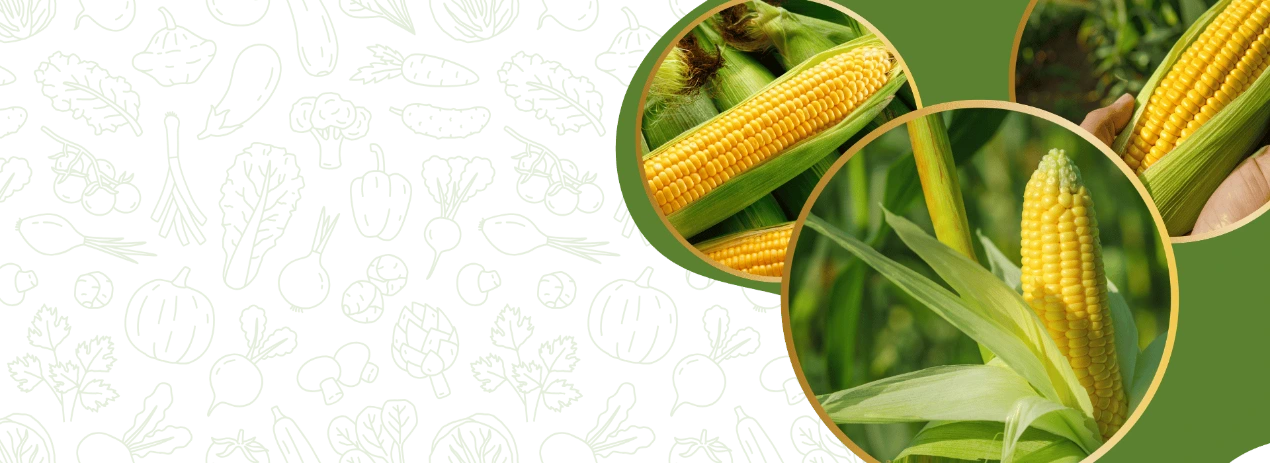
F1 Hybrid Corn Varieties
Our corn hybrids are designed for commercial cultivation with strong plant vigor, uniform cob setting, attractive firmness, and reliable market performance. Suitable for open-field and protected cultivation depending on hybrid selection.
Complete Package of Practices for Sweet Corn Cultivation
Sweet corn is one of the highest-value cereal-vegetable crops in the world — harvested at the immature "milk stage" while the kernels are still juicy and sweet, before sugars convert to starch. Unlike field corn (maize) grown for grain and feed, sweet corn is a vegetable crop, with very different variety choice (sugar genetics), isolation needs, harvest timing and post-harvest handling. It is a warm-season annual, and success depends on choosing the right sugar-gene variety, isolating it from any other corn, planting in blocks for proper wind pollination, protecting against fall armyworm and earworm, and harvesting in the narrow milk-stage window. This guide covers complete technical practice from sowing to harvest, plus a country-wise climate and sowing calendar for farmers worldwide.
Quick Navigation
- 01 Crop Overview
- 02 Climatic Requirements
- 03 Soil & Field Preparation
- 04 Sowing & Crop Establishment
- 05 Seed Rate & Seed Treatment
- 06 Spacing, Block Planting & Population
- 07 Sugar Genetics & Isolation
- 08 Nutrient Management
- 09 Irrigation
- 10 Weed & Intercultural Care
- 11 Pest Management
- 12 Disease Management
- 13 Physiological Disorders
- 14 Harvesting & Post-Harvest
- 15 Country-Wise Climate & Sowing Guide
- 16 Frequently Asked Questions
1. Crop Overview
- Common names: Sweet corn, sugar corn, green corn, table corn, mithi makai
- Scientific name: Zea mays L. var. saccharata
- Crop type: Warm-season annual; frost-sensitive; wind-pollinated; monoecious (separate male tassel and female ear on the same plant)
- Distinct from field corn / maize: sweet corn carries a recessive sugar gene that prevents the conversion of sugar to starch during early kernel development, giving the sweet, juicy "milk-stage" kernel that is the harvest product.
- Sugar-gene types (covered in detail in section 7):
- Normal sugary (su) — traditional sweet corn; 4–6% sugar; converts to starch within 12–24 hours of picking
- Sugary enhanced (se) — improved tenderness; 8–12% sugar; 2–4 day shelf life
- Supersweet (sh2) — 25–30% sugar; 5–10 day shelf life; tougher kernel; demands isolation
- Kernel colours: yellow (standard), white, bicolour (white + yellow), and specialty rainbow / glass-gem colours for niche markets
- End uses: fresh cob (boiled, roasted, BBQ), processed (canned kernel, frozen kernel, frozen cob, cream-style), juice / drink, cob salad, baby corn (a different crop, see notes)
- Pollination: wind-pollinated; pollen sheds from the tassel for 5–7 days; silks are receptive for 7–10 days; the overlap is the critical fertilisation window
2. Climatic Requirements
- Temperature: Optimum 21–30 °C; minimum soil temperature for germination 16 °C (18–20 °C for supersweet sh2 types, which germinate poorly in cold soil); frost kills the crop instantly.
- Heat stress at pollination: above 35 °C the pollen dies and silks dry out — the ear ends up with patchy kernel fill. Schedule sowing so pollination falls in the mildest window.
- Rainfall: 500–800 mm well-distributed across the cycle; very sensitive to drought during tasselling and silking, and to waterlogging at any stage.
- Daylength: Mostly day-neutral in modern hybrids — can be grown in spring, kharif (monsoon) and rabi (winter) wherever frost-free.
- Sunshine: Full sun is essential; partial shade reduces ear size, kernel fill and sugar content.
- Wind: Sweet corn is brittle and lodges in strong wind — balanced N and earthing-up reduce risk.
3. Soil & Field Preparation
- Soil: Deep, well-drained sandy loam to clay-loam rich in organic matter; pH 6.0–7.0.
- Avoid heavy clay (poor drainage causes root rot at silking), saline soils (EC above 2 dS/m starts to reduce yield), and strongly acidic (<5.5) soils.
- Plough deeply (20–25 cm) once, then 2–3 harrowings to a fine, level tilth.
- Incorporate 10–15 t/ha well-decomposed FYM or compost at the last ploughing.
- Form ridges or raised beds in irrigated systems for drainage and easy hoeing / earthing-up.
- Sweet corn responds strongly to soil organic matter — building soil OM over multiple cycles dramatically improves yield and quality.
4. Sowing & Crop Establishment
- Sweet corn is direct-sown; no nursery is used.
- Sowing depth: 3–5 cm. Deeper sowing in dry warm soil; shallower in heavy or moist soil. Supersweet (sh2) seed has a delicate, shrivelled appearance and should be sown shallow (2–3 cm) into moist, warm soil.
- Method: Dibbling, seed-drill or precision planter. One seed per hill at the correct spacing.
- Soil temperature: wait until soil temperature is above 16 °C (above 18–20 °C for supersweet). Cold-soil sowing causes severe germination loss, especially for sh2.
- Pre-sowing irrigation 4–5 days before planting gives the most uniform germination.
- Germination: 5–10 days at soil temperature above 18 °C; slower and patchier below 16 °C.
- Staggered sowing: for continuous fresh-market supply, sow new batches every 10–14 days (or use varieties of different maturities planted on the same day).
5. Seed Rate & Seed Treatment
Seed rate
- Normal sugary (su) and sugary enhanced (se): 8–10 kg/ha
- Supersweet (sh2): 6–8 kg/ha — smaller, lighter kernel
- Baby corn or twin-row commercial: 10–12 kg/ha (higher density)
Seed treatment
- Treat seed with Thiram / Captan @ 2–3 g/kg or Trichoderma viride @ 4 g/kg to control seed rot, damping-off and seedling diseases.
- For shoot-fly and stem-borer-prone areas, treat with imidacloprid (or similar systemic) @ 5–7 g/kg seed as per local registration.
- Use only fresh seed (under 12 months old) — supersweet (sh2) seed loses germination very quickly in warm humid storage and is the most fragile of all corn types.
- Avoid soaking sweet corn seed before sowing — especially supersweet, which absorbs water unevenly and rots.
6. Spacing, Block Planting & Plant Population
| System | Row spacing | Plant spacing | Plants per ha | Notes |
|---|---|---|---|---|
| Standard fresh market | 60–75 cm | 20–25 cm | 55,000–75,000 | Single row; thinned to one plant per hill |
| High-input commercial | 60 cm | 20 cm | 75,000–85,000 | Drip-irrigated; needs careful N and water management |
| Processing (canning, freezing) | 75 cm | 20–25 cm | 55,000–65,000 | Once-over machine harvest |
| Twin-row on raised bed | 30 cm twin / 90 cm between beds | 20 cm | 70,000–80,000 | Better pollination, ideal for drip and machinery |
Block planting is essential, not optional
- Sweet corn is wind-pollinated. A long, narrow single row of corn gets poor kernel fill at the tip and on one side of the cob, because the wind blows pollen away before it lands on the silks.
- Always plant in a square or rectangular block of at least 4–6 rows — never a single line. Even backyard plantings need a 3 × 3 m minimum block for proper pollination.
- For commercial fields, plant in blocks of 25 × 25 m or larger; orient the long side perpendicular to the prevailing wind so pollen lands within the block.
7. Sugar Genetics & Isolation — The Critical Choice
Sweet corn has three sugar-enhancement gene families. Each affects sugar level, shelf life, kernel texture and the all-important question of which other corns it can safely be grown near. Choose the wrong type and you either lose shelf life or end up with a starchy, inedible crop — a multi-thousand-dollar mistake at field scale.
| Normal sugary (su) | Sugary enhanced (se) | Supersweet (sh2) | |
|---|---|---|---|
| Sugar at peak harvest | 4–6% | 8–12% | 25–30% |
| Sugar-to-starch conversion | Very fast — loses sweetness in 12–24 hours | Moderate — sweetness holds 2–4 days | Slow — sweetness holds 5–10 days |
| Kernel texture | Tender, creamy, soft skin | Tender, creamy — the "best-eating" type | Crisp, juicy, slightly tough skin |
| Cold-soil germination | Good | Moderate | Poor — needs soil above 18–20 °C |
| Seed cost | Lowest | Medium | Highest |
| Best for | Local fresh market, eat-same-day | Premium fresh market | Export, processing, supermarket chain with cold chain |
| Isolation requirement | Moderate — cross-pollination by field corn dulls flavour | Strict — do not mix with sh2 | Strict — cross by any other corn makes kernels starchy and inedible |
The isolation rule (most important for supersweet sh2)
- If pollen from field corn, popcorn, or su / se sweet corn reaches the silks of a sh2 supersweet crop, the kernels develop with starchy, gummy texture and lose all sweetness. The crop becomes commercially worthless.
- To avoid this, separate sweet corn from any other corn by one of two methods:
- Distance isolation: at least 250 m between blocks of different corn types. Greater distance is safer.
- Time isolation: stagger planting dates so the tassel of one block sheds 14 days before or after the silk of the other block. Use varieties of clearly different maturity classes.
- The risk is highest in farming areas where small-holder field corn is everywhere — isolation by time is usually more practical than isolation by distance.
"Synergistic" / augmented hybrids
- Some modern hybrids combine sugar genes (su + se, or se + sh2) on the same ear to balance flavour, tenderness and shelf life. Some sources call these "synergistic", "augmented", "Triplesweet", "Mirai" or similar trade names — the isolation rules still apply.
8. Nutrient Management (per hectare)
Sweet corn is a heavy feeder, especially for nitrogen. Indicative dose — adjust to soil test and local recommendation:
| Nutrient | Dose | Application timing |
|---|---|---|
| Nitrogen (N) | 150–180 kg | 1/4 basal; 1/4 at 4-leaf (knee-high); 1/4 at 8-leaf (pre-tassel); 1/4 at silking |
| Phosphorus (P2O5) | 60–80 kg | Full basal at sowing |
| Potassium (K2O) | 60–80 kg | Full basal; improves kernel fill and sugar content |
| Sulphur (S) | 20–30 kg | Basal; supports protein and ear development |
| Zinc (Zn) | 20–25 kg as ZnSO4 | Basal in zinc-deficient soils — very common in maize/corn fields |
| Boron (B) | 0.5–1.0 kg as borax | Foliar 0.2% boric acid at silking; improves kernel set on the tip of the ear |
9. Irrigation
- Sweet corn is sensitive to both drought and waterlogging.
- Critical stages for irrigation:
- Knee-high (35–40 DAS) — rapid vegetative growth
- Tasselling (50–55 DAS)
- Silking and pollination (55–65 DAS) — the single most critical period; water stress here destroys yield
- Milk stage / kernel filling (70–80 DAS)
- In the irrigated dry season, irrigate every 5–7 days; in kharif / monsoon, only protective irrigation during dry spells.
- Drip irrigation with fertigation is ideal for commercial fields — gives even moisture, applies N in small doses, saves water, and reduces stalk rot.
- Avoid lodging-causing heavy irrigation in late stages; reduce irrigation 7–10 days before harvest so ears firm up.
10. Weed & Intercultural Care
- Sweet corn is a poor competitor in the first 30–40 days — weed-free establishment is critical for yield.
- Two hand-weedings (at 15–20 and 35–40 DAS) plus inter-row hoeing are usually sufficient.
- Earthing-up at 35–40 days (just before tasselling) strengthens the base of the stem against lodging and covers brace roots.
- Pre-emergence herbicide (e.g. atrazine 1.0 kg a.i./ha, or pendimethalin) can be used as per local recommendation in large-scale plantings — carefully follow PHI for sweet corn.
- Detasselling is needed only in hybrid seed production (to prevent self-pollination of the female parent), not in commercial sweet corn production.
- De-suckering (removing side shoots / tillers): not necessary in modern hybrids; they self-regulate.
- Mulching with crop residue or biodegradable plastic on raised beds reduces weed pressure and conserves moisture.
11. Plant Protection — Pests
| Pest | Symptom | Management |
|---|---|---|
| Fall armyworm (Spodoptera frugiperda) | The #1 global maize / sweet corn pest. Larvae feed in the whorl, leaving ragged holes, sawdust frass, and eventually damage to the developing ear | Pheromone traps (15–20/ha) for monitoring; release egg parasitoids (Trichogramma); biopesticides (Bt, NPV, NSKE 5%); whorl-targeted spray application; preserve natural enemies; rotate insecticide chemistry to delay resistance |
| Corn earworm (Helicoverpa armigera) | Larvae enter through the silk channel and feed on developing kernels at the ear tip | Pheromone traps; HaNPV; Bt sprays at silking; corn-oil + Bt drop in the silk channel (commercial European/US practice); harvest promptly |
| Stem borer (Chilo partellus, Sesamia) | "Dead heart" of young plant; tunnels in the stem; ear damage | Resistant hybrids; timely sowing; granule application of recommended insecticide in the whorl; Trichogramma release |
| Shoot fly (Atherigona soccata) | Dead heart of seedlings; the first 30 days are critical | Seed treatment; early sowing to escape peak fly emergence; need-based foliar spray at seedling stage |
| Aphids (corn leaf aphid) | Sap-sucking; honeydew on tassel; transmit virus | Yellow sticky traps; neem oil; need-based sprays; preserve lady-beetle natural enemies |
| Cutworm | Cuts young seedlings at the soil line | Pre-sowing soil drench; clean field bunds; light traps; hand-pick at night |
| Birds & squirrels | Damage on developing ears, especially at the field edge | Reflective tape, scarecrows, harvest promptly at maturity; netting in small / specialty plots |
12. Plant Protection — Diseases
| Disease | Symptom | Management |
|---|---|---|
| Turcicum leaf blight / Northern corn leaf blight (Exserohilum turcicum) | Long, cigar-shaped grey-green lesions on leaves; severe defoliation in cool wet weather | Resistant hybrids; crop rotation; mancozeb / propiconazole sprays at first symptom |
| Maydis leaf blight / Southern corn leaf blight (Bipolaris maydis) | Small tan lesions with reddish margins; common in warm humid weather | Resistant hybrids; field sanitation; fungicide sprays as needed |
| Downy mildew (Peronosclerospora spp.) | Pale-yellow stripes on leaves; white downy growth on underside; stunting; often called "crazy top" | Resistant hybrids; metalaxyl seed treatment; rogue out infected plants early; avoid late kharif planting |
| Common smut (Ustilago maydis) | Large grey-black galls on ears, tassels, leaves and stalks | Resistant hybrids; field sanitation; remove and destroy galls before they burst; avoid mechanical injury |
| Charcoal rot / stalk rot (Macrophomina) | Premature drying, hollow stem, lodging in hot dry weather at maturity | Maintain even moisture; balanced potassium; deep ploughing; resistant hybrids |
| Rust (Puccinia sorghi) | Reddish-brown pustules on both leaf surfaces | Resistant hybrids; mancozeb / propiconazole; field sanitation |
| Banded leaf and sheath blight (Rhizoctonia solani) | Banded grey-brown lesions on lower leaves and sheath in humid weather | Resistant hybrids; avoid over-fertilising N; field sanitation; carbendazim spray |
13. Physiological Disorders
- Tip dieback / unfilled tip of ear: the most common quality defect — caused by water stress, nitrogen stress, or boron deficiency at silking. Apply foliar boron (0.2% boric acid) at silking and keep irrigation tight at this stage.
- Patchy / one-sided kernel fill: caused by poor pollination — wind dispersing pollen out of the block, single-row layout, hot dry conditions above 35 °C, or pollen-silk timing mismatch. Plant in blocks; choose hybrids well-matched to the season.
- Lodging: top-heavy stalks fall over from wind, heavy ears, or stalk rot. Manage with balanced N (excess N causes lodging), earthing-up, avoiding late heavy irrigation, and choosing short-statured hybrids in windy zones.
- Heat sterility: temperatures above 35 °C during pollination kill pollen and dry silks — shift sowing date so pollination falls in cooler weather.
- Bleeding sap / kernel split: caused by sudden irrigation after a dry spell at the milk stage — maintain even irrigation.
- Tassel-only / no-ear plant: caused by excessive shade or extreme stress at the V6–V8 stage — thin properly, manage spacing.
- Suckering / multiple tillers: some varieties produce non-bearing side shoots from the base — modern hybrids self-regulate, no need to de-sucker.
14. Harvesting & Post-Harvest
The "milk stage" harvest window
- Sweet corn is harvested at the "milk stage", when the kernels are full-sized but soft, and a thumbnail press produces a milky-white juice (not clear, not pasty).
- Maturity signs:
- Silks have turned brown and dry at the tip
- The kernels are plump and the rows are clearly defined
- Pressing a kernel with a thumbnail produces milky juice (clear juice = too early; doughy paste = too late)
- The ear feels firm in the husk
- Timing: 18–22 days after silking is typical for most varieties.
- Harvest window: narrow — only 3–5 days between "perfect" and "too starchy" for su types; up to 7–10 days for supersweet sh2 types.
- Harvest in the cool early morning for maximum sugar — sugar levels are highest after a cool night.
- Snap ears off downward with a sharp twist; cut tassel-bearing plants down after harvest to discourage pest carry-over.
Yield
- Standard fresh market: 15–20 t/ha green ears (with husk); ~10–13 t/ha de-husked.
- High-input commercial / processing: 20–25 t/ha green ears.
- Equivalent kernel weight (for processing): 4–6 t/ha.
Post-harvest handling
- Pre-cool immediately — sweet corn loses 25–50% of its sugar within 24 hours at ambient temperature. Hydro-cool or top-ice within 1 hour of harvest.
- Store at 0–1 °C and 95% RH:
- Normal sugary (su): 2–3 day shelf life
- Sugary enhanced (se): 4–6 day shelf life
- Supersweet (sh2): 7–10 day shelf life
- For processing (canning, freezing), de-husk and process within 4–6 hours of harvest.
- Pack in ventilated crates or jute mesh; for export, top with ice or pre-cool to 0 °C and ship in refrigerated containers.
15. Country-Wise Climate & Sowing Guide
Sweet corn needs warm soil for sowing (16+ °C, 18+ °C for supersweet), then mild 21–30 °C temperatures for the rest of the cycle. Critically, schedule sowing so that silking falls in a mild window (below 35 °C), because heat at pollination collapses yield. Windows below are indicative — adjust to local altitude and micro-climate.
| Country / Region | Climate | Best sowing / season | Heat & rain caution |
|---|---|---|---|
| SOUTH ASIA | |||
| India (plains) | Subtropical | Kharif: Jun–Jul. Rabi: Oct–Nov. Spring: Jan–Feb (irrigated) | Avoid silking into peak May–Jun heat; manage fall armyworm year-round |
| India (hills) | Temperate | Mar–Jul (Himachal, Uttarakhand, Kashmir, Nilgiris) | Frost ends the crop in late autumn |
| Pakistan / Bangladesh / Nepal | Subtropical | Spring (Jan–Feb) and autumn (Sep–Oct) | Avoid mid-summer silking |
| SOUTHEAST ASIA | |||
| Thailand / Vietnam / Philippines / Indonesia | Tropical | Year-round in lowlands with irrigation; main crops Nov–Jan and May–Jul | Major export of fresh and canned sweet corn; high fall armyworm pressure |
| AFRICA | |||
| Kenya / Tanzania / Uganda | Tropical highland | Onset of long rains (Mar–Apr) and short rains (Sep–Oct) | Manage fall armyworm intensively (since 2016) |
| South Africa / Zimbabwe | Subtropical | Oct–Dec (summer crop) | Major continental sweet corn belt; manage heat and stalk rot |
| Egypt / Morocco | Arid subtropical / Mediterranean | Mar–May (winter and spring crop with irrigation) | Important EU export window; drip irrigation essential |
| MIDDLE EAST | |||
| Gulf (Saudi / UAE / Oman) | Hot arid | Oct–Feb (cool season only) | Summer impossible in open field; protected niche cultivation |
| AMERICAS & EUROPE | |||
| USA (Florida, southern California, Texas) | Subtropical | Oct–Apr (winter / spring crop) | World's largest sweet corn market; supersweet dominates |
| USA (Midwest, Mid-Atlantic) | Temperate | May–Jul (after last frost) | Main fresh-market and processing belt |
| Mexico / Central America | Subtropical / tropical | Autumn–winter (export window to USA) | Avoid summer-rain silking |
| France / Hungary / Spain / Italy | Temperate / Mediterranean | Apr–Jun (one summer cycle) | Major EU sweet corn producers; manage stalk rot at maturity |
| EAST ASIA & PACIFIC | |||
| China | Wide range | Apr–Jul in the north; multiple crops in the south | Rapidly growing fresh and processed sweet corn market |
| Japan / Korea | Temperate | Apr–Jun | Premium fresh-market; very high quality requirements |
| Australia (south) / New Zealand | Temperate | Oct–Dec (Southern Hemisphere spring) | Manage frost at sowing; supersweet dominates |
| Australia (north, Queensland) | Tropical / subtropical | Mar–Aug (cooler dry season) | Avoid wet-season silking |
16. Frequently Asked Questions
What is the difference between sweet corn and field corn / maize?
They are the same species (Zea mays) but completely different products. Field corn / maize is harvested dry as starchy grain for feed and milling. Sweet corn carries a recessive sugar gene that delays the conversion of sugar to starch — it is harvested at the immature "milk stage" with juicy sweet kernels for eating as a vegetable. Each needs its own variety and agronomy.
What's the difference between su, se and sh2 sweet corn?
These are three sugar-enhancement gene families. su (normal sugary) — 4–6% sugar, tender, but converts to starch within hours. se (sugary enhanced) — 8–12% sugar, the best-eating type, 2–4 day shelf life. sh2 (supersweet) — 25–30% sugar, 5–10 day shelf life, but tougher kernel and demanding to grow. See section 7 for a full comparison.
Why does sweet corn need to be planted in blocks, not single rows?
Sweet corn is wind-pollinated. The male tassel sheds pollen that has to land on the silks of female ears. A long single row gives a strong "wind tunnel" effect — pollen blows away before it can pollinate, leaving ears with patchy kernel fill or unfilled tips. Always plant in a square block of at least 4–6 rows; bigger is better. Even a small kitchen garden needs a 3 × 3 m block.
Why must I isolate supersweet (sh2) corn from other corns?
If pollen from field corn, popcorn, or normal su / se sweet corn fertilises a sh2 supersweet crop, the kernels develop with starchy, gummy texture and the crop loses all sweetness — it becomes commercially worthless. Isolate by 250 m distance or by 14-day staggered flowering from any other corn nearby.
How do I know when sweet corn is ready to harvest?
Three signs: (1) silks at the tip have turned brown and dry; (2) the ear feels firm and plump in the husk; (3) pressing a kernel with a thumbnail produces a milky-white juice. Clear juice = too early; doughy paste = too late. Typical timing: 18–22 days after silking. Harvest in the cool early morning for maximum sugar.
How do I control fall armyworm in sweet corn?
Fall armyworm (Spodoptera frugiperda) is now the #1 corn pest globally. No single spray works for long. Use integrated management: pheromone traps (15–20/ha) for early detection; biopesticides (NPV, Bt, neem 5%) as the first line; selective insecticides with rotation only when thresholds are crossed; preserve natural enemies; release Trichogramma egg parasitoids; target sprays into the whorl where larvae feed. Rotating insecticide chemistry every 2 sprays is essential to delay resistance.
How much sweet corn seed do I need per hectare?
About 8–10 kg/ha for su and se types, and 6–8 kg/ha for supersweet sh2 (smaller, lighter kernel).
Why is the tip of my sweet corn cob empty / unfilled?
Tip dieback has three main causes: water stress at silking, nitrogen stress at silking, or boron deficiency. Apply 0.2% boric acid foliar spray at silking, keep irrigation steady at this stage, and ensure the planned N top-dress at pre-tassel / silking is applied on time.
Explore More Farmson Crop Guides
Moringa Cultivation Multicut Fodder Grass Marigold Cultivation Sunflower View All Vegetable SeedsGrow with Farmson Biotech Sweet Corn Seeds
High-yield F1 hybrid su, se and supersweet sh2 sweet corn varieties for fresh-market, processing and export.
Send Export InquiryComplete Package of Practices for Sweet Corn Cultivation
Sweet corn is one of the highest-value cereal-vegetable crops in the world — harvested at the immature "milk stage" while the kernels are still juicy and sweet, before sugars convert to starch. Unlike field corn (maize) grown for grain and feed, sweet corn is a vegetable crop, with very different variety choice (sugar genetics), isolation needs, harvest timing and post-harvest handling. It is a warm-season annual, and success depends on choosing the right sugar-gene variety, isolating it from any other corn, planting in blocks for proper wind pollination, protecting against fall armyworm and earworm, and harvesting in the narrow milk-stage window. This guide covers complete technical practice from sowing to harvest, plus a country-wise climate and sowing calendar for farmers worldwide.
Quick Navigation
- 01 Crop Overview
- 02 Climatic Requirements
- 03 Soil & Field Preparation
- 04 Sowing & Crop Establishment
- 05 Seed Rate & Seed Treatment
- 06 Spacing, Block Planting & Population
- 07 Sugar Genetics & Isolation
- 08 Nutrient Management
- 09 Irrigation
- 10 Weed & Intercultural Care
- 11 Pest Management
- 12 Disease Management
- 13 Physiological Disorders
- 14 Harvesting & Post-Harvest
- 15 Country-Wise Climate & Sowing Guide
- 16 Frequently Asked Questions
1. Crop Overview
- Common names: Sweet corn, sugar corn, green corn, table corn, mithi makai
- Scientific name: Zea mays L. var. saccharata
- Crop type: Warm-season annual; frost-sensitive; wind-pollinated; monoecious (separate male tassel and female ear on the same plant)
- Distinct from field corn / maize: sweet corn carries a recessive sugar gene that prevents the conversion of sugar to starch during early kernel development, giving the sweet, juicy "milk-stage" kernel that is the harvest product.
- Sugar-gene types (covered in detail in section 7):
- Normal sugary (su) — traditional sweet corn; 4–6% sugar; converts to starch within 12–24 hours of picking
- Sugary enhanced (se) — improved tenderness; 8–12% sugar; 2–4 day shelf life
- Supersweet (sh2) — 25–30% sugar; 5–10 day shelf life; tougher kernel; demands isolation
- Kernel colours: yellow (standard), white, bicolour (white + yellow), and specialty rainbow / glass-gem colours for niche markets
- End uses: fresh cob (boiled, roasted, BBQ), processed (canned kernel, frozen kernel, frozen cob, cream-style), juice / drink, cob salad, baby corn (a different crop, see notes)
- Pollination: wind-pollinated; pollen sheds from the tassel for 5–7 days; silks are receptive for 7–10 days; the overlap is the critical fertilisation window
2. Climatic Requirements
- Temperature: Optimum 21–30 °C; minimum soil temperature for germination 16 °C (18–20 °C for supersweet sh2 types, which germinate poorly in cold soil); frost kills the crop instantly.
- Heat stress at pollination: above 35 °C the pollen dies and silks dry out — the ear ends up with patchy kernel fill. Schedule sowing so pollination falls in the mildest window.
- Rainfall: 500–800 mm well-distributed across the cycle; very sensitive to drought during tasselling and silking, and to waterlogging at any stage.
- Daylength: Mostly day-neutral in modern hybrids — can be grown in spring, kharif (monsoon) and rabi (winter) wherever frost-free.
- Sunshine: Full sun is essential; partial shade reduces ear size, kernel fill and sugar content.
- Wind: Sweet corn is brittle and lodges in strong wind — balanced N and earthing-up reduce risk.
3. Soil & Field Preparation
- Soil: Deep, well-drained sandy loam to clay-loam rich in organic matter; pH 6.0–7.0.
- Avoid heavy clay (poor drainage causes root rot at silking), saline soils (EC above 2 dS/m starts to reduce yield), and strongly acidic (<5.5) soils.
- Plough deeply (20–25 cm) once, then 2–3 harrowings to a fine, level tilth.
- Incorporate 10–15 t/ha well-decomposed FYM or compost at the last ploughing.
- Form ridges or raised beds in irrigated systems for drainage and easy hoeing / earthing-up.
- Sweet corn responds strongly to soil organic matter — building soil OM over multiple cycles dramatically improves yield and quality.
4. Sowing & Crop Establishment
- Sweet corn is direct-sown; no nursery is used.
- Sowing depth: 3–5 cm. Deeper sowing in dry warm soil; shallower in heavy or moist soil. Supersweet (sh2) seed has a delicate, shrivelled appearance and should be sown shallow (2–3 cm) into moist, warm soil.
- Method: Dibbling, seed-drill or precision planter. One seed per hill at the correct spacing.
- Soil temperature: wait until soil temperature is above 16 °C (above 18–20 °C for supersweet). Cold-soil sowing causes severe germination loss, especially for sh2.
- Pre-sowing irrigation 4–5 days before planting gives the most uniform germination.
- Germination: 5–10 days at soil temperature above 18 °C; slower and patchier below 16 °C.
- Staggered sowing: for continuous fresh-market supply, sow new batches every 10–14 days (or use varieties of different maturities planted on the same day).
5. Seed Rate & Seed Treatment
Seed rate
- Normal sugary (su) and sugary enhanced (se): 8–10 kg/ha
- Supersweet (sh2): 6–8 kg/ha — smaller, lighter kernel
- Baby corn or twin-row commercial: 10–12 kg/ha (higher density)
Seed treatment
- Treat seed with Thiram / Captan @ 2–3 g/kg or Trichoderma viride @ 4 g/kg to control seed rot, damping-off and seedling diseases.
- For shoot-fly and stem-borer-prone areas, treat with imidacloprid (or similar systemic) @ 5–7 g/kg seed as per local registration.
- Use only fresh seed (under 12 months old) — supersweet (sh2) seed loses germination very quickly in warm humid storage and is the most fragile of all corn types.
- Avoid soaking sweet corn seed before sowing — especially supersweet, which absorbs water unevenly and rots.
6. Spacing, Block Planting & Plant Population
| System | Row spacing | Plant spacing | Plants per ha | Notes |
|---|---|---|---|---|
| Standard fresh market | 60–75 cm | 20–25 cm | 55,000–75,000 | Single row; thinned to one plant per hill |
| High-input commercial | 60 cm | 20 cm | 75,000–85,000 | Drip-irrigated; needs careful N and water management |
| Processing (canning, freezing) | 75 cm | 20–25 cm | 55,000–65,000 | Once-over machine harvest |
| Twin-row on raised bed | 30 cm twin / 90 cm between beds | 20 cm | 70,000–80,000 | Better pollination, ideal for drip and machinery |
Block planting is essential, not optional
- Sweet corn is wind-pollinated. A long, narrow single row of corn gets poor kernel fill at the tip and on one side of the cob, because the wind blows pollen away before it lands on the silks.
- Always plant in a square or rectangular block of at least 4–6 rows — never a single line. Even backyard plantings need a 3 × 3 m minimum block for proper pollination.
- For commercial fields, plant in blocks of 25 × 25 m or larger; orient the long side perpendicular to the prevailing wind so pollen lands within the block.
7. Sugar Genetics & Isolation — The Critical Choice
Sweet corn has three sugar-enhancement gene families. Each affects sugar level, shelf life, kernel texture and the all-important question of which other corns it can safely be grown near. Choose the wrong type and you either lose shelf life or end up with a starchy, inedible crop — a multi-thousand-dollar mistake at field scale.
| Normal sugary (su) | Sugary enhanced (se) | Supersweet (sh2) | |
|---|---|---|---|
| Sugar at peak harvest | 4–6% | 8–12% | 25–30% |
| Sugar-to-starch conversion | Very fast — loses sweetness in 12–24 hours | Moderate — sweetness holds 2–4 days | Slow — sweetness holds 5–10 days |
| Kernel texture | Tender, creamy, soft skin | Tender, creamy — the "best-eating" type | Crisp, juicy, slightly tough skin |
| Cold-soil germination | Good | Moderate | Poor — needs soil above 18–20 °C |
| Seed cost | Lowest | Medium | Highest |
| Best for | Local fresh market, eat-same-day | Premium fresh market | Export, processing, supermarket chain with cold chain |
| Isolation requirement | Moderate — cross-pollination by field corn dulls flavour | Strict — do not mix with sh2 | Strict — cross by any other corn makes kernels starchy and inedible |
The isolation rule (most important for supersweet sh2)
- If pollen from field corn, popcorn, or su / se sweet corn reaches the silks of a sh2 supersweet crop, the kernels develop with starchy, gummy texture and lose all sweetness. The crop becomes commercially worthless.
- To avoid this, separate sweet corn from any other corn by one of two methods:
- Distance isolation: at least 250 m between blocks of different corn types. Greater distance is safer.
- Time isolation: stagger planting dates so the tassel of one block sheds 14 days before or after the silk of the other block. Use varieties of clearly different maturity classes.
- The risk is highest in farming areas where small-holder field corn is everywhere — isolation by time is usually more practical than isolation by distance.
"Synergistic" / augmented hybrids
- Some modern hybrids combine sugar genes (su + se, or se + sh2) on the same ear to balance flavour, tenderness and shelf life. Some sources call these "synergistic", "augmented", "Triplesweet", "Mirai" or similar trade names — the isolation rules still apply.
8. Nutrient Management (per hectare)
Sweet corn is a heavy feeder, especially for nitrogen. Indicative dose — adjust to soil test and local recommendation:
| Nutrient | Dose | Application timing |
|---|---|---|
| Nitrogen (N) | 150–180 kg | 1/4 basal; 1/4 at 4-leaf (knee-high); 1/4 at 8-leaf (pre-tassel); 1/4 at silking |
| Phosphorus (P2O5) | 60–80 kg | Full basal at sowing |
| Potassium (K2O) | 60–80 kg | Full basal; improves kernel fill and sugar content |
| Sulphur (S) | 20–30 kg | Basal; supports protein and ear development |
| Zinc (Zn) | 20–25 kg as ZnSO4 | Basal in zinc-deficient soils — very common in maize/corn fields |
| Boron (B) | 0.5–1.0 kg as borax | Foliar 0.2% boric acid at silking; improves kernel set on the tip of the ear |
9. Irrigation
- Sweet corn is sensitive to both drought and waterlogging.
- Critical stages for irrigation:
- Knee-high (35–40 DAS) — rapid vegetative growth
- Tasselling (50–55 DAS)
- Silking and pollination (55–65 DAS) — the single most critical period; water stress here destroys yield
- Milk stage / kernel filling (70–80 DAS)
- In the irrigated dry season, irrigate every 5–7 days; in kharif / monsoon, only protective irrigation during dry spells.
- Drip irrigation with fertigation is ideal for commercial fields — gives even moisture, applies N in small doses, saves water, and reduces stalk rot.
- Avoid lodging-causing heavy irrigation in late stages; reduce irrigation 7–10 days before harvest so ears firm up.
10. Weed & Intercultural Care
- Sweet corn is a poor competitor in the first 30–40 days — weed-free establishment is critical for yield.
- Two hand-weedings (at 15–20 and 35–40 DAS) plus inter-row hoeing are usually sufficient.
- Earthing-up at 35–40 days (just before tasselling) strengthens the base of the stem against lodging and covers brace roots.
- Pre-emergence herbicide (e.g. atrazine 1.0 kg a.i./ha, or pendimethalin) can be used as per local recommendation in large-scale plantings — carefully follow PHI for sweet corn.
- Detasselling is needed only in hybrid seed production (to prevent self-pollination of the female parent), not in commercial sweet corn production.
- De-suckering (removing side shoots / tillers): not necessary in modern hybrids; they self-regulate.
- Mulching with crop residue or biodegradable plastic on raised beds reduces weed pressure and conserves moisture.
11. Plant Protection — Pests
| Pest | Symptom | Management |
|---|---|---|
| Fall armyworm (Spodoptera frugiperda) | The #1 global maize / sweet corn pest. Larvae feed in the whorl, leaving ragged holes, sawdust frass, and eventually damage to the developing ear | Pheromone traps (15–20/ha) for monitoring; release egg parasitoids (Trichogramma); biopesticides (Bt, NPV, NSKE 5%); whorl-targeted spray application; preserve natural enemies; rotate insecticide chemistry to delay resistance |
| Corn earworm (Helicoverpa armigera) | Larvae enter through the silk channel and feed on developing kernels at the ear tip | Pheromone traps; HaNPV; Bt sprays at silking; corn-oil + Bt drop in the silk channel (commercial European/US practice); harvest promptly |
| Stem borer (Chilo partellus, Sesamia) | "Dead heart" of young plant; tunnels in the stem; ear damage | Resistant hybrids; timely sowing; granule application of recommended insecticide in the whorl; Trichogramma release |
| Shoot fly (Atherigona soccata) | Dead heart of seedlings; the first 30 days are critical | Seed treatment; early sowing to escape peak fly emergence; need-based foliar spray at seedling stage |
| Aphids (corn leaf aphid) | Sap-sucking; honeydew on tassel; transmit virus | Yellow sticky traps; neem oil; need-based sprays; preserve lady-beetle natural enemies |
| Cutworm | Cuts young seedlings at the soil line | Pre-sowing soil drench; clean field bunds; light traps; hand-pick at night |
| Birds & squirrels | Damage on developing ears, especially at the field edge | Reflective tape, scarecrows, harvest promptly at maturity; netting in small / specialty plots |
12. Plant Protection — Diseases
| Disease | Symptom | Management |
|---|---|---|
| Turcicum leaf blight / Northern corn leaf blight (Exserohilum turcicum) | Long, cigar-shaped grey-green lesions on leaves; severe defoliation in cool wet weather | Resistant hybrids; crop rotation; mancozeb / propiconazole sprays at first symptom |
| Maydis leaf blight / Southern corn leaf blight (Bipolaris maydis) | Small tan lesions with reddish margins; common in warm humid weather | Resistant hybrids; field sanitation; fungicide sprays as needed |
| Downy mildew (Peronosclerospora spp.) | Pale-yellow stripes on leaves; white downy growth on underside; stunting; often called "crazy top" | Resistant hybrids; metalaxyl seed treatment; rogue out infected plants early; avoid late kharif planting |
| Common smut (Ustilago maydis) | Large grey-black galls on ears, tassels, leaves and stalks | Resistant hybrids; field sanitation; remove and destroy galls before they burst; avoid mechanical injury |
| Charcoal rot / stalk rot (Macrophomina) | Premature drying, hollow stem, lodging in hot dry weather at maturity | Maintain even moisture; balanced potassium; deep ploughing; resistant hybrids |
| Rust (Puccinia sorghi) | Reddish-brown pustules on both leaf surfaces | Resistant hybrids; mancozeb / propiconazole; field sanitation |
| Banded leaf and sheath blight (Rhizoctonia solani) | Banded grey-brown lesions on lower leaves and sheath in humid weather | Resistant hybrids; avoid over-fertilising N; field sanitation; carbendazim spray |
13. Physiological Disorders
- Tip dieback / unfilled tip of ear: the most common quality defect — caused by water stress, nitrogen stress, or boron deficiency at silking. Apply foliar boron (0.2% boric acid) at silking and keep irrigation tight at this stage.
- Patchy / one-sided kernel fill: caused by poor pollination — wind dispersing pollen out of the block, single-row layout, hot dry conditions above 35 °C, or pollen-silk timing mismatch. Plant in blocks; choose hybrids well-matched to the season.
- Lodging: top-heavy stalks fall over from wind, heavy ears, or stalk rot. Manage with balanced N (excess N causes lodging), earthing-up, avoiding late heavy irrigation, and choosing short-statured hybrids in windy zones.
- Heat sterility: temperatures above 35 °C during pollination kill pollen and dry silks — shift sowing date so pollination falls in cooler weather.
- Bleeding sap / kernel split: caused by sudden irrigation after a dry spell at the milk stage — maintain even irrigation.
- Tassel-only / no-ear plant: caused by excessive shade or extreme stress at the V6–V8 stage — thin properly, manage spacing.
- Suckering / multiple tillers: some varieties produce non-bearing side shoots from the base — modern hybrids self-regulate, no need to de-sucker.
14. Harvesting & Post-Harvest
The "milk stage" harvest window
- Sweet corn is harvested at the "milk stage", when the kernels are full-sized but soft, and a thumbnail press produces a milky-white juice (not clear, not pasty).
- Maturity signs:
- Silks have turned brown and dry at the tip
- The kernels are plump and the rows are clearly defined
- Pressing a kernel with a thumbnail produces milky juice (clear juice = too early; doughy paste = too late)
- The ear feels firm in the husk
- Timing: 18–22 days after silking is typical for most varieties.
- Harvest window: narrow — only 3–5 days between "perfect" and "too starchy" for su types; up to 7–10 days for supersweet sh2 types.
- Harvest in the cool early morning for maximum sugar — sugar levels are highest after a cool night.
- Snap ears off downward with a sharp twist; cut tassel-bearing plants down after harvest to discourage pest carry-over.
Yield
- Standard fresh market: 15–20 t/ha green ears (with husk); ~10–13 t/ha de-husked.
- High-input commercial / processing: 20–25 t/ha green ears.
- Equivalent kernel weight (for processing): 4–6 t/ha.
Post-harvest handling
- Pre-cool immediately — sweet corn loses 25–50% of its sugar within 24 hours at ambient temperature. Hydro-cool or top-ice within 1 hour of harvest.
- Store at 0–1 °C and 95% RH:
- Normal sugary (su): 2–3 day shelf life
- Sugary enhanced (se): 4–6 day shelf life
- Supersweet (sh2): 7–10 day shelf life
- For processing (canning, freezing), de-husk and process within 4–6 hours of harvest.
- Pack in ventilated crates or jute mesh; for export, top with ice or pre-cool to 0 °C and ship in refrigerated containers.
15. Country-Wise Climate & Sowing Guide
Sweet corn needs warm soil for sowing (16+ °C, 18+ °C for supersweet), then mild 21–30 °C temperatures for the rest of the cycle. Critically, schedule sowing so that silking falls in a mild window (below 35 °C), because heat at pollination collapses yield. Windows below are indicative — adjust to local altitude and micro-climate.
| Country / Region | Climate | Best sowing / season | Heat & rain caution |
|---|---|---|---|
| SOUTH ASIA | |||
| India (plains) | Subtropical | Kharif: Jun–Jul. Rabi: Oct–Nov. Spring: Jan–Feb (irrigated) | Avoid silking into peak May–Jun heat; manage fall armyworm year-round |
| India (hills) | Temperate | Mar–Jul (Himachal, Uttarakhand, Kashmir, Nilgiris) | Frost ends the crop in late autumn |
| Pakistan / Bangladesh / Nepal | Subtropical | Spring (Jan–Feb) and autumn (Sep–Oct) | Avoid mid-summer silking |
| SOUTHEAST ASIA | |||
| Thailand / Vietnam / Philippines / Indonesia | Tropical | Year-round in lowlands with irrigation; main crops Nov–Jan and May–Jul | Major export of fresh and canned sweet corn; high fall armyworm pressure |
| AFRICA | |||
| Kenya / Tanzania / Uganda | Tropical highland | Onset of long rains (Mar–Apr) and short rains (Sep–Oct) | Manage fall armyworm intensively (since 2016) |
| South Africa / Zimbabwe | Subtropical | Oct–Dec (summer crop) | Major continental sweet corn belt; manage heat and stalk rot |
| Egypt / Morocco | Arid subtropical / Mediterranean | Mar–May (winter and spring crop with irrigation) | Important EU export window; drip irrigation essential |
| MIDDLE EAST | |||
| Gulf (Saudi / UAE / Oman) | Hot arid | Oct–Feb (cool season only) | Summer impossible in open field; protected niche cultivation |
| AMERICAS & EUROPE | |||
| USA (Florida, southern California, Texas) | Subtropical | Oct–Apr (winter / spring crop) | World's largest sweet corn market; supersweet dominates |
| USA (Midwest, Mid-Atlantic) | Temperate | May–Jul (after last frost) | Main fresh-market and processing belt |
| Mexico / Central America | Subtropical / tropical | Autumn–winter (export window to USA) | Avoid summer-rain silking |
| France / Hungary / Spain / Italy | Temperate / Mediterranean | Apr–Jun (one summer cycle) | Major EU sweet corn producers; manage stalk rot at maturity |
| EAST ASIA & PACIFIC | |||
| China | Wide range | Apr–Jul in the north; multiple crops in the south | Rapidly growing fresh and processed sweet corn market |
| Japan / Korea | Temperate | Apr–Jun | Premium fresh-market; very high quality requirements |
| Australia (south) / New Zealand | Temperate | Oct–Dec (Southern Hemisphere spring) | Manage frost at sowing; supersweet dominates |
| Australia (north, Queensland) | Tropical / subtropical | Mar–Aug (cooler dry season) | Avoid wet-season silking |
16. Frequently Asked Questions
What is the difference between sweet corn and field corn / maize?
They are the same species (Zea mays) but completely different products. Field corn / maize is harvested dry as starchy grain for feed and milling. Sweet corn carries a recessive sugar gene that delays the conversion of sugar to starch — it is harvested at the immature "milk stage" with juicy sweet kernels for eating as a vegetable. Each needs its own variety and agronomy.
What's the difference between su, se and sh2 sweet corn?
These are three sugar-enhancement gene families. su (normal sugary) — 4–6% sugar, tender, but converts to starch within hours. se (sugary enhanced) — 8–12% sugar, the best-eating type, 2–4 day shelf life. sh2 (supersweet) — 25–30% sugar, 5–10 day shelf life, but tougher kernel and demanding to grow. See section 7 for a full comparison.
Why does sweet corn need to be planted in blocks, not single rows?
Sweet corn is wind-pollinated. The male tassel sheds pollen that has to land on the silks of female ears. A long single row gives a strong "wind tunnel" effect — pollen blows away before it can pollinate, leaving ears with patchy kernel fill or unfilled tips. Always plant in a square block of at least 4–6 rows; bigger is better. Even a small kitchen garden needs a 3 × 3 m block.
Why must I isolate supersweet (sh2) corn from other corns?
If pollen from field corn, popcorn, or normal su / se sweet corn fertilises a sh2 supersweet crop, the kernels develop with starchy, gummy texture and the crop loses all sweetness — it becomes commercially worthless. Isolate by 250 m distance or by 14-day staggered flowering from any other corn nearby.
How do I know when sweet corn is ready to harvest?
Three signs: (1) silks at the tip have turned brown and dry; (2) the ear feels firm and plump in the husk; (3) pressing a kernel with a thumbnail produces a milky-white juice. Clear juice = too early; doughy paste = too late. Typical timing: 18–22 days after silking. Harvest in the cool early morning for maximum sugar.
How do I control fall armyworm in sweet corn?
Fall armyworm (Spodoptera frugiperda) is now the #1 corn pest globally. No single spray works for long. Use integrated management: pheromone traps (15–20/ha) for early detection; biopesticides (NPV, Bt, neem 5%) as the first line; selective insecticides with rotation only when thresholds are crossed; preserve natural enemies; release Trichogramma egg parasitoids; target sprays into the whorl where larvae feed. Rotating insecticide chemistry every 2 sprays is essential to delay resistance.
How much sweet corn seed do I need per hectare?
About 8–10 kg/ha for su and se types, and 6–8 kg/ha for supersweet sh2 (smaller, lighter kernel).
Why is the tip of my sweet corn cob empty / unfilled?
Tip dieback has three main causes: water stress at silking, nitrogen stress at silking, or boron deficiency. Apply 0.2% boric acid foliar spray at silking, keep irrigation steady at this stage, and ensure the planned N top-dress at pre-tassel / silking is applied on time.
Explore More Farmson Crop Guides
Moringa Cultivation Multicut Fodder Grass Marigold Cultivation Sunflower View All Vegetable SeedsGrow with Farmson Biotech Sweet Corn Seeds
High-yield F1 hybrid su, se and supersweet sh2 sweet corn varieties for fresh-market, processing and export.
Send Export InquiryAgricultural Advisory Notice
The recommendations and crop guidance provided on this website are intended for informational purposes only and should not be considered a guaranteed agronomic outcome. Local climatic conditions, soil health, cultivation methods, and regional practices may influence actual crop performance. FARMSON BIOTECH PVT LTD recommends farmers seek guidance from authorized agricultural experts or local government agricultural authorities before cultivation decisions.