F1 Hybrid & OPV Brinjal Seeds & Cultivation Guide
Commercial brinjal hybrids developed for uniform fruit quality, strong adaptability, and high market acceptance.
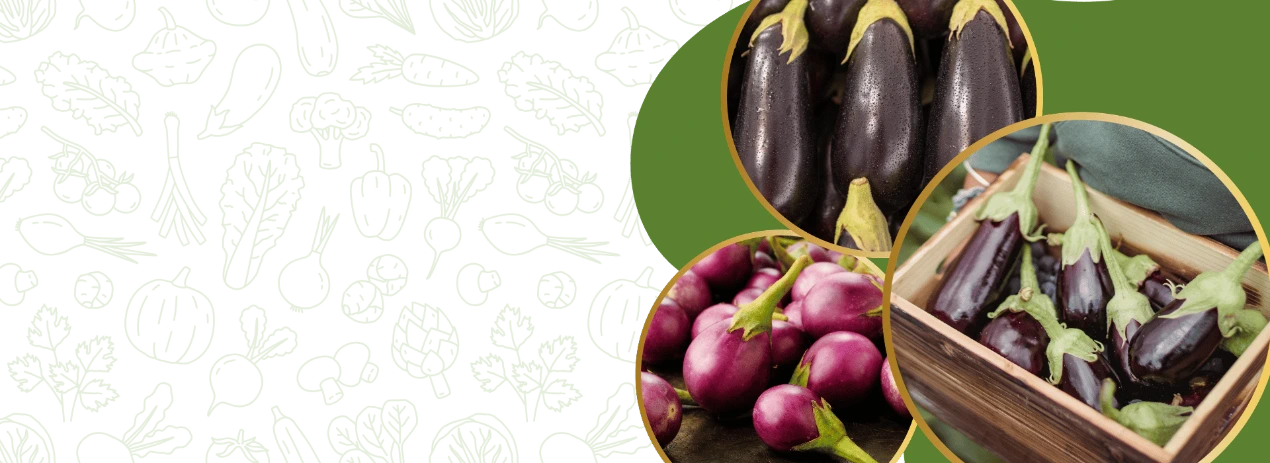
F1 Hybrid & OPV Brinjal/Eggplant Varieties
These hybrid brinjal varieties offer excellent fruit uniformity, glossy appearance, strong plant vigor, and continuous harvesting potential. Suitable for fresh markets and commercial cultivation, the hybrids are selected for reliable productivity and attractive fruit characteristics.
Complete Package of Practices for Brinjal Cultivation
Brinjal (eggplant / aubergine) is a hardy, heat-tolerant, long-duration vegetable grown across the tropics and subtropics for fresh markets. It is one of the most productive vegetables, but two problems dominate its management: the shoot & fruit borer and bacterial wilt. Success depends on a clean nursery, a strong IPM programme for the borer, wilt management (including grafting in problem soils), and steady nutrition and irrigation over its long picking season. This guide covers full technical practice plus a country-wise climate and sowing calendar for farmers worldwide.
Quick Navigation
- 01 Crop Overview
- 02 Climatic Requirements
- 03 Soil & Field Preparation
- 04 Nursery Raising
- 05 Seed Rate & Seed Treatment
- 06 Transplanting & Spacing
- 07 Grafting for Wilt-Prone Soils
- 08 Nutrient Management
- 09 Irrigation & Fertigation
- 10 Weed & Intercultural Care
- 11 Pest Management
- 12 Disease Management
- 13 Other Disorders & Care
- 14 Harvesting & Post-Harvest
- 15 Country-Wise Climate & Sowing Guide
- 16 Frequently Asked Questions
1. Crop Overview
- Common names: Brinjal, eggplant, aubergine
- Scientific name: Solanum melongena L.
- Crop type: Warm-season, hardy, long-duration vegetable with multiple harvests
- Fruit types: Long, round, oval and small varieties in purple, green, white and striped colours
- Uses: Fresh cooking, frying, roasting, curries, pickling
- Nutritional value: Low-calorie, good source of fibre and antioxidants
2. Climatic Requirements
- Temperature: 22–30 °C is ideal. Brinjal is more heat-tolerant than tomato and sweet pepper, but is frost-sensitive and grows slowly below about 17 °C.
- Climate: Thrives in warm, fairly dry conditions with good sunlight.
- Soil: Well-drained fertile loam rich in organic matter; pH 6.0–7.0. Avoid waterlogging and salinity.
- Rainfall / humidity: Moderate; very wet conditions worsen wilt and fruit rot.
3. Soil & Field Preparation
- Plough to a fine tilth and level the field for good drainage.
- Incorporate 20–25 t/ha of well-decomposed FYM / compost during land preparation.
- Form ridges and furrows or raised beds; drip + mulch on raised beds suits this long-duration crop.
4. Nursery Raising
- Raise seedlings in pro-trays with sterilized coco-peat for healthy, uniform plants.
- Keep the nursery under an insect-proof net (40–50 mesh) to exclude leafhoppers and whitefly and prevent little-leaf and virus.
- Give light daily irrigation; feed with 19:19:19 plus micronutrients; drench with fungicide if damping-off appears.
- Seedlings are ready in 30–40 days, with 4–5 true leaves. Harden before transplanting.
5. Seed Rate & Seed Treatment
Seed rate
- Hybrid: 150–200 g/ha
- Open-pollinated varieties: 400–500 g/ha
Seed treatment
- Treat seed with Trichoderma viride @ 4 g/kg, or Thiram / Captan @ 2–3 g/kg, to control seed- and soil-borne diseases.
6. Transplanting & Spacing
- Transplant healthy seedlings in the evening; irrigate immediately.
- Spacing: 60 x 60 cm for normal types; 75–90 x 60 cm for vigorous, spreading hybrids.
- Dip seedling roots in a fungicide solution before planting to reduce wilt and damping-off.
7. Grafting for Wilt-Prone Soils
- In fields with a history of bacterial wilt or soil-borne wilts, grafting the brinjal variety onto a resistant wild rootstock (such as Solanum torvum) is a proven solution.
- Grafted plants keep the chosen variety's fruit quality while gaining the rootstock's wilt resistance and vigour.
- Grafting also extends the picking season and is widely used for protected and high-value crops.
8. Nutrient Management (per hectare)
Indicative dose — adjust to soil test report and local recommendation:
| Nutrient | Dose | Application timing |
|---|---|---|
| Nitrogen (N) | 100–150 kg | Half basal; balance in splits over the long fruiting period |
| Phosphorus (P2O5) | 50–80 kg | Full basal at planting |
| Potassium (K2O) | 50–100 kg | Basal plus top-dress at fruiting |
| Micronutrients | As recommended | Support continuous flowering and fruit set |
9. Irrigation & Fertigation
- Keep soil evenly moist; avoid both drought and waterlogging.
- Critical stages: flowering and fruit development.
- Drip irrigation with mulch gives uniform moisture, saves water and reduces disease in this long crop.
10. Weed & Intercultural Care
- Keep the field weed-free in the early stages by hoeing or mulching.
- Earthing-up supports plants during heavy fruiting.
- Remove old and diseased leaves to improve airflow and reduce pest and disease build-up.
11. Plant Protection — Pests
| Pest | Symptom | Management |
|---|---|---|
| Shoot & fruit borer (major) | Wilting, drooping shoot tips; bore holes and tunnels in fruit | Clip and destroy affected shoots and fruit regularly; pheromone traps; resistant varieties; need-based sprays as the last step |
| Jassids / aphids | Sap-sucking; leaf yellowing and curling | Yellow sticky traps; manage early |
| Whitefly / leafhopper | Sap-sucking; spread little-leaf and virus | Netted nursery; sticky traps; rogue out little-leaf plants |
| Epilachna beetle & mites | Skeletonised leaves; bronzing | Hand-pick beetles; need-based control |
12. Plant Protection — Diseases
| Disease | Symptom | Management |
|---|---|---|
| Bacterial wilt (Ralstonia) | Sudden wilting of healthy green plants; collapse | Resistant or grafted plants; crop rotation; good drainage; avoid wounding roots |
| Damping-off | Seedling collapse in nursery | Sterile media; seed treatment; avoid over-watering |
| Phomopsis blight / fruit rot | Spots on leaves and soft rot on fruit | Clean seed; crop rotation; protectant fungicide; remove affected fruit |
| Little leaf (phytoplasma) | Tiny, bunched, pale leaves; no fruit (leafhopper-borne) | Control leafhoppers; rogue out and destroy affected plants early |
| Verticillium / Fusarium wilt | Yellowing and wilting from one side | Crop rotation; grafted plants; soil drainage |
13. Other Disorders & Care
- Fruit malformation: caused by poor pollination or temperature stress — maintain healthy plants and good growing conditions.
- Hard, seedy, dull fruit: a sign of over-mature harvest — pick fruit young and glossy.
- Keep removing old leaves and damaged fruit to maintain plant vigour over the long season.
14. Harvesting & Post-Harvest
- Harvest fruit while young, tender and glossy, at marketable size, before the seeds harden and the skin dulls.
- Cut fruit with the calyx and a short stalk using a knife or scissors; do not pull.
- Pick every 5–7 days over the long fruiting season.
- Handle gently; grade by size and colour; pack in ventilated crates.
- Yield: hybrids 40–60 t/ha; open-pollinated varieties 25–35 t/ha.
15. Country-Wise Climate & Sowing Guide
Brinjal is hardy and heat-tolerant, so it can be grown over a wider window than tomato or sweet pepper. The aim is still to keep the crop in warm weather (22–30 °C), away from frost, and to avoid heavy-rain periods that worsen wilt and fruit rot. Windows below are indicative — adjust to local altitude and micro-climate.
| Country / Region | Climate | Best sowing / season | Rainy-season & frost caution |
|---|---|---|---|
| TROPICAL & SUBTROPICAL (main belts) | |||
| India | Tropical / subtropical | Kharif: Jun–Jul. Rabi: Oct–Nov. Summer: Jan–Feb | Heavy monsoon and waterlogging worsen wilt |
| Pakistan / Bangladesh | Subtropical | Spring and autumn | Protect from frost and monsoon waterlogging |
| Egypt / N. Africa | Arid subtropical | Spring and autumn | Dry; irrigation-led, manage peak heat |
| Nigeria / Kenya / E. Africa | Tropical (altitude-dependent) | Most of the year in warm zones; dry-season preferred | Avoid wet-season wilt and fruit rot |
| Gulf (Saudi / UAE) | Hot arid | Oct–Apr (cool to warm season) | Very peak summer heat may need some shade |
| SE Asia | Humid tropical | Year-round in warm zones; dry season best | Wet season brings wilt and fruit rot |
| MEDITERRANEAN & MILD TEMPERATE | |||
| Spain / Italy / Turkey | Mediterranean | Spring (Mar–May); protected to extend season | Frost in winter; manage mid-summer heat |
| Mexico | Subtropical | Autumn–winter and spring windows | Avoid summer-rain wilt periods |
| TEMPERATE (summer crop or greenhouse) | |||
| USA | Temperate to subtropical | Spring after last frost; autumn–winter in the south | Match to frost-free window |
| N. Europe | Cool temperate | Mainly greenhouse / poly-tunnel | Open field limited by short, cool season |
| China | Wide range (major producer) | Spring; protected cultivation widely used | Avoid summer-rain wilt in the south |
16. Frequently Asked Questions
How do I control the shoot and fruit borer in brinjal?
Sprays alone fail because the larva hides inside shoots and fruit. The reliable method is mechanical IPM: regularly clip and destroy wilting shoot tips and bored fruit, use pheromone traps, choose tolerant varieties, and spray only on a need basis. Doing this consistently is the key to a clean, profitable crop.
Why do my healthy brinjal plants suddenly wilt and die?
That is usually bacterial wilt, a soil-borne disease. Use resistant or grafted plants, rotate crops, ensure good drainage, and avoid injuring the roots during weeding.
What is grafting and when should I use it?
Grafting joins your chosen brinjal variety onto a wilt-resistant wild rootstock. Use it when your field has a history of sudden wilting, so you keep good fruit quality while gaining resistance and vigour.
What temperature does brinjal need?
About 22–30 °C is ideal. Brinjal handles heat better than tomato or pepper but is frost-sensitive and grows slowly below about 17 °C.
How much brinjal seed is needed per hectare?
About 150–200 g/ha for hybrids and 400–500 g/ha for open-pollinated varieties.
When should I harvest brinjal fruit?
Pick fruit young, tender and glossy at marketable size, before the seeds harden and the skin turns dull. Harvest every 5–7 days through the season.
Why are the leaves small and bunched with no fruit?
That is little leaf, a phytoplasma disease spread by leafhoppers. Control leafhoppers and remove affected plants promptly, as they will not recover or yield.
Explore More Farmson Crop Guides
Tomato Cultivation Hot Chilli Sweet Pepper Okra Onion Cultivation View All Vegetable SeedsGrow with Farmson Biotech Brinjal Seeds
High-yield F1 hybrid & OPV brinjal varieties in long, round and oval types for every market.
Send Export InquiryComplete Package of Practices for Brinjal Cultivation
Brinjal (eggplant / aubergine) is a hardy, heat-tolerant, long-duration vegetable grown across the tropics and subtropics for fresh markets. It is one of the most productive vegetables, but two problems dominate its management: the shoot & fruit borer and bacterial wilt. Success depends on a clean nursery, a strong IPM programme for the borer, wilt management (including grafting in problem soils), and steady nutrition and irrigation over its long picking season. This guide covers full technical practice plus a country-wise climate and sowing calendar for farmers worldwide.
Quick Navigation
- 01 Crop Overview
- 02 Climatic Requirements
- 03 Soil & Field Preparation
- 04 Nursery Raising
- 05 Seed Rate & Seed Treatment
- 06 Transplanting & Spacing
- 07 Grafting for Wilt-Prone Soils
- 08 Nutrient Management
- 09 Irrigation & Fertigation
- 10 Weed & Intercultural Care
- 11 Pest Management
- 12 Disease Management
- 13 Other Disorders & Care
- 14 Harvesting & Post-Harvest
- 15 Country-Wise Climate & Sowing Guide
- 16 Frequently Asked Questions
1. Crop Overview
- Common names: Brinjal, eggplant, aubergine
- Scientific name: Solanum melongena L.
- Crop type: Warm-season, hardy, long-duration vegetable with multiple harvests
- Fruit types: Long, round, oval and small varieties in purple, green, white and striped colours
- Uses: Fresh cooking, frying, roasting, curries, pickling
- Nutritional value: Low-calorie, good source of fibre and antioxidants
2. Climatic Requirements
- Temperature: 22–30 °C is ideal. Brinjal is more heat-tolerant than tomato and sweet pepper, but is frost-sensitive and grows slowly below about 17 °C.
- Climate: Thrives in warm, fairly dry conditions with good sunlight.
- Soil: Well-drained fertile loam rich in organic matter; pH 6.0–7.0. Avoid waterlogging and salinity.
- Rainfall / humidity: Moderate; very wet conditions worsen wilt and fruit rot.
3. Soil & Field Preparation
- Plough to a fine tilth and level the field for good drainage.
- Incorporate 20–25 t/ha of well-decomposed FYM / compost during land preparation.
- Form ridges and furrows or raised beds; drip + mulch on raised beds suits this long-duration crop.
4. Nursery Raising
- Raise seedlings in pro-trays with sterilized coco-peat for healthy, uniform plants.
- Keep the nursery under an insect-proof net (40–50 mesh) to exclude leafhoppers and whitefly and prevent little-leaf and virus.
- Give light daily irrigation; feed with 19:19:19 plus micronutrients; drench with fungicide if damping-off appears.
- Seedlings are ready in 30–40 days, with 4–5 true leaves. Harden before transplanting.
5. Seed Rate & Seed Treatment
Seed rate
- Hybrid: 150–200 g/ha
- Open-pollinated varieties: 400–500 g/ha
Seed treatment
- Treat seed with Trichoderma viride @ 4 g/kg, or Thiram / Captan @ 2–3 g/kg, to control seed- and soil-borne diseases.
6. Transplanting & Spacing
- Transplant healthy seedlings in the evening; irrigate immediately.
- Spacing: 60 x 60 cm for normal types; 75–90 x 60 cm for vigorous, spreading hybrids.
- Dip seedling roots in a fungicide solution before planting to reduce wilt and damping-off.
7. Grafting for Wilt-Prone Soils
- In fields with a history of bacterial wilt or soil-borne wilts, grafting the brinjal variety onto a resistant wild rootstock (such as Solanum torvum) is a proven solution.
- Grafted plants keep the chosen variety's fruit quality while gaining the rootstock's wilt resistance and vigour.
- Grafting also extends the picking season and is widely used for protected and high-value crops.
8. Nutrient Management (per hectare)
Indicative dose — adjust to soil test report and local recommendation:
| Nutrient | Dose | Application timing |
|---|---|---|
| Nitrogen (N) | 100–150 kg | Half basal; balance in splits over the long fruiting period |
| Phosphorus (P2O5) | 50–80 kg | Full basal at planting |
| Potassium (K2O) | 50–100 kg | Basal plus top-dress at fruiting |
| Micronutrients | As recommended | Support continuous flowering and fruit set |
9. Irrigation & Fertigation
- Keep soil evenly moist; avoid both drought and waterlogging.
- Critical stages: flowering and fruit development.
- Drip irrigation with mulch gives uniform moisture, saves water and reduces disease in this long crop.
10. Weed & Intercultural Care
- Keep the field weed-free in the early stages by hoeing or mulching.
- Earthing-up supports plants during heavy fruiting.
- Remove old and diseased leaves to improve airflow and reduce pest and disease build-up.
11. Plant Protection — Pests
| Pest | Symptom | Management |
|---|---|---|
| Shoot & fruit borer (major) | Wilting, drooping shoot tips; bore holes and tunnels in fruit | Clip and destroy affected shoots and fruit regularly; pheromone traps; resistant varieties; need-based sprays as the last step |
| Jassids / aphids | Sap-sucking; leaf yellowing and curling | Yellow sticky traps; manage early |
| Whitefly / leafhopper | Sap-sucking; spread little-leaf and virus | Netted nursery; sticky traps; rogue out little-leaf plants |
| Epilachna beetle & mites | Skeletonised leaves; bronzing | Hand-pick beetles; need-based control |
12. Plant Protection — Diseases
| Disease | Symptom | Management |
|---|---|---|
| Bacterial wilt (Ralstonia) | Sudden wilting of healthy green plants; collapse | Resistant or grafted plants; crop rotation; good drainage; avoid wounding roots |
| Damping-off | Seedling collapse in nursery | Sterile media; seed treatment; avoid over-watering |
| Phomopsis blight / fruit rot | Spots on leaves and soft rot on fruit | Clean seed; crop rotation; protectant fungicide; remove affected fruit |
| Little leaf (phytoplasma) | Tiny, bunched, pale leaves; no fruit (leafhopper-borne) | Control leafhoppers; rogue out and destroy affected plants early |
| Verticillium / Fusarium wilt | Yellowing and wilting from one side | Crop rotation; grafted plants; soil drainage |
13. Other Disorders & Care
- Fruit malformation: caused by poor pollination or temperature stress — maintain healthy plants and good growing conditions.
- Hard, seedy, dull fruit: a sign of over-mature harvest — pick fruit young and glossy.
- Keep removing old leaves and damaged fruit to maintain plant vigour over the long season.
14. Harvesting & Post-Harvest
- Harvest fruit while young, tender and glossy, at marketable size, before the seeds harden and the skin dulls.
- Cut fruit with the calyx and a short stalk using a knife or scissors; do not pull.
- Pick every 5–7 days over the long fruiting season.
- Handle gently; grade by size and colour; pack in ventilated crates.
- Yield: hybrids 40–60 t/ha; open-pollinated varieties 25–35 t/ha.
15. Country-Wise Climate & Sowing Guide
Brinjal is hardy and heat-tolerant, so it can be grown over a wider window than tomato or sweet pepper. The aim is still to keep the crop in warm weather (22–30 °C), away from frost, and to avoid heavy-rain periods that worsen wilt and fruit rot. Windows below are indicative — adjust to local altitude and micro-climate.
| Country / Region | Climate | Best sowing / season | Rainy-season & frost caution |
|---|---|---|---|
| TROPICAL & SUBTROPICAL (main belts) | |||
| India | Tropical / subtropical | Kharif: Jun–Jul. Rabi: Oct–Nov. Summer: Jan–Feb | Heavy monsoon and waterlogging worsen wilt |
| Pakistan / Bangladesh | Subtropical | Spring and autumn | Protect from frost and monsoon waterlogging |
| Egypt / N. Africa | Arid subtropical | Spring and autumn | Dry; irrigation-led, manage peak heat |
| Nigeria / Kenya / E. Africa | Tropical (altitude-dependent) | Most of the year in warm zones; dry-season preferred | Avoid wet-season wilt and fruit rot |
| Gulf (Saudi / UAE) | Hot arid | Oct–Apr (cool to warm season) | Very peak summer heat may need some shade |
| SE Asia | Humid tropical | Year-round in warm zones; dry season best | Wet season brings wilt and fruit rot |
| MEDITERRANEAN & MILD TEMPERATE | |||
| Spain / Italy / Turkey | Mediterranean | Spring (Mar–May); protected to extend season | Frost in winter; manage mid-summer heat |
| Mexico | Subtropical | Autumn–winter and spring windows | Avoid summer-rain wilt periods |
| TEMPERATE (summer crop or greenhouse) | |||
| USA | Temperate to subtropical | Spring after last frost; autumn–winter in the south | Match to frost-free window |
| N. Europe | Cool temperate | Mainly greenhouse / poly-tunnel | Open field limited by short, cool season |
| China | Wide range (major producer) | Spring; protected cultivation widely used | Avoid summer-rain wilt in the south |
16. Frequently Asked Questions
How do I control the shoot and fruit borer in brinjal?
Sprays alone fail because the larva hides inside shoots and fruit. The reliable method is mechanical IPM: regularly clip and destroy wilting shoot tips and bored fruit, use pheromone traps, choose tolerant varieties, and spray only on a need basis. Doing this consistently is the key to a clean, profitable crop.
Why do my healthy brinjal plants suddenly wilt and die?
That is usually bacterial wilt, a soil-borne disease. Use resistant or grafted plants, rotate crops, ensure good drainage, and avoid injuring the roots during weeding.
What is grafting and when should I use it?
Grafting joins your chosen brinjal variety onto a wilt-resistant wild rootstock. Use it when your field has a history of sudden wilting, so you keep good fruit quality while gaining resistance and vigour.
What temperature does brinjal need?
About 22–30 °C is ideal. Brinjal handles heat better than tomato or pepper but is frost-sensitive and grows slowly below about 17 °C.
How much brinjal seed is needed per hectare?
About 150–200 g/ha for hybrids and 400–500 g/ha for open-pollinated varieties.
When should I harvest brinjal fruit?
Pick fruit young, tender and glossy at marketable size, before the seeds harden and the skin turns dull. Harvest every 5–7 days through the season.
Why are the leaves small and bunched with no fruit?
That is little leaf, a phytoplasma disease spread by leafhoppers. Control leafhoppers and remove affected plants promptly, as they will not recover or yield.
Explore More Farmson Crop Guides
Tomato Cultivation Hot Chilli Sweet Pepper Okra Onion Cultivation View All Vegetable SeedsGrow with Farmson Biotech Brinjal Seeds
High-yield F1 hybrid & OPV brinjal varieties in long, round and oval types for every market.
Send Export InquiryAgricultural Advisory Notice
The recommendations and crop guidance provided on this website are intended for informational purposes only and should not be considered a guaranteed agronomic outcome. Local climatic conditions, soil health, cultivation methods, and regional practices may influence actual crop performance. FARMSON BIOTECH PVT LTD recommends farmers seek guidance from authorized agricultural experts or local government agricultural authorities before cultivation decisions.