High-Quality Moringa Seeds
Premium moringa seed varieties suitable for commercial leaf and pod production.
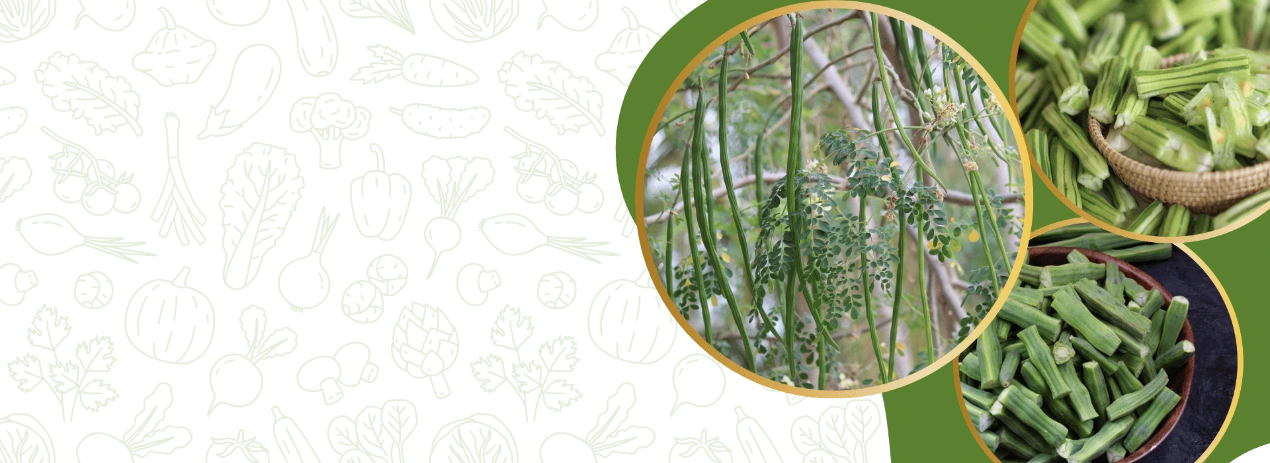
Moringa Varieties
These moringa varieties support vigorous growth, quality pod production, and adaptability across multiple climatic conditions for commercial farming applications.
Complete Package of Practices for Moringa Cultivation
Moringa (drumstick tree, sahjan, malunggay) is one of the most nutritionally remarkable plants in the world — a fast-growing, drought-tolerant tropical tree whose tender pods, leaves and seeds are all valuable. The leaves are sold globally as a "superfood" powder; the pods (drumsticks) are a staple vegetable in South Asian cooking; the seeds yield ben oil and a natural water-purifier. Moringa is grown as an annual short-cycle pod crop, a perennial multi-purpose tree, or as an ultra-high-density intensive leaf crop depending on the end-use. Success depends on choosing the right cultivation system, planting on free-draining soil, managing tree height by pruning, and protecting against pod fly and hairy caterpillar. This guide covers complete technical practice from planting to harvest, plus a country-wise climate and planting calendar for farmers worldwide.
Quick Navigation
- 01 Crop Overview
- 02 Climatic Requirements
- 03 Soil & Land Preparation
- 04 Propagation & Establishment
- 05 Seed Rate & Treatment
- 06 Spacing & Plant Population
- 07 Three Cultivation Systems
- 08 Nutrient Management
- 09 Irrigation
- 10 Pruning, Topping & Weed Care
- 11 Pest Management
- 12 Disease Management
- 13 Physiological Disorders
- 14 Harvesting & Post-Harvest
- 15 Country-Wise Climate & Planting Guide
- 16 Frequently Asked Questions
1. Crop Overview
- Common names: Moringa, drumstick, sahjan / sehjan / suragwa, munaga, malunggay, marungai, ben tree, horseradish tree, "miracle tree"
- Scientific name: Moringa oleifera Lam.
- Crop type: Fast-growing, drought-tolerant, frost-sensitive perennial tree native to the Indian sub-continent; deep-rooted; flowers and pods almost year-round in warm climates
- End uses and product types:
- Tender pods (drumsticks) — the classic South Asian vegetable, sold fresh, frozen and canned
- Fresh leaves — cooked as a green; the "superfood" leaf for fresh and frozen export
- Dried leaf powder — the largest global moringa product, sold as a supplement, in capsules, teas and food fortification
- Seeds — pressed for ben (behen) oil for cosmetics and food; used as natural flocculant for water purification
- Flowers — culinary and honey production
- Seed cake — livestock feed and organic fertilizer after oil extraction
- Main varieties:
- PKM-1, PKM-2 (Periyakulam, TNAU) — annual hybrid pod types, 6–8 month first harvest, high yield
- ODC, ODC-3 (Odisha Drumstick) — annual high-yield pod hybrid
- KM-1, GKVK-2 — bushy pod and leaf types
- Traditional / local perennial — long-lived trees, lower yield per tree but stable for 10–20 years
- Leaf / powder selections — bushy types selected for fast leaf regrowth and high protein
- Nutritional value (leaf): exceptional — high protein (25–30% dry weight), vitamin A, vitamin C, calcium, iron, potassium and the full range of essential amino acids; one of the most nutrient-dense leafy crops known
- Pollination: Cross-pollinated by bees; some varieties partially self-incompatible — bee colonies improve pod set
2. Climatic Requirements
- Temperature: Optimum 25–35 °C; tolerates up to 40 °C with irrigation; growth slows below 18 °C; severely damaged by frost — the tree top dies back below 0 °C but the root usually survives mild frost and resprouts.
- Rainfall: Highly adaptable — grows in 250–1500 mm annual rainfall. One of the few oilseed / vegetable trees that thrives in semi-arid (dryland) conditions.
- Daylength: Day-neutral; flowers freely in warm conditions year-round in the deep tropics.
- Sunshine: Needs full sun — partial shade reduces both pod and leaf yield.
- Altitude: Sea level to 1000 m; some lines tolerate up to 1500 m.
- Wind: Brittle wood and shallow surface roots make moringa prone to lodging in strong wind — avoid very exposed sites or use windbreaks.
- Drought tolerance: Excellent — once established, the deep tap root finds water; the tree drops leaves under severe drought and re-flushes when rain returns.
3. Soil & Land Preparation
- Soil: Well-drained sandy loam to loam; tolerates marginal soils that few other crops can use — rocky, gravelly, low-fertility, and mildly saline soils all work.
- pH: Optimum 6.3–7.5; tolerates 5.5–8.5.
- The non-negotiable rule: drainage. Moringa is the most waterlogging-sensitive tree in the catalogue. Wet feet kills it within days through root rot.
- Avoid heavy clay, low-lying flood-prone land, and any field with a high water table in the monsoon.
- Plough deeply (25–30 cm) and harrow to a fine tilth; mark out planting lines.
- Dig pits 45 × 45 × 45 cm (for annual / pod orchards); 60 × 60 × 60 cm for perennial / traditional plantings.
- Fill each pit with topsoil + 10–15 kg well-decomposed FYM + 100 g single super phosphate + 25 g neem cake as a starter mix.
- In rainfed dryland conditions, harvest pit-level water by shaping a shallow basin around each pit.
4. Propagation & Establishment
Moringa can be propagated three ways — each suits a different cultivation system. The choice has lasting consequences for tree life, yield and quality.
| Method | How | Best for | Trade-off |
|---|---|---|---|
| Direct seeding | 2–3 seeds per pit, 2–3 cm deep, in situ; thin to one strong seedling at 30 days | Annual hybrid pod orchards (PKM, ODC) | Strong tap root, longest-lived tree, full yield potential |
| Polybag nursery + transplant | Sow in polybags 30–45 days before planting; transplant at 25–30 cm height | Commercial leaf production; precise stand uniformity | Best establishment in difficult seasons; needs nursery management |
| Stem cuttings (vegetative) | Hardwood cuttings 1–1.5 m long, 5–10 cm thick, planted 30–40 cm deep at the start of the rains | Traditional perennial farm-trees, live fences, quick shade | No tap root — tree is shallow-rooted, less drought-tolerant, shorter-lived, much lower seed set |
- Best planting time: at the onset of the rainy season; in irrigated systems, any month when minimum temperature is above 18 °C and no frost risk for 60 days.
- Germination: 7–14 days at soil temperature above 20 °C; soak seed 24 hours before sowing.
- For seed-grown trees, do not transplant after 45 days — the long tap root, once damaged, sets the tree back for months.
- For cuttings: use cuttings from a healthy mother tree, taken at the end of the dry season; let the cut end dry in shade for 3–4 days before planting to reduce rot.
5. Seed Rate & Treatment
Seed rate
- Annual hybrid pod orchard (PKM, ODC, KM): 500–625 g/ha
- Polybag nursery (for transplanted commercial leaf): 1.0–1.5 kg/ha equivalent
- Ultra-high-density intensive leaf production: 6–10 kg/ha at 10 × 10 to 20 × 20 cm spacing
- Traditional perennial (very wide spacing): 100–150 g/ha (one pit + 2–3 seeds, very few plants per hectare)
Seed treatment
- Soak seed in clean water for 24 hours before sowing to soften the hard seed coat and accelerate germination.
- Treat with Trichoderma viride @ 4 g/kg or Thiram / Captan @ 2–3 g/kg to prevent seed rot and damping-off.
- For ultra-high-density leaf production, treat with a fungicide and dust with neem cake.
- Use fresh seed (less than 12 months old) — germination drops rapidly after a year, especially in warm humid storage.
6. Spacing & Plant Population
| System | Spacing | Plants per ha | Notes |
|---|---|---|---|
| Annual hybrid (PKM-1, ODC) for pods | 2.5 × 2.5 m or 3 × 3 m | 1100–1600 | Direct seeded; topped at 1 m to encourage branching |
| Traditional perennial pod orchard | 5 × 5 m or 4 × 4 m | 400–625 | Long-lived trees; lower per-hectare yield but stable |
| Backyard / hedge / live-fence | 1–2 m apart in a row | variable | Dual purpose; cuttings or seeds |
| Commercial leaf production | 1 × 1 m or 50 × 50 cm | 10,000–40,000 | Cut every 35–55 days; kept bushy at 1.0–1.5 m |
| Ultra-high-density leaf for powder | 10–20 cm rows; 5–10 cm in row | 500,000–1,000,000 | Cut at 60 days, then every 35–45 days; resembles a fodder crop |
| Seed production orchard | 4 × 4 m | 625 | Trees allowed to grow to full height; bee colonies at flowering |
7. Three Cultivation Systems — Choose Your Path First
Moringa is one of the few crops where the same seed gives totally different end-products and economics depending on how you grow it. Make this choice at the very start, because the spacing, fertilizer, pruning and harvest cycle are all different.
System A — Annual hybrid pod orchard
- Variety: PKM-1, PKM-2, ODC, KM-1 — bred for early pod set
- Spacing: 2.5 × 2.5 m or 3 × 3 m
- Cycle: first pod harvest 6–8 months from seed; ratoon (cut back, regrow) for 2–3 more years; replant after that
- Yield: 50–60 t/ha pods in year 1; lower in ratoon years
- Ideal for: commercial growers chasing high pod yield per hectare for fresh market and processing
System B — Traditional perennial multi-purpose tree
- Variety: traditional local types or seedlings from a good mother tree; lower yield but stable over 10–20 years
- Spacing: 5 × 5 m (intercropped); 4 × 4 m (pure orchard); or scattered farm trees
- Cycle: first pods 18–24 months from seed; tree lives 10–20+ years; light annual prune for height management
- Yield: 30–50 kg pods per tree per year + leaves, seeds and flowers as bonus
- Ideal for: farm-tree integration, intercropping in coconut / mango orchards, dryland farms with low input
System C — Ultra-high-density intensive leaf production
- Variety: bushy, fast-regrowth leaf lines
- Spacing: 10–20 cm rows; thousands of plants per hectare; grown more like fodder than a tree crop
- Cycle: first cut at 60 days, then a fresh cut every 35–45 days; replant or restart every 12–24 months
- Yield: 100–150 t/ha fresh leaf per year — about 15–20 t/ha of dried leaf powder
- Ideal for: the leaf powder / "superfood" export market; food fortification; nutrition supplements; animal-feed concentrate
8. Nutrient Management (per hectare per year)
Moringa is undemanding for a tree but responds strongly to fertilizer in commercial systems. Indicative dose — adjust to soil test and system:
| System | FYM (t) | N (kg) | P2O5 (kg) | K2O (kg) |
|---|---|---|---|---|
| Annual pod orchard (PKM/ODC) | 15–20 | 75–100 | 50–75 | 75–100 |
| Traditional perennial | 10–15 | 50 | 50 | 50 |
| Intensive leaf production | 20–25 | 120–150 | 60 | 60 |
- Basal: full FYM + full P + 1/2 K + 1/4 N at pit-filling.
- Top-dress: remaining N in 2–3 splits — at 30 days after planting, at first flowering, and after each pod / leaf harvest in ratoon crops.
- For intensive leaf systems, apply 10–15 kg N/ha after every cut through fertigation or top-dress to push the next flush.
- Sulphur (20–30 kg/ha as gypsum) and micronutrients (Zn, B, Mg as per soil test) improve seed-set and oil content in seed orchards.
- Foliar sprays of 1% urea + 0.5% micronutrient mix at 30 and 45 DAP boost early growth.
9. Irrigation
- Moringa is drought-tolerant once established, but yields much more with steady irrigation.
- Establishment (first 90 days): irrigate every 4–6 days — the young plant has no deep root yet.
- Bearing tree: irrigate every 7–12 days in the dry season; every 5–7 days during flowering and pod-fill (critical stages).
- Intensive leaf production: irrigate every 2–4 days — the closely-spaced young plants behave like a leaf-vegetable crop, not a tree.
- Drip irrigation with one or two emitters per tree is the standard for commercial orchards — saves water, reduces weeds, and works well on the marginal soils where moringa is planted.
- Never let water stand around the base — root rot kills moringa quickly. Even on flat fields, plant on slight ridges or mounds in monsoon climates.
- Stop irrigation 7–10 days before pod harvest to firm pods and reduce post-harvest spoilage.
10. Pruning, Topping & Weed Care
Topping the central leader (essential)
- Moringa naturally grows tall and pole-like, with most pods out of reach. To bring harvest down to ground level, top the central leader at 1.0–1.2 m when the tree is 60–90 days old (1.5–1.8 m tall).
- This forces 4–6 side branches that crop at hand height, doubling labour efficiency and giving you a bushy, productive tree.
- If side branches grow too tall, top them again at 1.8–2.0 m at the end of each harvest cycle.
Annual / ratoon pruning
- After the main pod harvest (annual hybrid system), cut the whole tree back to 0.9–1.2 m at the end of the season. The ratoon flush will give a second crop in 4–5 months.
- In traditional perennial trees, prune lightly each year to remove dead, crossing or shaded branches.
- In intensive leaf systems, "cut" is the harvest — cut back to 50–60 cm every 35–45 days.
Weed control
- Keep the basin around each tree weed-free for the first 6 months — weeds compete heavily with young moringa.
- Hand-weed or hoe shallowly 2–3 times in the first 90 days; intercrop with short-cycle legumes (cowpea, mung) in the inter-rows for income and nitrogen fixation.
- Mulch with crop residue or dry leaves to conserve moisture and suppress weeds.
- In intensive leaf systems, the dense planting closes the canopy fast and out-competes most weeds after the first weeding.
11. Plant Protection — Pests
| Pest | Symptom | Management |
|---|---|---|
| Hairy caterpillar (Eupterote mollifera) | Massive defoliation in colonies; can strip a tree in days; the signature moringa pest | Hand-pick and destroy in early infestation; spray Bt or NSKE 5%; light traps in commercial orchards; need-based selective insecticide |
| Pod fly (Gitona distigma) | Maggots inside the pod cause it to crack and gum — major commercial pest | Sanitation; collect and destroy fallen pods daily; cover-bait sprays; pheromone monitoring; harvest pods early before maggot maturity |
| Pod borer / bud worm (Noorda blitealis, Noorda moringae) | Borer inside developing pods and buds; flower drop; pod scarring | Pheromone traps; HaNPV / NSKE 5%; need-based sprays at bud and pod stage |
| Stem borer | Tunnels in stem and branches; wilting branches with sawdust frass at entry hole | Inject kerosene or recommended insecticide into tunnel and plug with mud; remove and destroy infested branches |
| Termites | Attack on roots and stem base, especially of cuttings and young plants in dry sandy soil | Pit treatment with neem cake; biological control with Metarhizium; soil drench at planting |
| Bud weevil | Holes in buds; flower drop | Need-based sprays at bud stage; clean field bunds |
| Leaf-eating caterpillars / armyworm | Defoliation, especially in intensive leaf plots | NSKE 5%; Bt; pheromone traps; selective insecticides with short PHI for leaf crops |
12. Plant Protection — Diseases
| Disease | Symptom | Management |
|---|---|---|
| Twig canker / dieback (Macrophoma) | Branch tips die back; brown sunken lesions on stems; one of the most common field problems | Prune out infected branches well below the lesion and burn; copper oxychloride or carbendazim wash on cut surfaces; avoid mechanical injury |
| Root rot (Diplodia, Pythium) | Sudden wilting; brown decayed roots; common in waterlogged conditions | Drainage is the key — raised pits / mounds; Trichoderma in pit soil; avoid over-irrigation |
| Damping-off (Pythium) | Seedlings collapse at the soil line, especially in nursery | Seed treatment with Trichoderma; well-drained nursery; avoid over-watering |
| Powdery mildew (Leveillula) | White powdery patches on the upper leaf surface in warm dry weather | Sulphur dust or wettable sulphur; hexaconazole / carbendazim; remove dense interior growth |
| Anthracnose (Colletotrichum) | Black sunken lesions on pods, especially in humid weather | Field sanitation; mancozeb / carbendazim sprays; harvest pods promptly |
| Wilt (Fusarium) | Yellowing, wilting; vascular browning | Resistant rootstock if available; Trichoderma; field sanitation; rotate planting block |
| Bacterial soft rot of pods | Watery, slimy soft rot inside pod in humid weather | Harvest at correct stage; clean field sanitation; copper sprays in wet conditions |
13. Physiological Disorders
- Flower and young-pod drop: the most common complaint — caused by very high temperatures (above 38–40 °C at flowering), water stress, low boron, or poor bee activity. Maintain even moisture, apply foliar boron (0.1% boric acid) at flowering, and keep bee colonies near the orchard.
- Lodging: moringa wood is brittle and the root system is relatively shallow — trees lean or split in wind, especially after heavy rain. Manage with topping to bush habit, windbreaks, and earthing up the base.
- Frost damage: the top dies back below 0 °C but the stump usually resprouts when warmth returns. In frost-risk zones, plant in spring after the last frost or use a sheltered south-facing site.
- Chlorosis (yellow leaves): caused by waterlogging, iron deficiency on alkaline soils, or nitrogen deficiency. Drain, soil-test, and correct accordingly.
- Pod gummosis / cracking: gum exuding from pods, sometimes with cracking — caused by sudden irrigation after a dry spell, or pod fly damage. Maintain steady moisture and control pod fly.
- Short-lived ratoon decline: annual hybrid trees lose vigour after 3–4 ratoon cycles. Plan to replant every 3–4 years rather than chase declining yield.
- Bitter / fibrous pods: over-mature picking, water stress, or genetics — pick young, irrigate steadily, choose modern varieties.
14. Harvesting & Post-Harvest
Pod harvest
- Stage: pick pods when they are tender, deep green, and 40–60 cm long with seeds inside still soft (snap cleanly when bent). Over-mature pods become fibrous and bitter.
- First harvest: 6–8 months from seed for annual hybrid; 18–24 months for traditional perennial.
- Frequency: every 3–5 days during the main flush; pods develop over 8–10 weeks of continuous bearing.
- Cut pods with a sharp knife or secateurs — do not pull, as you damage the bearing wood.
- Yield: Annual hybrid 50–60 t/ha first year; traditional perennial 30–50 kg per tree per year.
Leaf harvest
- First cut: 60–90 days after planting; subsequent cuts every 35–55 days.
- Cut bushy plants back to 50–60 cm from the ground; the regrowth flush is what you harvest next.
- Pick leaves in the early morning for the best vitamin C content and shelf life.
- Yield: 100–150 t/ha fresh leaf per year in intensive systems; equivalent to 15–20 t/ha dried leaf powder.
- Drying for powder: shade-dry leaves at 35–40 °C until brittle (typically 1–3 days); never sun-dry, which destroys vitamins. Grind to a fine powder and pack in airtight, light-proof bags.
Seed harvest
- Allow pods to dry on the tree until they turn brown and split open.
- Collect pods, dry further in shade, then shell out the seeds.
- Sun-dry seeds to 8–9% moisture; store in cool, dry, airtight containers.
- One tree yields 1–3 kg seed per year in mature perennials.
Post-harvest handling of pods
- Pre-cool pods to 8–10 °C within 4 hours of harvest.
- Store at 5–7 °C and 90–95% RH — shelf life 7–10 days; do not store below 5 °C (chilling injury).
- Pack in ventilated crates lined with paper or banana leaf to cushion pods.
- Grade by length (export 30–45 cm), straightness and freedom from blemish.
15. Country-Wise Climate & Planting Guide
Moringa thrives in warm, frost-free, well-drained sites with 25–35 °C temperatures. Plant at the onset of the rainy season in rainfed dryland systems; any frost-free month in irrigated systems. Windows below are indicative — adjust to local altitude and micro-climate.
| Country / Region | Climate | Best planting / season | Notes |
|---|---|---|---|
| SOUTH ASIA (origin and largest production area) | |||
| India (Tamil Nadu, Karnataka, Andhra Pradesh, Maharashtra) | Tropical / subtropical | Year-round in the south; best plantings Feb–Mar (irrigated) or onset of monsoon (Jun–Jul) in rainfed | World's largest moringa producer; TNAU PKM hybrids dominate |
| India (North & Central) | Subtropical | Feb–Mar (post-frost); avoid the very hot mid-May plantings | Frost dieback in Dec–Jan in the north; root usually resprouts |
| Pakistan / Bangladesh / Nepal | Subtropical / tropical | Mar–Apr (post-frost) or onset of monsoon | Excellent dryland and saline-soil performance in Sindh and southern Punjab |
| Sri Lanka | Humid tropical | Year-round; best plantings at the onset of major rains (Sep–Oct or Mar–Apr) | Strong traditional vegetable use; growing leaf-powder export |
| AFRICA (rapidly growing leaf and pod export markets) | |||
| Kenya / Tanzania / Uganda | Tropical (lowland) | Start of long rains (Mar–Apr) and short rains (Sep–Oct) | Major leaf-powder export to EU and USA from highland and coastal zones |
| Ethiopia / Sudan | Semi-arid tropical | Onset of main rains (Jun–Jul) | Drought-tolerant; suits Sahel agroforestry |
| Ghana / Nigeria / Senegal / Niger / Burkina Faso | Tropical / Sahelian | Onset of rains (Apr–Jun, varies by latitude) | Important food-security tree; live fences and intercropped systems |
| South Africa / Zimbabwe / Mozambique | Subtropical | Spring (Sep–Nov) | Frost risk in highveld; manage with planting time |
| SOUTHEAST ASIA & PACIFIC | |||
| Philippines | Tropical | Year-round; main plantings Apr–Jun | "Malunggay" — the national leafy vegetable; major leaf-powder producer |
| Thailand / Vietnam / Cambodia / Myanmar | Tropical | Onset of rains (May–Jun) or Nov–Dec dry season with irrigation | Strong fresh pod market |
| Indonesia / Malaysia | Equatorial / tropical | Year-round | Suited to smallholder backyard and live-fence systems |
| MIDDLE EAST, CARIBBEAN & AMERICAS | |||
| Gulf (Saudi / UAE / Oman / Yemen) | Hot arid | Mar–Apr and Sep–Oct (avoid mid-summer planting) | Drought tolerance fits the climate; needs drip irrigation |
| Egypt / Morocco | Arid subtropical / Mediterranean | Mar–May | Manage winter frost; drip irrigation essential |
| Caribbean (Jamaica, Cuba, Haiti, DR) | Tropical island | Year-round; best at start of rains | Strong domestic leaf and pod market; growing export |
| Mexico / Central / South America | Tropical / subtropical | Onset of rainy season (May–Jun) | Expanding leaf-powder and oilseed market |
| USA (Florida, Hawaii, southern California, Texas) | Subtropical | Mar–May (post-frost) | Niche premium leaf-powder market; frost-dieback overwintering in marginal zones |
| Australia (North) | Tropical | Sep–Nov (Southern Hemisphere spring) | Wet season establishment; well-suited to north Queensland and NT |
16. Frequently Asked Questions
How soon do I get the first harvest from moringa?
With annual hybrids (PKM-1, PKM-2, ODC), first pod harvest is at 6–8 months from seed. With traditional perennial trees, first pods are at 18–24 months. For leaf production, first cut is at 60–90 days from planting, with new cuts every 35–55 days.
Is it better to grow moringa from seed or cuttings?
For commercial production, almost always from seed. Seed-grown trees have a strong tap root, are drought-tolerant, live longer, and yield much more. Cuttings give a quick perennial tree for shade, live fences or backyards, but the rootless tree is shallow-rooted, less drought-tolerant, shorter-lived, and yields far fewer pods and seeds.
Why do moringa trees grow so tall and difficult to harvest?
Untrained, moringa grows like a pole with all the pods at the top. The fix is simple: top the central leader at 1.0–1.2 m when the tree is 60–90 days old. The tree responds by sending out 4–6 side branches that fruit at hand height, doubling labour efficiency.
Can moringa be grown in drought / dryland conditions?
Yes — moringa is one of the most drought-tolerant vegetable / tree crops in the world. Once the tap root is established, the tree handles 250–500 mm of annual rainfall well. It drops leaves in severe drought and re-flushes when rain returns. Good drainage matters more than rainfall — moringa dies from waterlogging long before it dies from drought.
What is the difference between PKM and ODC moringa varieties?
Both are modern annual-hybrid pod-type varieties. PKM-1 and PKM-2 were bred by TNAU at Periyakulam (Tamil Nadu) and are the best-known commercial moringa hybrids globally — early flowering, 6–8 month first harvest, 50–60 t/ha yield. ODC (Odisha Drumstick) is a similar annual high-yielding type. Both ratoon for 2–3 years after the first harvest.
How is moringa leaf powder made?
Harvest fresh leaves in the early morning. Wash gently, drain. Shade-dry at 35–40 °C until brittle (1–3 days) — never sun-dry, which destroys vitamins. Grind to a fine powder and pack in airtight, light-proof bags. Store cool and dry. 100 kg of fresh leaf gives about 10–15 kg of finished powder.
Why are my moringa pods cracking and gumming?
Two main causes: pod fly (Gitona distigma) — maggots inside cause the pod to gum and crack; control by sanitation, daily collection of fallen pods, and pheromone-baited traps. Or sudden heavy irrigation after a dry spell — the pod expands faster than the skin can stretch. Maintain steady moisture.
Will moringa survive frost?
The tree top is killed by frost below 0 °C. The root system usually survives mild frost and resprouts from the stump when warmth returns — just cut the dead top off at ground level and let it regrow. In frost-prone zones, plant in spring after the last frost or use a sheltered south-facing site.
Explore More Farmson Crop Guides
Sweet Corn Multicut Fodder Grass Tomato Cultivation Spinach Cultivation View All Vegetable SeedsGrow with Farmson Biotech Moringa Seeds
High-yielding PKM, ODC and selected moringa varieties for pods, leaf-powder export and seed-oil production.
Send Export InquiryComplete Package of Practices for Moringa Cultivation
Moringa (drumstick tree, sahjan, malunggay) is one of the most nutritionally remarkable plants in the world — a fast-growing, drought-tolerant tropical tree whose tender pods, leaves and seeds are all valuable. The leaves are sold globally as a "superfood" powder; the pods (drumsticks) are a staple vegetable in South Asian cooking; the seeds yield ben oil and a natural water-purifier. Moringa is grown as an annual short-cycle pod crop, a perennial multi-purpose tree, or as an ultra-high-density intensive leaf crop depending on the end-use. Success depends on choosing the right cultivation system, planting on free-draining soil, managing tree height by pruning, and protecting against pod fly and hairy caterpillar. This guide covers complete technical practice from planting to harvest, plus a country-wise climate and planting calendar for farmers worldwide.
Quick Navigation
- 01 Crop Overview
- 02 Climatic Requirements
- 03 Soil & Land Preparation
- 04 Propagation & Establishment
- 05 Seed Rate & Treatment
- 06 Spacing & Plant Population
- 07 Three Cultivation Systems
- 08 Nutrient Management
- 09 Irrigation
- 10 Pruning, Topping & Weed Care
- 11 Pest Management
- 12 Disease Management
- 13 Physiological Disorders
- 14 Harvesting & Post-Harvest
- 15 Country-Wise Climate & Planting Guide
- 16 Frequently Asked Questions
1. Crop Overview
- Common names: Moringa, drumstick, sahjan / sehjan / suragwa, munaga, malunggay, marungai, ben tree, horseradish tree, "miracle tree"
- Scientific name: Moringa oleifera Lam.
- Crop type: Fast-growing, drought-tolerant, frost-sensitive perennial tree native to the Indian sub-continent; deep-rooted; flowers and pods almost year-round in warm climates
- End uses and product types:
- Tender pods (drumsticks) — the classic South Asian vegetable, sold fresh, frozen and canned
- Fresh leaves — cooked as a green; the "superfood" leaf for fresh and frozen export
- Dried leaf powder — the largest global moringa product, sold as a supplement, in capsules, teas and food fortification
- Seeds — pressed for ben (behen) oil for cosmetics and food; used as natural flocculant for water purification
- Flowers — culinary and honey production
- Seed cake — livestock feed and organic fertilizer after oil extraction
- Main varieties:
- PKM-1, PKM-2 (Periyakulam, TNAU) — annual hybrid pod types, 6–8 month first harvest, high yield
- ODC, ODC-3 (Odisha Drumstick) — annual high-yield pod hybrid
- KM-1, GKVK-2 — bushy pod and leaf types
- Traditional / local perennial — long-lived trees, lower yield per tree but stable for 10–20 years
- Leaf / powder selections — bushy types selected for fast leaf regrowth and high protein
- Nutritional value (leaf): exceptional — high protein (25–30% dry weight), vitamin A, vitamin C, calcium, iron, potassium and the full range of essential amino acids; one of the most nutrient-dense leafy crops known
- Pollination: Cross-pollinated by bees; some varieties partially self-incompatible — bee colonies improve pod set
2. Climatic Requirements
- Temperature: Optimum 25–35 °C; tolerates up to 40 °C with irrigation; growth slows below 18 °C; severely damaged by frost — the tree top dies back below 0 °C but the root usually survives mild frost and resprouts.
- Rainfall: Highly adaptable — grows in 250–1500 mm annual rainfall. One of the few oilseed / vegetable trees that thrives in semi-arid (dryland) conditions.
- Daylength: Day-neutral; flowers freely in warm conditions year-round in the deep tropics.
- Sunshine: Needs full sun — partial shade reduces both pod and leaf yield.
- Altitude: Sea level to 1000 m; some lines tolerate up to 1500 m.
- Wind: Brittle wood and shallow surface roots make moringa prone to lodging in strong wind — avoid very exposed sites or use windbreaks.
- Drought tolerance: Excellent — once established, the deep tap root finds water; the tree drops leaves under severe drought and re-flushes when rain returns.
3. Soil & Land Preparation
- Soil: Well-drained sandy loam to loam; tolerates marginal soils that few other crops can use — rocky, gravelly, low-fertility, and mildly saline soils all work.
- pH: Optimum 6.3–7.5; tolerates 5.5–8.5.
- The non-negotiable rule: drainage. Moringa is the most waterlogging-sensitive tree in the catalogue. Wet feet kills it within days through root rot.
- Avoid heavy clay, low-lying flood-prone land, and any field with a high water table in the monsoon.
- Plough deeply (25–30 cm) and harrow to a fine tilth; mark out planting lines.
- Dig pits 45 × 45 × 45 cm (for annual / pod orchards); 60 × 60 × 60 cm for perennial / traditional plantings.
- Fill each pit with topsoil + 10–15 kg well-decomposed FYM + 100 g single super phosphate + 25 g neem cake as a starter mix.
- In rainfed dryland conditions, harvest pit-level water by shaping a shallow basin around each pit.
4. Propagation & Establishment
Moringa can be propagated three ways — each suits a different cultivation system. The choice has lasting consequences for tree life, yield and quality.
| Method | How | Best for | Trade-off |
|---|---|---|---|
| Direct seeding | 2–3 seeds per pit, 2–3 cm deep, in situ; thin to one strong seedling at 30 days | Annual hybrid pod orchards (PKM, ODC) | Strong tap root, longest-lived tree, full yield potential |
| Polybag nursery + transplant | Sow in polybags 30–45 days before planting; transplant at 25–30 cm height | Commercial leaf production; precise stand uniformity | Best establishment in difficult seasons; needs nursery management |
| Stem cuttings (vegetative) | Hardwood cuttings 1–1.5 m long, 5–10 cm thick, planted 30–40 cm deep at the start of the rains | Traditional perennial farm-trees, live fences, quick shade | No tap root — tree is shallow-rooted, less drought-tolerant, shorter-lived, much lower seed set |
- Best planting time: at the onset of the rainy season; in irrigated systems, any month when minimum temperature is above 18 °C and no frost risk for 60 days.
- Germination: 7–14 days at soil temperature above 20 °C; soak seed 24 hours before sowing.
- For seed-grown trees, do not transplant after 45 days — the long tap root, once damaged, sets the tree back for months.
- For cuttings: use cuttings from a healthy mother tree, taken at the end of the dry season; let the cut end dry in shade for 3–4 days before planting to reduce rot.
5. Seed Rate & Treatment
Seed rate
- Annual hybrid pod orchard (PKM, ODC, KM): 500–625 g/ha
- Polybag nursery (for transplanted commercial leaf): 1.0–1.5 kg/ha equivalent
- Ultra-high-density intensive leaf production: 6–10 kg/ha at 10 × 10 to 20 × 20 cm spacing
- Traditional perennial (very wide spacing): 100–150 g/ha (one pit + 2–3 seeds, very few plants per hectare)
Seed treatment
- Soak seed in clean water for 24 hours before sowing to soften the hard seed coat and accelerate germination.
- Treat with Trichoderma viride @ 4 g/kg or Thiram / Captan @ 2–3 g/kg to prevent seed rot and damping-off.
- For ultra-high-density leaf production, treat with a fungicide and dust with neem cake.
- Use fresh seed (less than 12 months old) — germination drops rapidly after a year, especially in warm humid storage.
6. Spacing & Plant Population
| System | Spacing | Plants per ha | Notes |
|---|---|---|---|
| Annual hybrid (PKM-1, ODC) for pods | 2.5 × 2.5 m or 3 × 3 m | 1100–1600 | Direct seeded; topped at 1 m to encourage branching |
| Traditional perennial pod orchard | 5 × 5 m or 4 × 4 m | 400–625 | Long-lived trees; lower per-hectare yield but stable |
| Backyard / hedge / live-fence | 1–2 m apart in a row | variable | Dual purpose; cuttings or seeds |
| Commercial leaf production | 1 × 1 m or 50 × 50 cm | 10,000–40,000 | Cut every 35–55 days; kept bushy at 1.0–1.5 m |
| Ultra-high-density leaf for powder | 10–20 cm rows; 5–10 cm in row | 500,000–1,000,000 | Cut at 60 days, then every 35–45 days; resembles a fodder crop |
| Seed production orchard | 4 × 4 m | 625 | Trees allowed to grow to full height; bee colonies at flowering |
7. Three Cultivation Systems — Choose Your Path First
Moringa is one of the few crops where the same seed gives totally different end-products and economics depending on how you grow it. Make this choice at the very start, because the spacing, fertilizer, pruning and harvest cycle are all different.
System A — Annual hybrid pod orchard
- Variety: PKM-1, PKM-2, ODC, KM-1 — bred for early pod set
- Spacing: 2.5 × 2.5 m or 3 × 3 m
- Cycle: first pod harvest 6–8 months from seed; ratoon (cut back, regrow) for 2–3 more years; replant after that
- Yield: 50–60 t/ha pods in year 1; lower in ratoon years
- Ideal for: commercial growers chasing high pod yield per hectare for fresh market and processing
System B — Traditional perennial multi-purpose tree
- Variety: traditional local types or seedlings from a good mother tree; lower yield but stable over 10–20 years
- Spacing: 5 × 5 m (intercropped); 4 × 4 m (pure orchard); or scattered farm trees
- Cycle: first pods 18–24 months from seed; tree lives 10–20+ years; light annual prune for height management
- Yield: 30–50 kg pods per tree per year + leaves, seeds and flowers as bonus
- Ideal for: farm-tree integration, intercropping in coconut / mango orchards, dryland farms with low input
System C — Ultra-high-density intensive leaf production
- Variety: bushy, fast-regrowth leaf lines
- Spacing: 10–20 cm rows; thousands of plants per hectare; grown more like fodder than a tree crop
- Cycle: first cut at 60 days, then a fresh cut every 35–45 days; replant or restart every 12–24 months
- Yield: 100–150 t/ha fresh leaf per year — about 15–20 t/ha of dried leaf powder
- Ideal for: the leaf powder / "superfood" export market; food fortification; nutrition supplements; animal-feed concentrate
8. Nutrient Management (per hectare per year)
Moringa is undemanding for a tree but responds strongly to fertilizer in commercial systems. Indicative dose — adjust to soil test and system:
| System | FYM (t) | N (kg) | P2O5 (kg) | K2O (kg) |
|---|---|---|---|---|
| Annual pod orchard (PKM/ODC) | 15–20 | 75–100 | 50–75 | 75–100 |
| Traditional perennial | 10–15 | 50 | 50 | 50 |
| Intensive leaf production | 20–25 | 120–150 | 60 | 60 |
- Basal: full FYM + full P + 1/2 K + 1/4 N at pit-filling.
- Top-dress: remaining N in 2–3 splits — at 30 days after planting, at first flowering, and after each pod / leaf harvest in ratoon crops.
- For intensive leaf systems, apply 10–15 kg N/ha after every cut through fertigation or top-dress to push the next flush.
- Sulphur (20–30 kg/ha as gypsum) and micronutrients (Zn, B, Mg as per soil test) improve seed-set and oil content in seed orchards.
- Foliar sprays of 1% urea + 0.5% micronutrient mix at 30 and 45 DAP boost early growth.
9. Irrigation
- Moringa is drought-tolerant once established, but yields much more with steady irrigation.
- Establishment (first 90 days): irrigate every 4–6 days — the young plant has no deep root yet.
- Bearing tree: irrigate every 7–12 days in the dry season; every 5–7 days during flowering and pod-fill (critical stages).
- Intensive leaf production: irrigate every 2–4 days — the closely-spaced young plants behave like a leaf-vegetable crop, not a tree.
- Drip irrigation with one or two emitters per tree is the standard for commercial orchards — saves water, reduces weeds, and works well on the marginal soils where moringa is planted.
- Never let water stand around the base — root rot kills moringa quickly. Even on flat fields, plant on slight ridges or mounds in monsoon climates.
- Stop irrigation 7–10 days before pod harvest to firm pods and reduce post-harvest spoilage.
10. Pruning, Topping & Weed Care
Topping the central leader (essential)
- Moringa naturally grows tall and pole-like, with most pods out of reach. To bring harvest down to ground level, top the central leader at 1.0–1.2 m when the tree is 60–90 days old (1.5–1.8 m tall).
- This forces 4–6 side branches that crop at hand height, doubling labour efficiency and giving you a bushy, productive tree.
- If side branches grow too tall, top them again at 1.8–2.0 m at the end of each harvest cycle.
Annual / ratoon pruning
- After the main pod harvest (annual hybrid system), cut the whole tree back to 0.9–1.2 m at the end of the season. The ratoon flush will give a second crop in 4–5 months.
- In traditional perennial trees, prune lightly each year to remove dead, crossing or shaded branches.
- In intensive leaf systems, "cut" is the harvest — cut back to 50–60 cm every 35–45 days.
Weed control
- Keep the basin around each tree weed-free for the first 6 months — weeds compete heavily with young moringa.
- Hand-weed or hoe shallowly 2–3 times in the first 90 days; intercrop with short-cycle legumes (cowpea, mung) in the inter-rows for income and nitrogen fixation.
- Mulch with crop residue or dry leaves to conserve moisture and suppress weeds.
- In intensive leaf systems, the dense planting closes the canopy fast and out-competes most weeds after the first weeding.
11. Plant Protection — Pests
| Pest | Symptom | Management |
|---|---|---|
| Hairy caterpillar (Eupterote mollifera) | Massive defoliation in colonies; can strip a tree in days; the signature moringa pest | Hand-pick and destroy in early infestation; spray Bt or NSKE 5%; light traps in commercial orchards; need-based selective insecticide |
| Pod fly (Gitona distigma) | Maggots inside the pod cause it to crack and gum — major commercial pest | Sanitation; collect and destroy fallen pods daily; cover-bait sprays; pheromone monitoring; harvest pods early before maggot maturity |
| Pod borer / bud worm (Noorda blitealis, Noorda moringae) | Borer inside developing pods and buds; flower drop; pod scarring | Pheromone traps; HaNPV / NSKE 5%; need-based sprays at bud and pod stage |
| Stem borer | Tunnels in stem and branches; wilting branches with sawdust frass at entry hole | Inject kerosene or recommended insecticide into tunnel and plug with mud; remove and destroy infested branches |
| Termites | Attack on roots and stem base, especially of cuttings and young plants in dry sandy soil | Pit treatment with neem cake; biological control with Metarhizium; soil drench at planting |
| Bud weevil | Holes in buds; flower drop | Need-based sprays at bud stage; clean field bunds |
| Leaf-eating caterpillars / armyworm | Defoliation, especially in intensive leaf plots | NSKE 5%; Bt; pheromone traps; selective insecticides with short PHI for leaf crops |
12. Plant Protection — Diseases
| Disease | Symptom | Management |
|---|---|---|
| Twig canker / dieback (Macrophoma) | Branch tips die back; brown sunken lesions on stems; one of the most common field problems | Prune out infected branches well below the lesion and burn; copper oxychloride or carbendazim wash on cut surfaces; avoid mechanical injury |
| Root rot (Diplodia, Pythium) | Sudden wilting; brown decayed roots; common in waterlogged conditions | Drainage is the key — raised pits / mounds; Trichoderma in pit soil; avoid over-irrigation |
| Damping-off (Pythium) | Seedlings collapse at the soil line, especially in nursery | Seed treatment with Trichoderma; well-drained nursery; avoid over-watering |
| Powdery mildew (Leveillula) | White powdery patches on the upper leaf surface in warm dry weather | Sulphur dust or wettable sulphur; hexaconazole / carbendazim; remove dense interior growth |
| Anthracnose (Colletotrichum) | Black sunken lesions on pods, especially in humid weather | Field sanitation; mancozeb / carbendazim sprays; harvest pods promptly |
| Wilt (Fusarium) | Yellowing, wilting; vascular browning | Resistant rootstock if available; Trichoderma; field sanitation; rotate planting block |
| Bacterial soft rot of pods | Watery, slimy soft rot inside pod in humid weather | Harvest at correct stage; clean field sanitation; copper sprays in wet conditions |
13. Physiological Disorders
- Flower and young-pod drop: the most common complaint — caused by very high temperatures (above 38–40 °C at flowering), water stress, low boron, or poor bee activity. Maintain even moisture, apply foliar boron (0.1% boric acid) at flowering, and keep bee colonies near the orchard.
- Lodging: moringa wood is brittle and the root system is relatively shallow — trees lean or split in wind, especially after heavy rain. Manage with topping to bush habit, windbreaks, and earthing up the base.
- Frost damage: the top dies back below 0 °C but the stump usually resprouts when warmth returns. In frost-risk zones, plant in spring after the last frost or use a sheltered south-facing site.
- Chlorosis (yellow leaves): caused by waterlogging, iron deficiency on alkaline soils, or nitrogen deficiency. Drain, soil-test, and correct accordingly.
- Pod gummosis / cracking: gum exuding from pods, sometimes with cracking — caused by sudden irrigation after a dry spell, or pod fly damage. Maintain steady moisture and control pod fly.
- Short-lived ratoon decline: annual hybrid trees lose vigour after 3–4 ratoon cycles. Plan to replant every 3–4 years rather than chase declining yield.
- Bitter / fibrous pods: over-mature picking, water stress, or genetics — pick young, irrigate steadily, choose modern varieties.
14. Harvesting & Post-Harvest
Pod harvest
- Stage: pick pods when they are tender, deep green, and 40–60 cm long with seeds inside still soft (snap cleanly when bent). Over-mature pods become fibrous and bitter.
- First harvest: 6–8 months from seed for annual hybrid; 18–24 months for traditional perennial.
- Frequency: every 3–5 days during the main flush; pods develop over 8–10 weeks of continuous bearing.
- Cut pods with a sharp knife or secateurs — do not pull, as you damage the bearing wood.
- Yield: Annual hybrid 50–60 t/ha first year; traditional perennial 30–50 kg per tree per year.
Leaf harvest
- First cut: 60–90 days after planting; subsequent cuts every 35–55 days.
- Cut bushy plants back to 50–60 cm from the ground; the regrowth flush is what you harvest next.
- Pick leaves in the early morning for the best vitamin C content and shelf life.
- Yield: 100–150 t/ha fresh leaf per year in intensive systems; equivalent to 15–20 t/ha dried leaf powder.
- Drying for powder: shade-dry leaves at 35–40 °C until brittle (typically 1–3 days); never sun-dry, which destroys vitamins. Grind to a fine powder and pack in airtight, light-proof bags.
Seed harvest
- Allow pods to dry on the tree until they turn brown and split open.
- Collect pods, dry further in shade, then shell out the seeds.
- Sun-dry seeds to 8–9% moisture; store in cool, dry, airtight containers.
- One tree yields 1–3 kg seed per year in mature perennials.
Post-harvest handling of pods
- Pre-cool pods to 8–10 °C within 4 hours of harvest.
- Store at 5–7 °C and 90–95% RH — shelf life 7–10 days; do not store below 5 °C (chilling injury).
- Pack in ventilated crates lined with paper or banana leaf to cushion pods.
- Grade by length (export 30–45 cm), straightness and freedom from blemish.
15. Country-Wise Climate & Planting Guide
Moringa thrives in warm, frost-free, well-drained sites with 25–35 °C temperatures. Plant at the onset of the rainy season in rainfed dryland systems; any frost-free month in irrigated systems. Windows below are indicative — adjust to local altitude and micro-climate.
| Country / Region | Climate | Best planting / season | Notes |
|---|---|---|---|
| SOUTH ASIA (origin and largest production area) | |||
| India (Tamil Nadu, Karnataka, Andhra Pradesh, Maharashtra) | Tropical / subtropical | Year-round in the south; best plantings Feb–Mar (irrigated) or onset of monsoon (Jun–Jul) in rainfed | World's largest moringa producer; TNAU PKM hybrids dominate |
| India (North & Central) | Subtropical | Feb–Mar (post-frost); avoid the very hot mid-May plantings | Frost dieback in Dec–Jan in the north; root usually resprouts |
| Pakistan / Bangladesh / Nepal | Subtropical / tropical | Mar–Apr (post-frost) or onset of monsoon | Excellent dryland and saline-soil performance in Sindh and southern Punjab |
| Sri Lanka | Humid tropical | Year-round; best plantings at the onset of major rains (Sep–Oct or Mar–Apr) | Strong traditional vegetable use; growing leaf-powder export |
| AFRICA (rapidly growing leaf and pod export markets) | |||
| Kenya / Tanzania / Uganda | Tropical (lowland) | Start of long rains (Mar–Apr) and short rains (Sep–Oct) | Major leaf-powder export to EU and USA from highland and coastal zones |
| Ethiopia / Sudan | Semi-arid tropical | Onset of main rains (Jun–Jul) | Drought-tolerant; suits Sahel agroforestry |
| Ghana / Nigeria / Senegal / Niger / Burkina Faso | Tropical / Sahelian | Onset of rains (Apr–Jun, varies by latitude) | Important food-security tree; live fences and intercropped systems |
| South Africa / Zimbabwe / Mozambique | Subtropical | Spring (Sep–Nov) | Frost risk in highveld; manage with planting time |
| SOUTHEAST ASIA & PACIFIC | |||
| Philippines | Tropical | Year-round; main plantings Apr–Jun | "Malunggay" — the national leafy vegetable; major leaf-powder producer |
| Thailand / Vietnam / Cambodia / Myanmar | Tropical | Onset of rains (May–Jun) or Nov–Dec dry season with irrigation | Strong fresh pod market |
| Indonesia / Malaysia | Equatorial / tropical | Year-round | Suited to smallholder backyard and live-fence systems |
| MIDDLE EAST, CARIBBEAN & AMERICAS | |||
| Gulf (Saudi / UAE / Oman / Yemen) | Hot arid | Mar–Apr and Sep–Oct (avoid mid-summer planting) | Drought tolerance fits the climate; needs drip irrigation |
| Egypt / Morocco | Arid subtropical / Mediterranean | Mar–May | Manage winter frost; drip irrigation essential |
| Caribbean (Jamaica, Cuba, Haiti, DR) | Tropical island | Year-round; best at start of rains | Strong domestic leaf and pod market; growing export |
| Mexico / Central / South America | Tropical / subtropical | Onset of rainy season (May–Jun) | Expanding leaf-powder and oilseed market |
| USA (Florida, Hawaii, southern California, Texas) | Subtropical | Mar–May (post-frost) | Niche premium leaf-powder market; frost-dieback overwintering in marginal zones |
| Australia (North) | Tropical | Sep–Nov (Southern Hemisphere spring) | Wet season establishment; well-suited to north Queensland and NT |
16. Frequently Asked Questions
How soon do I get the first harvest from moringa?
With annual hybrids (PKM-1, PKM-2, ODC), first pod harvest is at 6–8 months from seed. With traditional perennial trees, first pods are at 18–24 months. For leaf production, first cut is at 60–90 days from planting, with new cuts every 35–55 days.
Is it better to grow moringa from seed or cuttings?
For commercial production, almost always from seed. Seed-grown trees have a strong tap root, are drought-tolerant, live longer, and yield much more. Cuttings give a quick perennial tree for shade, live fences or backyards, but the rootless tree is shallow-rooted, less drought-tolerant, shorter-lived, and yields far fewer pods and seeds.
Why do moringa trees grow so tall and difficult to harvest?
Untrained, moringa grows like a pole with all the pods at the top. The fix is simple: top the central leader at 1.0–1.2 m when the tree is 60–90 days old. The tree responds by sending out 4–6 side branches that fruit at hand height, doubling labour efficiency.
Can moringa be grown in drought / dryland conditions?
Yes — moringa is one of the most drought-tolerant vegetable / tree crops in the world. Once the tap root is established, the tree handles 250–500 mm of annual rainfall well. It drops leaves in severe drought and re-flushes when rain returns. Good drainage matters more than rainfall — moringa dies from waterlogging long before it dies from drought.
What is the difference between PKM and ODC moringa varieties?
Both are modern annual-hybrid pod-type varieties. PKM-1 and PKM-2 were bred by TNAU at Periyakulam (Tamil Nadu) and are the best-known commercial moringa hybrids globally — early flowering, 6–8 month first harvest, 50–60 t/ha yield. ODC (Odisha Drumstick) is a similar annual high-yielding type. Both ratoon for 2–3 years after the first harvest.
How is moringa leaf powder made?
Harvest fresh leaves in the early morning. Wash gently, drain. Shade-dry at 35–40 °C until brittle (1–3 days) — never sun-dry, which destroys vitamins. Grind to a fine powder and pack in airtight, light-proof bags. Store cool and dry. 100 kg of fresh leaf gives about 10–15 kg of finished powder.
Why are my moringa pods cracking and gumming?
Two main causes: pod fly (Gitona distigma) — maggots inside cause the pod to gum and crack; control by sanitation, daily collection of fallen pods, and pheromone-baited traps. Or sudden heavy irrigation after a dry spell — the pod expands faster than the skin can stretch. Maintain steady moisture.
Will moringa survive frost?
The tree top is killed by frost below 0 °C. The root system usually survives mild frost and resprouts from the stump when warmth returns — just cut the dead top off at ground level and let it regrow. In frost-prone zones, plant in spring after the last frost or use a sheltered south-facing site.
Explore More Farmson Crop Guides
Sweet Corn Multicut Fodder Grass Tomato Cultivation Spinach Cultivation View All Vegetable SeedsGrow with Farmson Biotech Moringa Seeds
High-yielding PKM, ODC and selected moringa varieties for pods, leaf-powder export and seed-oil production.
Send Export InquiryAgricultural Advisory Notice
The recommendations and crop guidance provided on this website are intended for informational purposes only and should not be considered a guaranteed agronomic outcome. Local climatic conditions, soil health, cultivation methods, and regional practices may influence actual crop performance. FARMSON BIOTECH PVT LTD recommends farmers seek guidance from authorized agricultural experts or local government agricultural authorities before cultivation decisions.