F1 Hybrid
Tomato Seeds
High-performance tomato hybrids developed for strong yield potential and excellent fruit quality.
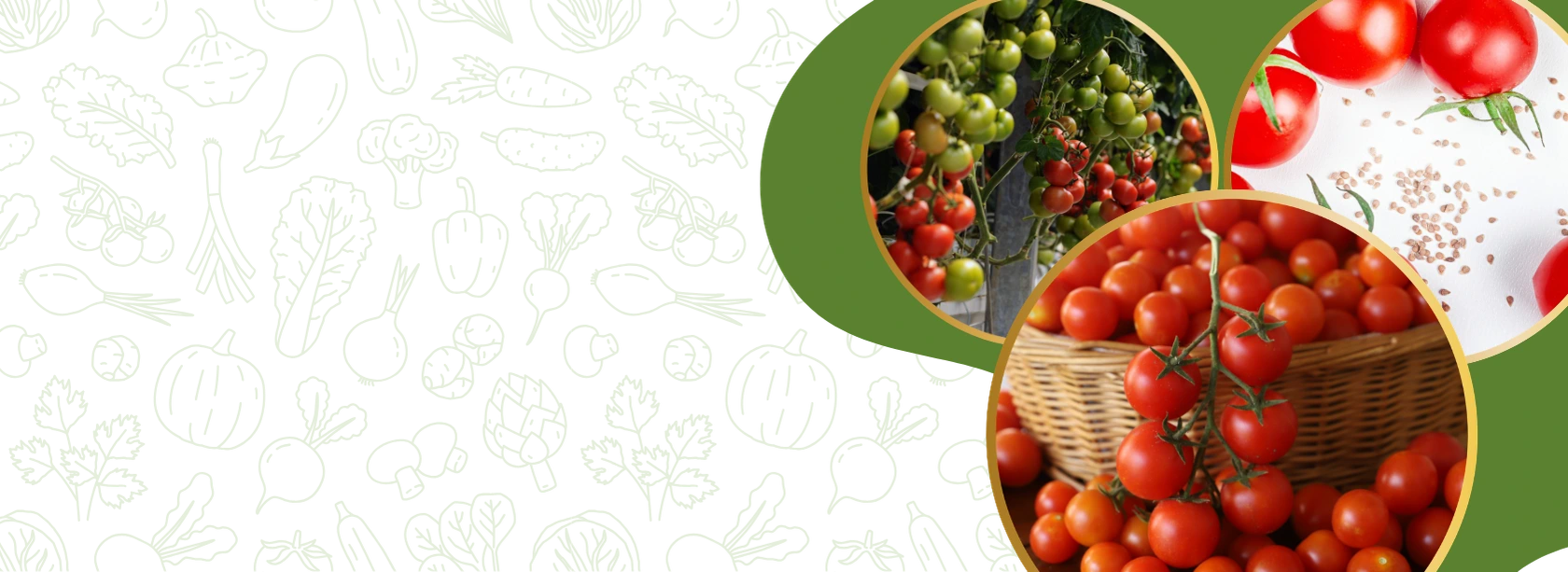
F1 Hybrid Tomato Varieties
Our tomato hybrids are designed for commercial cultivation with strong plant vigor, uniform fruit setting, attractive firmness, and reliable market performance. Suitable for open-field and protected cultivation depending on hybrid selection.
Complete Package of Practices for Tomato Cultivation
Tomato is one of the most commercially important vegetable crops, grown for fresh markets and processing worldwide. It is a warm-season, frost-sensitive crop, and success depends mainly on managing temperature for good fruit set, healthy nursery raising, proper staking, balanced nutrition, careful irrigation, and effective control of fruit borer, whitefly, and blight diseases. This guide covers complete technical practice from nursery to harvest, plus a country-wise climate and sowing calendar for farmers worldwide.
Quick Navigation
- 01 Crop Overview
- 02 Climatic Requirements
- 03 Soil & Field Preparation
- 04 Nursery Raising
- 05 Seed Rate & Seed Treatment
- 06 Transplanting & Spacing
- 07 Staking, Training & Pruning
- 08 Nutrient Management
- 09 Irrigation & Fertigation
- 10 Weed & Intercultural Care
- 11 Pest Management
- 12 Disease Management
- 13 Physiological Disorders
- 14 Harvesting & Post-Harvest
- 15 Country-Wise Climate & Sowing Guide
- 16 Frequently Asked Questions
1. Crop Overview
- Common names: Tomato, table tomato
- Scientific name: Solanum lycopersicum L.
- Crop type: Warm-season annual fruit-vegetable, day-neutral, frost-sensitive
- Growth habit: Determinate (bush) or indeterminate (vine / staking type)
- Uses: Fresh salad, cooking, processing, paste, ketchup, dehydration, juice
- Nutritional value: Rich in lycopene, vitamin C and antioxidants
2. Climatic Requirements
- Temperature: Optimum 21–28 °C by day and 15–20 °C by night. Night temperature strongly influences fruit set.
- Fruit-set limits: Poor set above 35 °C and below about 13–15 °C; pollen becomes sterile at these extremes, causing flower drop.
- Heat & colour: Very high temperature reduces lycopene and gives poor red colour.
- Soil: Well-drained fertile loam; pH 6.0–7.0. Avoid waterlogging, salinity and heavy clay.
- Rainfall / humidity: High humidity and heavy rain encourage blight and fruit rot; protected cultivation helps in wet or extreme climates.
3. Soil & Field Preparation
- Deep-plough for a fine tilth and plank for a uniform field.
- Incorporate 20–25 t/ha of well-decomposed FYM / compost at the last ploughing.
- Open furrows / form ridges or raised beds at the recommended spacing to ensure good drainage.
- Drip + plastic mulch on raised beds gives the best results and reduces weeds and disease.
4. Nursery Raising
- Solarize nursery soil for one month before sowing, or use a soil-less media.
- Pro-tray nursery (98-cell trays) with sterilized coco-peat is recommended for healthy, uniform, disease-free seedlings.
- Raise the nursery under an insect-proof net (40–50 mesh) to keep out whitefly and prevent leaf-curl virus.
- Give light daily irrigation; feed with 19:19:19 plus micronutrients.
- Seedlings are ready in 25–30 days, with 3–4 true leaves. Harden and reduce watering 24 hours before transplanting.
5. Seed Rate & Seed Treatment
Seed rate
- Hybrid: 100–150 g/ha
- Open-pollinated varieties: 300–400 g/ha
Seed treatment
- Treat seed with Trichoderma viride @ 4 g/kg seed, or Thiram / Captan @ 2–3 g/kg, to control seed- and soil-borne diseases.
6. Transplanting & Spacing
- Give a pre-soaking irrigation 3–4 days before transplanting.
- Dip seedlings in an insecticide + fungicide solution before planting; transplant in the evening.
- Determinate (bush): 60 x 45 cm
- Indeterminate (staked): 90–120 x 45–60 cm, or paired-row layout for drip
- Irrigate immediately after transplanting.
7. Staking, Training & Pruning
- Indeterminate (vine) types must be staked or trellised to keep fruit off the ground, improve airflow, and reduce disease and fruit rot.
- Train to a single or double stem; tie plants to stakes / wires as they grow.
- Remove side suckers regularly for staked crops to channel energy into fruit.
- Determinate (bush) types need little or no pruning and only light support.
8. Nutrient Management (per hectare)
Indicative dose — adjust to soil test report and local recommendation:
| Nutrient | Dose | Application timing |
|---|---|---|
| Nitrogen (N) | 100–150 kg | Half basal; balance in splits through vegetative and fruiting stages |
| Phosphorus (P2O5) | 50–80 kg | Full basal at planting |
| Potassium (K2O) | 50–100 kg | Basal plus top-dress at fruiting (improves fruit quality) |
| Calcium & Boron | As recommended | Prevents blossom-end rot and fruit cracking |
9. Irrigation & Fertigation
- Keep soil evenly moist; tomato is sensitive to fluctuating moisture.
- Critical stages: flowering and fruit development — never let the crop dry out and then flood it.
- Irregular irrigation causes blossom-end rot and fruit cracking.
- Drip irrigation with mulch is strongly recommended for uniform moisture, water saving and lower disease.
10. Weed & Intercultural Care
- Keep the field weed-free in the early stages through hoeing or mulching.
- Earthing-up at 30–40 days supports the plants and improves root growth.
- Plastic mulch greatly reduces weeds, conserves moisture and keeps fruit clean.
11. Plant Protection — Pests
| Pest | Symptom | Management |
|---|---|---|
| Fruit borer (Helicoverpa) | Bores into fruit; circular holes and rotting | Pheromone traps; remove damaged fruit; need-based sprays per local recommendation |
| Whitefly | Sucks sap; transmits leaf curl virus | Yellow sticky traps; insect-proof nursery; manage early and rotate insecticide groups |
| Aphids / thrips | Curled leaves; virus spread | Sticky traps; need-based control |
| Leaf miner | Serpentine mines in leaves | Remove affected leaves; need-based control |
12. Plant Protection — Diseases
| Disease | Symptom | Management |
|---|---|---|
| Damping-off | Seedlings collapse at soil line in nursery | Solarize / sterilize media; seed treatment; avoid over-watering |
| Early blight (Alternaria) | Brown concentric-ring spots on lower leaves | Crop rotation; protectant plus systemic fungicide; remove debris |
| Late blight (Phytophthora) | Water-soaked patches in cool, wet weather; rapid spread | Preventive sprays before wet spells; improve airflow |
| Bacterial & Fusarium wilt | Sudden wilting of healthy plants | Resistant varieties; crop rotation; soil drainage; bio-control |
| Tomato leaf curl virus | Curled, yellow, stunted leaves (whitefly-borne) | Netted nursery; whitefly control; rogue out infected plants early |
13. Physiological Disorders
- Blossom-end rot: sunken black patch at fruit base — caused by calcium deficiency and irregular watering. Maintain even moisture and adequate calcium.
- Fruit cracking: caused by irregular irrigation and sudden moisture changes — keep moisture steady.
- Sunscald: pale, scalded patch on exposed fruit — maintain healthy foliage cover.
- Flower drop: caused by temperature extremes (too hot or too cold) — choose varieties suited to your season.
14. Harvesting & Post-Harvest
- Harvest at the stage suited to the market: mature-green or breaker stage for distant markets, red-ripe for local sale and processing.
- Pick by hand in the cool part of the day; handle gently to avoid bruising.
- Grade by size and colour; pack in ventilated crates.
- Yield: hybrids 60–100 t/ha in open field (higher under protected cultivation); OPV 25–40 t/ha.
- Short-term storage is best at 10–13 °C; avoid chilling injury below 10 °C.
15. Country-Wise Climate & Sowing Guide
Tomato is grown almost everywhere, but the key driver is temperature and frost, not day length. The aim is to schedule flowering and fruit set into the mild window (21–28 °C) and away from extreme heat, frost, and heavy rain. Windows below are indicative — adjust to local altitude and micro-climate.
| Country / Region | Climate | Best sowing / season | Rainy-season & heat caution |
|---|---|---|---|
| TROPICAL & SUBTROPICAL (grow in the cool, dry season) | |||
| India | Tropical / subtropical | Rabi (main): Oct–Nov. Kharif: Jun–Jul. Summer: Jan–Feb | Avoid fruit set in peak monsoon (blight) and peak summer heat |
| Pakistan / Bangladesh | Subtropical | Autumn (Sep–Oct) and spring (Jan–Feb) | Protect from monsoon humidity and frost |
| Egypt | Arid subtropical | Aug–Oct and Feb–Mar | Dry; manage summer heat with timing |
| Nigeria / Kenya / E. Africa | Tropical (altitude-dependent) | Dry season / cooler highland window | Avoid heavy-rain fruit set; blight in wet season |
| Gulf (Saudi / UAE) | Hot arid | Oct–Mar (cool season); greenhouse in summer | Summer heat too high for open-field fruit set |
| SE Asia (Philippines / Thailand / Indonesia) | Humid tropical | Cool / dry season (Nov–Feb) | Wet season brings severe blight and fruit rot |
| MEDITERRANEAN & MILD TEMPERATE | |||
| Spain / Italy | Mediterranean | Field: spring (Mar–May). Greenhouse: much of the year | Manage summer heat; greenhouse extends season |
| Turkey / Iran / Morocco | Mediterranean / semi-arid | Spring; protected in winter | Frost risk in winter; heat in mid-summer |
| Mexico | Subtropical | Autumn–winter (export window) | Avoid summer rains at fruit set |
| TEMPERATE (summer crop or greenhouse) | |||
| USA | Temperate to subtropical | Spring after last frost (north); autumn–winter in Florida / California | Match to frost-free window; heat stress mid-summer in the south |
| Netherlands / N. Europe | Cool temperate | Mainly heated greenhouse, near year-round | Open field limited by short, cool season |
| China | Wide range | Spring in the north; protected cultivation widely used | Avoid summer-rain fruit set in the south |
16. Frequently Asked Questions
Why are my tomato flowers dropping without setting fruit?
The most common cause is temperature stress. Fruit set fails when day temperature goes above about 35 °C or night temperature drops below about 13–15 °C, because the pollen becomes sterile. Schedule flowering into the mild season and choose heat-tolerant varieties for hot climates.
What causes blossom-end rot in tomato?
A sunken black patch at the base of the fruit, caused by calcium deficiency combined with irregular watering. Keep soil moisture even and ensure adequate calcium in the soil.
What is the difference between determinate and indeterminate tomato?
Determinate (bush) types grow to a set size, fruit over a short period, and need little staking. Indeterminate (vine) types keep growing and fruiting over a long period and must be staked or trellised.
What is the ideal temperature for growing tomato?
About 21–28 °C during the day and 15–20 °C at night. Tomato is frost-sensitive and sets fruit poorly in extreme heat or cold.
How much tomato seed is needed per hectare?
About 100–150 g/ha for hybrids and 300–400 g/ha for open-pollinated varieties.
Why do my tomatoes crack?
Fruit cracking is usually caused by irregular irrigation and sudden swings in soil moisture. Keep watering steady, especially during fruit development.
How do I control tomato leaf curl virus?
The virus is spread by whitefly, so the key is whitefly control: raise seedlings under an insect-proof net, use yellow sticky traps, manage whitefly early, and remove infected plants promptly.
Explore More Farmson Crop Guides
Onion Cultivation Hot Chilli Sweet Pepper Brinjal / Eggplant Okra Watermelon View All Vegetable SeedsGrow with Farmson Biotech Tomato Seeds
High-performance F1 hybrid & OPV tomato varieties for open-field and protected cultivation.
Send Export InquiryComplete Package of Practices for Tomato Cultivation
Tomato is one of the most commercially important vegetable crops, grown for fresh markets and processing worldwide. It is a warm-season, frost-sensitive crop, and success depends mainly on managing temperature for good fruit set, healthy nursery raising, proper staking, balanced nutrition, careful irrigation, and effective control of fruit borer, whitefly, and blight diseases. This guide covers complete technical practice from nursery to harvest, plus a country-wise climate and sowing calendar for farmers worldwide.
Quick Navigation
- 01 Crop Overview
- 02 Climatic Requirements
- 03 Soil & Field Preparation
- 04 Nursery Raising
- 05 Seed Rate & Seed Treatment
- 06 Transplanting & Spacing
- 07 Staking, Training & Pruning
- 08 Nutrient Management
- 09 Irrigation & Fertigation
- 10 Weed & Intercultural Care
- 11 Pest Management
- 12 Disease Management
- 13 Physiological Disorders
- 14 Harvesting & Post-Harvest
- 15 Country-Wise Climate & Sowing Guide
- 16 Frequently Asked Questions
1. Crop Overview
- Common names: Tomato, table tomato
- Scientific name: Solanum lycopersicum L.
- Crop type: Warm-season annual fruit-vegetable, day-neutral, frost-sensitive
- Growth habit: Determinate (bush) or indeterminate (vine / staking type)
- Uses: Fresh salad, cooking, processing, paste, ketchup, dehydration, juice
- Nutritional value: Rich in lycopene, vitamin C and antioxidants
2. Climatic Requirements
- Temperature: Optimum 21–28 °C by day and 15–20 °C by night. Night temperature strongly influences fruit set.
- Fruit-set limits: Poor set above 35 °C and below about 13–15 °C; pollen becomes sterile at these extremes, causing flower drop.
- Heat & colour: Very high temperature reduces lycopene and gives poor red colour.
- Soil: Well-drained fertile loam; pH 6.0–7.0. Avoid waterlogging, salinity and heavy clay.
- Rainfall / humidity: High humidity and heavy rain encourage blight and fruit rot; protected cultivation helps in wet or extreme climates.
3. Soil & Field Preparation
- Deep-plough for a fine tilth and plank for a uniform field.
- Incorporate 20–25 t/ha of well-decomposed FYM / compost at the last ploughing.
- Open furrows / form ridges or raised beds at the recommended spacing to ensure good drainage.
- Drip + plastic mulch on raised beds gives the best results and reduces weeds and disease.
4. Nursery Raising
- Solarize nursery soil for one month before sowing, or use a soil-less media.
- Pro-tray nursery (98-cell trays) with sterilized coco-peat is recommended for healthy, uniform, disease-free seedlings.
- Raise the nursery under an insect-proof net (40–50 mesh) to keep out whitefly and prevent leaf-curl virus.
- Give light daily irrigation; feed with 19:19:19 plus micronutrients.
- Seedlings are ready in 25–30 days, with 3–4 true leaves. Harden and reduce watering 24 hours before transplanting.
5. Seed Rate & Seed Treatment
Seed rate
- Hybrid: 100–150 g/ha
- Open-pollinated varieties: 300–400 g/ha
Seed treatment
- Treat seed with Trichoderma viride @ 4 g/kg seed, or Thiram / Captan @ 2–3 g/kg, to control seed- and soil-borne diseases.
6. Transplanting & Spacing
- Give a pre-soaking irrigation 3–4 days before transplanting.
- Dip seedlings in an insecticide + fungicide solution before planting; transplant in the evening.
- Determinate (bush): 60 x 45 cm
- Indeterminate (staked): 90–120 x 45–60 cm, or paired-row layout for drip
- Irrigate immediately after transplanting.
7. Staking, Training & Pruning
- Indeterminate (vine) types must be staked or trellised to keep fruit off the ground, improve airflow, and reduce disease and fruit rot.
- Train to a single or double stem; tie plants to stakes / wires as they grow.
- Remove side suckers regularly for staked crops to channel energy into fruit.
- Determinate (bush) types need little or no pruning and only light support.
8. Nutrient Management (per hectare)
Indicative dose — adjust to soil test report and local recommendation:
| Nutrient | Dose | Application timing |
|---|---|---|
| Nitrogen (N) | 100–150 kg | Half basal; balance in splits through vegetative and fruiting stages |
| Phosphorus (P2O5) | 50–80 kg | Full basal at planting |
| Potassium (K2O) | 50–100 kg | Basal plus top-dress at fruiting (improves fruit quality) |
| Calcium & Boron | As recommended | Prevents blossom-end rot and fruit cracking |
9. Irrigation & Fertigation
- Keep soil evenly moist; tomato is sensitive to fluctuating moisture.
- Critical stages: flowering and fruit development — never let the crop dry out and then flood it.
- Irregular irrigation causes blossom-end rot and fruit cracking.
- Drip irrigation with mulch is strongly recommended for uniform moisture, water saving and lower disease.
10. Weed & Intercultural Care
- Keep the field weed-free in the early stages through hoeing or mulching.
- Earthing-up at 30–40 days supports the plants and improves root growth.
- Plastic mulch greatly reduces weeds, conserves moisture and keeps fruit clean.
11. Plant Protection — Pests
| Pest | Symptom | Management |
|---|---|---|
| Fruit borer (Helicoverpa) | Bores into fruit; circular holes and rotting | Pheromone traps; remove damaged fruit; need-based sprays per local recommendation |
| Whitefly | Sucks sap; transmits leaf curl virus | Yellow sticky traps; insect-proof nursery; manage early and rotate insecticide groups |
| Aphids / thrips | Curled leaves; virus spread | Sticky traps; need-based control |
| Leaf miner | Serpentine mines in leaves | Remove affected leaves; need-based control |
12. Plant Protection — Diseases
| Disease | Symptom | Management |
|---|---|---|
| Damping-off | Seedlings collapse at soil line in nursery | Solarize / sterilize media; seed treatment; avoid over-watering |
| Early blight (Alternaria) | Brown concentric-ring spots on lower leaves | Crop rotation; protectant plus systemic fungicide; remove debris |
| Late blight (Phytophthora) | Water-soaked patches in cool, wet weather; rapid spread | Preventive sprays before wet spells; improve airflow |
| Bacterial & Fusarium wilt | Sudden wilting of healthy plants | Resistant varieties; crop rotation; soil drainage; bio-control |
| Tomato leaf curl virus | Curled, yellow, stunted leaves (whitefly-borne) | Netted nursery; whitefly control; rogue out infected plants early |
13. Physiological Disorders
- Blossom-end rot: sunken black patch at fruit base — caused by calcium deficiency and irregular watering. Maintain even moisture and adequate calcium.
- Fruit cracking: caused by irregular irrigation and sudden moisture changes — keep moisture steady.
- Sunscald: pale, scalded patch on exposed fruit — maintain healthy foliage cover.
- Flower drop: caused by temperature extremes (too hot or too cold) — choose varieties suited to your season.
14. Harvesting & Post-Harvest
- Harvest at the stage suited to the market: mature-green or breaker stage for distant markets, red-ripe for local sale and processing.
- Pick by hand in the cool part of the day; handle gently to avoid bruising.
- Grade by size and colour; pack in ventilated crates.
- Yield: hybrids 60–100 t/ha in open field (higher under protected cultivation); OPV 25–40 t/ha.
- Short-term storage is best at 10–13 °C; avoid chilling injury below 10 °C.
15. Country-Wise Climate & Sowing Guide
Tomato is grown almost everywhere, but the key driver is temperature and frost, not day length. The aim is to schedule flowering and fruit set into the mild window (21–28 °C) and away from extreme heat, frost, and heavy rain. Windows below are indicative — adjust to local altitude and micro-climate.
| Country / Region | Climate | Best sowing / season | Rainy-season & heat caution |
|---|---|---|---|
| TROPICAL & SUBTROPICAL (grow in the cool, dry season) | |||
| India | Tropical / subtropical | Rabi (main): Oct–Nov. Kharif: Jun–Jul. Summer: Jan–Feb | Avoid fruit set in peak monsoon (blight) and peak summer heat |
| Pakistan / Bangladesh | Subtropical | Autumn (Sep–Oct) and spring (Jan–Feb) | Protect from monsoon humidity and frost |
| Egypt | Arid subtropical | Aug–Oct and Feb–Mar | Dry; manage summer heat with timing |
| Nigeria / Kenya / E. Africa | Tropical (altitude-dependent) | Dry season / cooler highland window | Avoid heavy-rain fruit set; blight in wet season |
| Gulf (Saudi / UAE) | Hot arid | Oct–Mar (cool season); greenhouse in summer | Summer heat too high for open-field fruit set |
| SE Asia (Philippines / Thailand / Indonesia) | Humid tropical | Cool / dry season (Nov–Feb) | Wet season brings severe blight and fruit rot |
| MEDITERRANEAN & MILD TEMPERATE | |||
| Spain / Italy | Mediterranean | Field: spring (Mar–May). Greenhouse: much of the year | Manage summer heat; greenhouse extends season |
| Turkey / Iran / Morocco | Mediterranean / semi-arid | Spring; protected in winter | Frost risk in winter; heat in mid-summer |
| Mexico | Subtropical | Autumn–winter (export window) | Avoid summer rains at fruit set |
| TEMPERATE (summer crop or greenhouse) | |||
| USA | Temperate to subtropical | Spring after last frost (north); autumn–winter in Florida / California | Match to frost-free window; heat stress mid-summer in the south |
| Netherlands / N. Europe | Cool temperate | Mainly heated greenhouse, near year-round | Open field limited by short, cool season |
| China | Wide range | Spring in the north; protected cultivation widely used | Avoid summer-rain fruit set in the south |
16. Frequently Asked Questions
Why are my tomato flowers dropping without setting fruit?
The most common cause is temperature stress. Fruit set fails when day temperature goes above about 35 °C or night temperature drops below about 13–15 °C, because the pollen becomes sterile. Schedule flowering into the mild season and choose heat-tolerant varieties for hot climates.
What causes blossom-end rot in tomato?
A sunken black patch at the base of the fruit, caused by calcium deficiency combined with irregular watering. Keep soil moisture even and ensure adequate calcium in the soil.
What is the difference between determinate and indeterminate tomato?
Determinate (bush) types grow to a set size, fruit over a short period, and need little staking. Indeterminate (vine) types keep growing and fruiting over a long period and must be staked or trellised.
What is the ideal temperature for growing tomato?
About 21–28 °C during the day and 15–20 °C at night. Tomato is frost-sensitive and sets fruit poorly in extreme heat or cold.
How much tomato seed is needed per hectare?
About 100–150 g/ha for hybrids and 300–400 g/ha for open-pollinated varieties.
Why do my tomatoes crack?
Fruit cracking is usually caused by irregular irrigation and sudden swings in soil moisture. Keep watering steady, especially during fruit development.
How do I control tomato leaf curl virus?
The virus is spread by whitefly, so the key is whitefly control: raise seedlings under an insect-proof net, use yellow sticky traps, manage whitefly early, and remove infected plants promptly.
Explore More Farmson Crop Guides
Onion Cultivation Hot Chilli Sweet Pepper Brinjal / Eggplant Okra Watermelon View All Vegetable SeedsGrow with Farmson Biotech Tomato Seeds
High-performance F1 hybrid & OPV tomato varieties for open-field and protected cultivation.
Send Export InquiryAgricultural Advisory Notice
The recommendations and crop guidance provided on this website are intended for informational purposes only and should not be considered a guaranteed agronomic outcome. Local climatic conditions, soil health, cultivation methods, and regional practices may influence actual crop performance. FARMSON BIOTECH PVT LTD recommends farmers seek guidance from authorized agricultural experts or local government agricultural authorities before cultivation decisions.