F1 Hybrid & OPV Okra Seeds & Cultivation Guide
High-yielding okra hybrids with tender fruits and excellent harvesting performance.
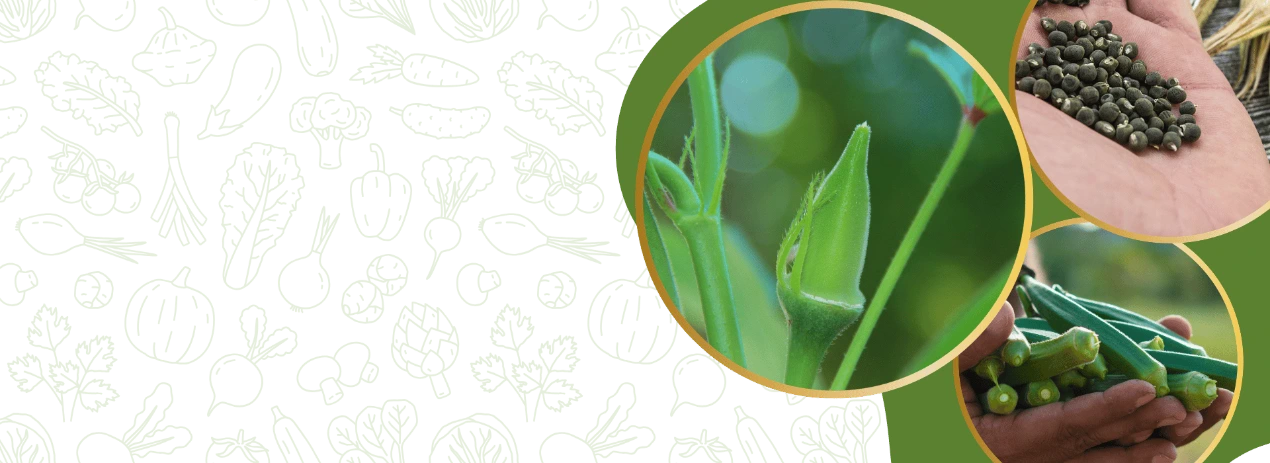
F1 Hybrid & OPV Okra Varieties
FARMSON BIOTECH Okra Seeds are developed for vigorous plant growth, uniform fruit setting, attractive color, and consistent harvesting suitable for commercial production.
Complete Package of Practices for Okra Cultivation
Okra (lady's finger / bhindi) is a fast-growing, warm-season vegetable that is sown directly in the field and starts yielding quickly. It is one of the easiest vegetables to grow, but two things decide the crop: good germination from its hard seed and protection from Yellow Vein Mosaic Virus, which is spread by whitefly. Tender pods must be picked very frequently, as they turn fibrous within a day or two. This guide covers full technical practice plus a country-wise climate and sowing calendar for farmers worldwide.
Quick Navigation
- 01 Crop Overview
- 02 Climatic Requirements
- 03 Soil & Field Preparation
- 04 Seed Rate, Soaking & Treatment
- 05 Sowing, Spacing & Thinning
- 06 Nutrient Management
- 07 Irrigation
- 08 Weed & Intercultural Care
- 09 Pest Management
- 10 Disease Management
- 11 Harvesting & Post-Harvest
- 12 Country-Wise Climate & Sowing Guide
- 13 Frequently Asked Questions
1. Crop Overview
- Common names: Okra, lady's finger, bhindi, gumbo
- Scientific name: Abelmoschus esculentus L.
- Crop type: Warm-season, fast-growing annual, direct-sown
- Edible part: Young tender green (or red) pods
- Uses: Fresh vegetable, frying, curries, soups; some dehydration and freezing
- Nutritional value: Good source of fibre, folate, vitamin C and antioxidants
2. Climatic Requirements
- Temperature: 24–35 °C is ideal. Okra is a true warm-season crop and is very frost-sensitive.
- Germination: needs warm soil; germination is poor below about 20 °C, so do not sow too early in cool weather.
- Soil: Well-drained fertile loam rich in organic matter; pH 6.0–7.0. Tolerates a range of soils but not waterlogging.
- Rainfall: Grows in both the rainy and summer seasons under warm conditions; good drainage is essential in the wet season.
3. Soil & Field Preparation
- Plough 2–3 times to a fine tilth.
- Incorporate 15–20 t/ha of well-decomposed FYM / compost during land preparation.
- Form ridges and furrows or flat beds with good drainage; raised beds with drip and mulch give excellent results.
4. Seed Rate, Soaking & Treatment
Seed rate
- Summer crop: 8–10 kg/ha (closer spacing)
- Rainy-season crop: 5–6 kg/ha (wider spacing)
- Hybrids generally need less seed than open-pollinated varieties.
Seed soaking & treatment
- Okra has a hard seed coat — soak seed in water for 12–24 hours before sowing to speed up and even out germination.
- Treat seed with Trichoderma viride @ 4 g/kg, or Thiram / Captan @ 2–3 g/kg, to control seed- and soil-borne diseases.
5. Sowing, Spacing & Thinning
- Sow seed directly in the field by dibbling 2–3 seeds per hole, 2–3 cm deep.
- Spacing: summer crop 45 x 30 cm; rainy-season crop 60 x 30 cm (wider, as plants grow larger in the rains).
- After germination, thin to 1–2 healthy seedlings per hole.
- Sow into moist soil, or give a light irrigation immediately after sowing.
6. Nutrient Management (per hectare)
Indicative dose — adjust to soil test report and local recommendation:
| Nutrient | Dose | Application timing |
|---|---|---|
| Nitrogen (N) | 80–100 kg | Half basal; balance in 2 splits at 30 and 45 days |
| Phosphorus (P2O5) | 50–60 kg | Full basal at sowing |
| Potassium (K2O) | 50–60 kg | Full basal at sowing |
| Micronutrients | As recommended | Support continuous flowering and podding |
7. Irrigation
- Keep soil evenly moist; the summer crop needs frequent irrigation (every 4–6 days), while the rainy crop needs little.
- Critical stages: flowering and pod development — moisture stress here reduces pods and quality.
- Avoid waterlogging, which causes root and collar rot.
- Drip irrigation with mulch gives uniform moisture and water saving.
8. Weed & Intercultural Care
- Keep the field weed-free in the early stages with 2–3 hoeings, or use mulch.
- Earthing-up at about 30 days supports the plants.
- Remove and destroy any virus-affected plants promptly (see disease section).
9. Plant Protection — Pests
| Pest | Symptom | Management |
|---|---|---|
| Whitefly (key) | Sap-sucking; spreads Yellow Vein Mosaic Virus | Yellow sticky traps; manage early and rotate insecticide groups; control is essential to stop the virus |
| Jassids / leafhopper | Leaf-edge yellowing, curling and "hopper burn" | Need-based sprays; tolerant varieties |
| Fruit & shoot borer | Bored shoots and pods; tunnels in fruit | Remove bored shoots and pods; pheromone traps; need-based sprays |
| Aphids / mites | Sap-sucking; leaf distortion | Sticky traps; need-based control |
10. Plant Protection — Diseases
| Disease | Symptom | Management |
|---|---|---|
| Yellow Vein Mosaic Virus (major) | Bright yellow network of veins; stunted plants; pale, hard pods | Grow resistant / tolerant varieties; control whitefly; rogue out infected plants early |
| Enation leaf curl virus | Curled, warty leaves (whitefly-borne) | Same as above; whitefly control and resistant varieties |
| Powdery mildew | White powdery growth on leaves | Improve airflow; sulphur or recommended fungicide |
| Cercospora leaf spot | Dark leaf spots, defoliation in wet weather | Crop rotation; protectant fungicide; field sanitation |
| Damping-off / collar rot | Seedling collapse in wet soils | Seed treatment; good drainage; avoid waterlogging |
11. Harvesting & Post-Harvest
- First harvest begins about 45–55 days after sowing.
- Pick pods while young, tender and 6–10 cm long, before they turn fibrous and hard.
- Pick very frequently — every 2–3 days; pods over-mature within a day or two and frequent picking also keeps the plant flowering.
- Cut pods with a short stalk; handle gently (some types have skin-irritating hairs — wear gloves).
- Yield: 8–15 t/ha, depending on variety, season and management.
- Pods are perishable — cool quickly, keep moist and market fast for the best price.
12. Country-Wise Climate & Sowing Guide
Okra is a warm-season crop driven by temperature: it needs warm soil to germinate and is killed by frost. The aim is to sow once the weather is reliably warm and to keep picking through the warm months. Windows below are indicative — adjust to local altitude and micro-climate.
| Country / Region | Climate | Best sowing / season | Heat & rain caution |
|---|---|---|---|
| TROPICAL & SUBTROPICAL (main okra belts) | |||
| India | Tropical / subtropical | Summer: Feb–Mar. Kharif (rainy): Jun–Jul | Ensure drainage in monsoon; very high heat needs more water |
| Pakistan / Bangladesh | Subtropical | Spring (Feb–Mar) and early rainy season | Avoid frost-prone early sowing |
| Egypt / N. Africa | Arid subtropical | Spring–summer (Mar–May) | Irrigation-led; thrives in the heat |
| Nigeria / Kenya / E. Africa | Tropical | Start of the warm rainy season, or dry season with irrigation | Drain well in heavy rains |
| Gulf (Saudi / UAE) | Hot arid | Mar–Sep (warm season) | One of the few crops that loves the Gulf heat with irrigation |
| SE Asia | Humid tropical | Year-round in warm zones | Drain well; manage wet-season leaf spot |
| MEDITERRANEAN & WARM TEMPERATE | |||
| Spain / Italy / Turkey | Mediterranean | Late spring–summer (after frost, May–Jun) | Needs the warm summer months |
| Mexico | Subtropical | Spring–summer | Avoid cool early sowing |
| TEMPERATE (warm summer crop) | |||
| USA (south) | Warm temperate | Late spring–summer once soil is warm | A classic warm-season crop in the southern states |
| N. Europe | Cool temperate | Summer / poly-tunnel only | Open field limited by short, cool summer |
| China | Warm temperate to subtropical | Spring–summer | Sow after frost; warm soil needed |
13. Frequently Asked Questions
Why is my okra germination poor?
Usually because the soil is too cold or the hard seed coat slows uptake of water. Sow only when the soil is warm (above about 20 °C) and soak the seed in water for 12–24 hours before sowing.
What is the bright yellow vein pattern on my okra leaves?
That is Yellow Vein Mosaic Virus, spread by whitefly and the biggest threat to okra. There is no cure once a plant is infected, so grow resistant or tolerant varieties, control whitefly from the start, and remove infected plants early.
How often should I pick okra?
Every 2–3 days. Pods turn fibrous and hard within a day or two of becoming over-mature, and frequent picking also keeps the plant flowering and productive.
Do I need to grow okra in a nursery?
No. Okra is sown directly in the field by dibbling seed, then thinned after germination. It does not need transplanting.
How much okra seed is needed per hectare?
About 8–10 kg/ha for the closer-spaced summer crop and 5–6 kg/ha for the wider-spaced rainy-season crop.
What temperature does okra need?
About 24–35 °C. It is a warm-season crop that loves heat with enough water, and is killed by frost.
What yield can I expect from okra?
About 8–15 t/ha, depending on variety, season and how regularly the pods are picked.
Explore More Farmson Crop Guides
Tomato Cultivation Hot Chilli Sweet Pepper Brinjal / Eggplant Cucumber View All Vegetable SeedsGrow with Farmson Biotech Okra Seeds
High-yield, virus-tolerant F1 hybrid & OPV okra varieties for tender, dark-green pods.
Send Export InquiryComplete Package of Practices for Okra Cultivation
Okra (lady's finger / bhindi) is a fast-growing, warm-season vegetable that is sown directly in the field and starts yielding quickly. It is one of the easiest vegetables to grow, but two things decide the crop: good germination from its hard seed and protection from Yellow Vein Mosaic Virus, which is spread by whitefly. Tender pods must be picked very frequently, as they turn fibrous within a day or two. This guide covers full technical practice plus a country-wise climate and sowing calendar for farmers worldwide.
Quick Navigation
- 01 Crop Overview
- 02 Climatic Requirements
- 03 Soil & Field Preparation
- 04 Seed Rate, Soaking & Treatment
- 05 Sowing, Spacing & Thinning
- 06 Nutrient Management
- 07 Irrigation
- 08 Weed & Intercultural Care
- 09 Pest Management
- 10 Disease Management
- 11 Harvesting & Post-Harvest
- 12 Country-Wise Climate & Sowing Guide
- 13 Frequently Asked Questions
1. Crop Overview
- Common names: Okra, lady's finger, bhindi, gumbo
- Scientific name: Abelmoschus esculentus L.
- Crop type: Warm-season, fast-growing annual, direct-sown
- Edible part: Young tender green (or red) pods
- Uses: Fresh vegetable, frying, curries, soups; some dehydration and freezing
- Nutritional value: Good source of fibre, folate, vitamin C and antioxidants
2. Climatic Requirements
- Temperature: 24–35 °C is ideal. Okra is a true warm-season crop and is very frost-sensitive.
- Germination: needs warm soil; germination is poor below about 20 °C, so do not sow too early in cool weather.
- Soil: Well-drained fertile loam rich in organic matter; pH 6.0–7.0. Tolerates a range of soils but not waterlogging.
- Rainfall: Grows in both the rainy and summer seasons under warm conditions; good drainage is essential in the wet season.
3. Soil & Field Preparation
- Plough 2–3 times to a fine tilth.
- Incorporate 15–20 t/ha of well-decomposed FYM / compost during land preparation.
- Form ridges and furrows or flat beds with good drainage; raised beds with drip and mulch give excellent results.
4. Seed Rate, Soaking & Treatment
Seed rate
- Summer crop: 8–10 kg/ha (closer spacing)
- Rainy-season crop: 5–6 kg/ha (wider spacing)
- Hybrids generally need less seed than open-pollinated varieties.
Seed soaking & treatment
- Okra has a hard seed coat — soak seed in water for 12–24 hours before sowing to speed up and even out germination.
- Treat seed with Trichoderma viride @ 4 g/kg, or Thiram / Captan @ 2–3 g/kg, to control seed- and soil-borne diseases.
5. Sowing, Spacing & Thinning
- Sow seed directly in the field by dibbling 2–3 seeds per hole, 2–3 cm deep.
- Spacing: summer crop 45 x 30 cm; rainy-season crop 60 x 30 cm (wider, as plants grow larger in the rains).
- After germination, thin to 1–2 healthy seedlings per hole.
- Sow into moist soil, or give a light irrigation immediately after sowing.
6. Nutrient Management (per hectare)
Indicative dose — adjust to soil test report and local recommendation:
| Nutrient | Dose | Application timing |
|---|---|---|
| Nitrogen (N) | 80–100 kg | Half basal; balance in 2 splits at 30 and 45 days |
| Phosphorus (P2O5) | 50–60 kg | Full basal at sowing |
| Potassium (K2O) | 50–60 kg | Full basal at sowing |
| Micronutrients | As recommended | Support continuous flowering and podding |
7. Irrigation
- Keep soil evenly moist; the summer crop needs frequent irrigation (every 4–6 days), while the rainy crop needs little.
- Critical stages: flowering and pod development — moisture stress here reduces pods and quality.
- Avoid waterlogging, which causes root and collar rot.
- Drip irrigation with mulch gives uniform moisture and water saving.
8. Weed & Intercultural Care
- Keep the field weed-free in the early stages with 2–3 hoeings, or use mulch.
- Earthing-up at about 30 days supports the plants.
- Remove and destroy any virus-affected plants promptly (see disease section).
9. Plant Protection — Pests
| Pest | Symptom | Management |
|---|---|---|
| Whitefly (key) | Sap-sucking; spreads Yellow Vein Mosaic Virus | Yellow sticky traps; manage early and rotate insecticide groups; control is essential to stop the virus |
| Jassids / leafhopper | Leaf-edge yellowing, curling and "hopper burn" | Need-based sprays; tolerant varieties |
| Fruit & shoot borer | Bored shoots and pods; tunnels in fruit | Remove bored shoots and pods; pheromone traps; need-based sprays |
| Aphids / mites | Sap-sucking; leaf distortion | Sticky traps; need-based control |
10. Plant Protection — Diseases
| Disease | Symptom | Management |
|---|---|---|
| Yellow Vein Mosaic Virus (major) | Bright yellow network of veins; stunted plants; pale, hard pods | Grow resistant / tolerant varieties; control whitefly; rogue out infected plants early |
| Enation leaf curl virus | Curled, warty leaves (whitefly-borne) | Same as above; whitefly control and resistant varieties |
| Powdery mildew | White powdery growth on leaves | Improve airflow; sulphur or recommended fungicide |
| Cercospora leaf spot | Dark leaf spots, defoliation in wet weather | Crop rotation; protectant fungicide; field sanitation |
| Damping-off / collar rot | Seedling collapse in wet soils | Seed treatment; good drainage; avoid waterlogging |
11. Harvesting & Post-Harvest
- First harvest begins about 45–55 days after sowing.
- Pick pods while young, tender and 6–10 cm long, before they turn fibrous and hard.
- Pick very frequently — every 2–3 days; pods over-mature within a day or two and frequent picking also keeps the plant flowering.
- Cut pods with a short stalk; handle gently (some types have skin-irritating hairs — wear gloves).
- Yield: 8–15 t/ha, depending on variety, season and management.
- Pods are perishable — cool quickly, keep moist and market fast for the best price.
12. Country-Wise Climate & Sowing Guide
Okra is a warm-season crop driven by temperature: it needs warm soil to germinate and is killed by frost. The aim is to sow once the weather is reliably warm and to keep picking through the warm months. Windows below are indicative — adjust to local altitude and micro-climate.
| Country / Region | Climate | Best sowing / season | Heat & rain caution |
|---|---|---|---|
| TROPICAL & SUBTROPICAL (main okra belts) | |||
| India | Tropical / subtropical | Summer: Feb–Mar. Kharif (rainy): Jun–Jul | Ensure drainage in monsoon; very high heat needs more water |
| Pakistan / Bangladesh | Subtropical | Spring (Feb–Mar) and early rainy season | Avoid frost-prone early sowing |
| Egypt / N. Africa | Arid subtropical | Spring–summer (Mar–May) | Irrigation-led; thrives in the heat |
| Nigeria / Kenya / E. Africa | Tropical | Start of the warm rainy season, or dry season with irrigation | Drain well in heavy rains |
| Gulf (Saudi / UAE) | Hot arid | Mar–Sep (warm season) | One of the few crops that loves the Gulf heat with irrigation |
| SE Asia | Humid tropical | Year-round in warm zones | Drain well; manage wet-season leaf spot |
| MEDITERRANEAN & WARM TEMPERATE | |||
| Spain / Italy / Turkey | Mediterranean | Late spring–summer (after frost, May–Jun) | Needs the warm summer months |
| Mexico | Subtropical | Spring–summer | Avoid cool early sowing |
| TEMPERATE (warm summer crop) | |||
| USA (south) | Warm temperate | Late spring–summer once soil is warm | A classic warm-season crop in the southern states |
| N. Europe | Cool temperate | Summer / poly-tunnel only | Open field limited by short, cool summer |
| China | Warm temperate to subtropical | Spring–summer | Sow after frost; warm soil needed |
13. Frequently Asked Questions
Why is my okra germination poor?
Usually because the soil is too cold or the hard seed coat slows uptake of water. Sow only when the soil is warm (above about 20 °C) and soak the seed in water for 12–24 hours before sowing.
What is the bright yellow vein pattern on my okra leaves?
That is Yellow Vein Mosaic Virus, spread by whitefly and the biggest threat to okra. There is no cure once a plant is infected, so grow resistant or tolerant varieties, control whitefly from the start, and remove infected plants early.
How often should I pick okra?
Every 2–3 days. Pods turn fibrous and hard within a day or two of becoming over-mature, and frequent picking also keeps the plant flowering and productive.
Do I need to grow okra in a nursery?
No. Okra is sown directly in the field by dibbling seed, then thinned after germination. It does not need transplanting.
How much okra seed is needed per hectare?
About 8–10 kg/ha for the closer-spaced summer crop and 5–6 kg/ha for the wider-spaced rainy-season crop.
What temperature does okra need?
About 24–35 °C. It is a warm-season crop that loves heat with enough water, and is killed by frost.
What yield can I expect from okra?
About 8–15 t/ha, depending on variety, season and how regularly the pods are picked.
Explore More Farmson Crop Guides
Tomato Cultivation Hot Chilli Sweet Pepper Brinjal / Eggplant Cucumber View All Vegetable SeedsGrow with Farmson Biotech Okra Seeds
High-yield, virus-tolerant F1 hybrid & OPV okra varieties for tender, dark-green pods.
Send Export InquiryAgricultural Advisory Notice
The recommendations and crop guidance provided on this website are intended for informational purposes only and should not be considered a guaranteed agronomic outcome. Local climatic conditions, soil health, cultivation methods, and regional practices may influence actual crop performance. FARMSON BIOTECH PVT LTD recommends farmers seek guidance from authorized agricultural experts or local government agricultural authorities before cultivation decisions.