F1 Hybrid Cucumber Seeds
High-yielding cucumber hybrids with uniform fruit quality and strong adaptability.
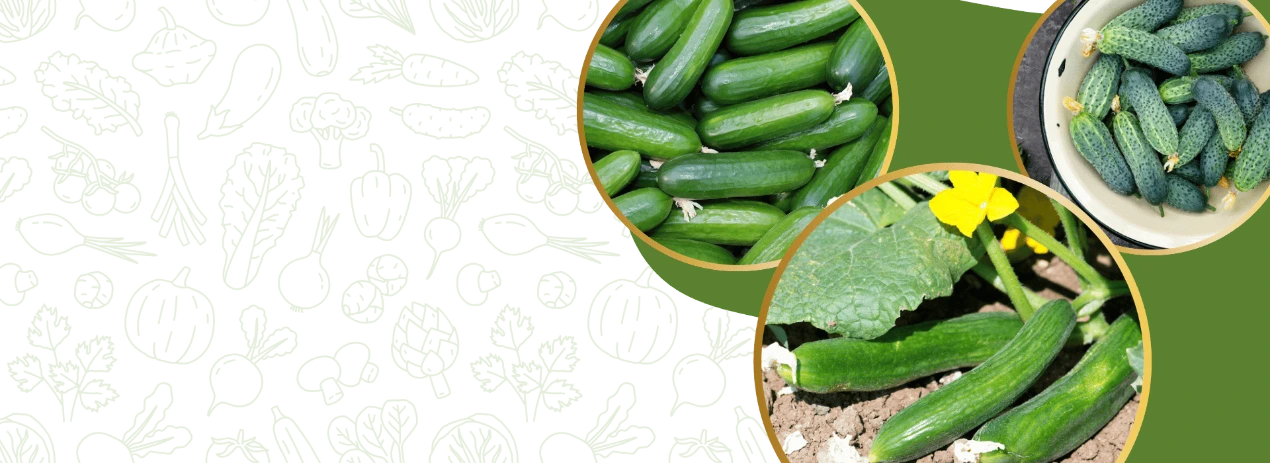
F1 Hybrid Cucumber Varieties
Our cucumber hybrids are designed for commercial growers seeking early production, attractive fruit appearance, excellent texture, and reliable productivity. Suitable for open-field and protected cultivation depending on variety selection.
Complete Package of Practices for Cucumber Cultivation
Cucumber is a fast-growing, warm-season vine grown for crisp, refreshing fruit eaten fresh or pickled. It performs best when trained on a trellis, which lifts the fruit off the ground for better quality and less disease. The main things to manage are pollination (most field types depend on bees, while parthenocarpic types set fruit without it), the downy and powdery mildews, and fruit fly. This guide covers full technical practice plus a country-wise climate and sowing calendar for farmers worldwide.
Quick Navigation
- 01 Crop Overview & Types
- 02 Climatic Requirements
- 03 Soil & Field Preparation
- 04 Seed Rate & Seed Treatment
- 05 Sowing, Spacing & Thinning
- 06 Trellising & Training
- 07 Pollination & Flowering
- 08 Nutrient Management
- 09 Irrigation & Fertigation
- 10 Weed & Intercultural Care
- 11 Pest Management
- 12 Disease Management
- 13 Bitterness & Other Disorders
- 14 Harvesting & Post-Harvest
- 15 Country-Wise Climate & Sowing Guide
- 16 Frequently Asked Questions
1. Crop Overview & Types
- Common names: Cucumber, kheera, gherkin (small pickling type)
- Scientific name: Cucumis sativus L.
- Crop type: Warm-season, fast-growing climbing/trailing vine
- Flower types: Monoecious (separate male and female flowers, bee-pollinated), gynoecious (mostly female, high-yielding) and parthenocarpic (set seedless fruit without pollination — ideal for greenhouse).
- Uses: Fresh salad (slicing types) and pickling (small gherkin types)
- Nutritional value: Very high water content, cooling, with vitamin K and antioxidants
2. Climatic Requirements
- Temperature: 18–30 °C is ideal; germination needs warm soil (20–30 °C). The crop is frost-sensitive and grows poorly below about 15 °C.
- Climate: Warm, sunny weather with moderate humidity gives the best growth.
- Soil: Well-drained fertile loam rich in organic matter; pH 6.0–7.0. Avoid waterlogging.
- Rainfall / humidity: Very high humidity and continuous leaf wetness encourage downy mildew — trellising and airflow help.
3. Soil & Field Preparation
- Plough to a fine tilth and level the field for good drainage.
- Incorporate 20–25 t/ha of well-decomposed FYM / compost during land preparation.
- Form raised beds or ridges; raised beds with drip and mulch are ideal, especially for trellised crops.
4. Seed Rate & Seed Treatment
Seed rate
- Open-field hybrids: 1.0–1.5 kg/ha
- Open-pollinated varieties: 2.5–3.0 kg/ha
- Parthenocarpic greenhouse types are sown at precise plant numbers per square metre.
Seed treatment
- Treat seed with Trichoderma viride @ 4 g/kg, or Thiram / Captan @ 2–3 g/kg, to control seed- and soil-borne diseases.
5. Sowing, Spacing & Thinning
- Sow directly by dibbling 2–3 seeds per hill 2–3 cm deep, or transplant 12–15 day pro-tray seedlings for an early, uniform crop.
- Spacing: ground culture about 1.5 m between rows and 0.5 m between plants; closer on trellis (about 1.0–1.2 m x 0.4–0.5 m).
- After germination, thin to 1–2 healthy seedlings per hill.
- Sow into warm, moist soil for quick, even germination.
6. Trellising & Training
- Training the vines up a trellis, net or pandal is strongly recommended: it lifts fruit off the ground, gives straighter and cleaner fruit, improves airflow, and greatly reduces disease and fruit rot.
- Guide the main vine upward and tie loosely; remove a few lower side-shoots to build a strong frame.
- Ground culture is possible for some field types but gives lower quality and more disease.
7. Pollination & Flowering
- Monoecious and gynoecious types need insect (bee) pollination to set fruit — encourage bees and avoid harming them.
- Spray pesticides only in the late evening, when bees are not active, to protect pollinators and fruit set.
- Parthenocarpic types set seedless fruit without pollination and are ideal for greenhouse and insect-proof structures.
- Poor pollination causes curved, narrow or aborted fruit, so good bee activity is essential for open-field crops.
8. Nutrient Management (per hectare)
Indicative dose — adjust to soil test report and local recommendation:
| Nutrient | Dose | Application timing |
|---|---|---|
| Nitrogen (N) | 80–120 kg | Half basal; balance in splits during vining and fruiting |
| Phosphorus (P2O5) | 50–60 kg | Full basal at sowing |
| Potassium (K2O) | 60–80 kg | Basal plus top-dress at fruiting |
| Micronutrients | As recommended | Support steady flowering and fruit quality |
9. Irrigation & Fertigation
- Cucumber has shallow roots and high water content, so keep soil evenly moist with frequent light irrigation.
- Critical stages: flowering and fruit development — moisture stress here causes bitterness and misshapen fruit.
- Avoid waterlogging, which causes root rot and wilt.
- Drip irrigation with mulch gives uniform moisture, saves water and keeps foliage dry to reduce mildew.
10. Weed & Intercultural Care
- Keep the field weed-free in the early stages by shallow hoeing or mulching (cucumber roots are shallow, so do not hoe deep).
- Plastic mulch reduces weeds, conserves moisture and keeps fruit clean.
- Keep training and tying the vines as they grow.
11. Plant Protection — Pests
| Pest | Symptom | Management |
|---|---|---|
| Fruit fly (major) | Stings young fruit; maggots inside; fruit rots and drops | Cue-lure / pheromone traps; collect and destroy fallen fruit; bait sprays; evening sprays to protect bees |
| Red pumpkin beetle | Eats cotyledons and young leaves at seedling stage | Protect seedlings; collect beetles; need-based control |
| Aphids / whitefly | Sap-sucking; spread mosaic virus | Yellow sticky traps; manage early |
| Thrips / mites | Leaf scarring and curling | Need-based control; scout regularly |
12. Plant Protection — Diseases
| Disease | Symptom | Management |
|---|---|---|
| Downy mildew | Yellow angular patches on top of leaves, grey growth beneath, in humid weather | Trellising for airflow; keep foliage dry; preventive fungicide before wet spells |
| Powdery mildew | White powdery growth on leaves | Improve airflow; sulphur or recommended fungicide; resistant varieties |
| Anthracnose / angular leaf spot | Spots and lesions on leaves and fruit | Clean seed; crop rotation; protectant fungicide; avoid leaf wetness |
| Cucumber mosaic virus | Mottled, distorted leaves; deformed fruit | Control aphids; resistant varieties; rogue out infected plants |
| Fusarium wilt / damping-off | Wilting; seedling collapse | Seed treatment; crop rotation; good drainage |
13. Bitterness & Other Disorders
- Bitter fruit: caused by stress — high temperature, moisture stress, low fertility or genetics. Keep moisture and nutrition steady and choose good varieties to avoid bitterness.
- Curved or misshapen fruit: usually from poor pollination or moisture stress — ensure good bee activity and even watering.
- Yellowing / over-mature fruit: a sign of delayed picking — harvest young and frequently.
14. Harvesting & Post-Harvest
- First harvest begins about 40–50 days after sowing.
- Pick fruit while young, tender, firm and green, at the right market size, before it turns seedy or yellow.
- Pick frequently — every 2–3 days; this keeps fruit tender and keeps the vine producing.
- Cut fruit with a short stalk; handle gently to avoid bruising.
- Yield: open field 15–25 t/ha; protected / parthenocarpic crops 80–100 t/ha or more.
- Cucumber is perishable — cool quickly and market fast for the best quality.
15. Country-Wise Climate & Sowing Guide
Cucumber is a warm-season crop sown once the soil is warm and frost has passed, and grown into the warm months. In hot, high-sun regions it benefits from light shade or protected cultivation. Windows below are indicative — adjust to local altitude and growing system.
| Country / Region | Climate | Best sowing / season | Heat & rain caution |
|---|---|---|---|
| TROPICAL & SUBTROPICAL | |||
| India | Tropical / subtropical | Summer: Feb–Mar. Rainy: Jun–Jul. Poly-house: near year-round | Drain well in monsoon; mildew pressure in humid weather |
| Pakistan / Bangladesh | Subtropical | Spring and early rainy season | Avoid frost-prone early sowing |
| Egypt / N. Africa | Arid subtropical | Spring; protected in summer | Irrigation-led; manage peak heat |
| Gulf (Saudi / UAE) | Hot arid | Oct–Mar open; poly-house for parthenocarpic types | Greenhouse cucumber is a major Gulf crop |
| Kenya / E. Africa / SE Asia | Tropical (altitude-dependent) | Warm dry window; greenhouse for export | Avoid heavy-rain mildew periods |
| MEDITERRANEAN & GREENHOUSE | |||
| Spain / Netherlands | Mediterranean / cool temperate | Greenhouse much of the year (parthenocarpic) | Major exporters of greenhouse cucumber |
| Turkey / Mexico | Mediterranean / subtropical | Spring field; protected for export windows | Frost in winter; heat in mid-summer |
| TEMPERATE (warm summer crop or greenhouse) | |||
| USA | Temperate to subtropical | Late spring–summer; greenhouse for slicing types | Sow after frost when soil is warm |
| China | Wide range (major producer) | Spring; protected cultivation very common | Avoid summer-rain mildew in the south |
| N. Europe | Cool temperate | Mainly heated greenhouse | Open field limited by short, cool season |
16. Frequently Asked Questions
Why are my cucumbers bitter?
Bitterness comes from plant stress — high temperature, moisture stress, low fertility, or variety. Keep soil moisture and nutrition steady, avoid heat stress, and grow good varieties to prevent it.
Why are my cucumber fruits curved or misshapen?
Usually poor pollination or uneven watering. Make sure bees can work the flowers (spray only in the evening), and keep the soil evenly moist. Parthenocarpic types avoid the pollination issue entirely.
Do cucumbers need a trellis?
Not strictly, but trellising greatly improves fruit shape and cleanliness and reduces mildew and rot. It is the single most worthwhile practice for quality cucumber.
What are parthenocarpic cucumbers?
They set seedless fruit without pollination, which makes them ideal for greenhouse and insect-proof growing where bees are absent. Most produce uniform, smooth, seedless fruit.
What temperature does cucumber need?
About 18–30 °C, with warm soil (20–30 °C) for germination. It is frost-sensitive and grows poorly below about 15 °C.
How often should I pick cucumber?
Every 2–3 days. Frequent picking keeps fruit young and tender and keeps the vine producing.
What yield can I expect from cucumber?
About 15–25 t/ha in the open field, and 80–100 t/ha or more under good protected cultivation with parthenocarpic types.
Explore More Farmson Crop Guides
Watermelon Muskmelon Bitter Gourd Bottle Gourd Tomato Cultivation View All Vegetable SeedsGrow with Farmson Biotech Cucumber Seeds
High-yield F1 hybrid, gynoecious & parthenocarpic cucumber varieties for field and greenhouse.
Send Export InquiryComplete Package of Practices for Cucumber Cultivation
Cucumber is a fast-growing, warm-season vine grown for crisp, refreshing fruit eaten fresh or pickled. It performs best when trained on a trellis, which lifts the fruit off the ground for better quality and less disease. The main things to manage are pollination (most field types depend on bees, while parthenocarpic types set fruit without it), the downy and powdery mildews, and fruit fly. This guide covers full technical practice plus a country-wise climate and sowing calendar for farmers worldwide.
Quick Navigation
- 01 Crop Overview & Types
- 02 Climatic Requirements
- 03 Soil & Field Preparation
- 04 Seed Rate & Seed Treatment
- 05 Sowing, Spacing & Thinning
- 06 Trellising & Training
- 07 Pollination & Flowering
- 08 Nutrient Management
- 09 Irrigation & Fertigation
- 10 Weed & Intercultural Care
- 11 Pest Management
- 12 Disease Management
- 13 Bitterness & Other Disorders
- 14 Harvesting & Post-Harvest
- 15 Country-Wise Climate & Sowing Guide
- 16 Frequently Asked Questions
1. Crop Overview & Types
- Common names: Cucumber, kheera, gherkin (small pickling type)
- Scientific name: Cucumis sativus L.
- Crop type: Warm-season, fast-growing climbing/trailing vine
- Flower types: Monoecious (separate male and female flowers, bee-pollinated), gynoecious (mostly female, high-yielding) and parthenocarpic (set seedless fruit without pollination — ideal for greenhouse).
- Uses: Fresh salad (slicing types) and pickling (small gherkin types)
- Nutritional value: Very high water content, cooling, with vitamin K and antioxidants
2. Climatic Requirements
- Temperature: 18–30 °C is ideal; germination needs warm soil (20–30 °C). The crop is frost-sensitive and grows poorly below about 15 °C.
- Climate: Warm, sunny weather with moderate humidity gives the best growth.
- Soil: Well-drained fertile loam rich in organic matter; pH 6.0–7.0. Avoid waterlogging.
- Rainfall / humidity: Very high humidity and continuous leaf wetness encourage downy mildew — trellising and airflow help.
3. Soil & Field Preparation
- Plough to a fine tilth and level the field for good drainage.
- Incorporate 20–25 t/ha of well-decomposed FYM / compost during land preparation.
- Form raised beds or ridges; raised beds with drip and mulch are ideal, especially for trellised crops.
4. Seed Rate & Seed Treatment
Seed rate
- Open-field hybrids: 1.0–1.5 kg/ha
- Open-pollinated varieties: 2.5–3.0 kg/ha
- Parthenocarpic greenhouse types are sown at precise plant numbers per square metre.
Seed treatment
- Treat seed with Trichoderma viride @ 4 g/kg, or Thiram / Captan @ 2–3 g/kg, to control seed- and soil-borne diseases.
5. Sowing, Spacing & Thinning
- Sow directly by dibbling 2–3 seeds per hill 2–3 cm deep, or transplant 12–15 day pro-tray seedlings for an early, uniform crop.
- Spacing: ground culture about 1.5 m between rows and 0.5 m between plants; closer on trellis (about 1.0–1.2 m x 0.4–0.5 m).
- After germination, thin to 1–2 healthy seedlings per hill.
- Sow into warm, moist soil for quick, even germination.
6. Trellising & Training
- Training the vines up a trellis, net or pandal is strongly recommended: it lifts fruit off the ground, gives straighter and cleaner fruit, improves airflow, and greatly reduces disease and fruit rot.
- Guide the main vine upward and tie loosely; remove a few lower side-shoots to build a strong frame.
- Ground culture is possible for some field types but gives lower quality and more disease.
7. Pollination & Flowering
- Monoecious and gynoecious types need insect (bee) pollination to set fruit — encourage bees and avoid harming them.
- Spray pesticides only in the late evening, when bees are not active, to protect pollinators and fruit set.
- Parthenocarpic types set seedless fruit without pollination and are ideal for greenhouse and insect-proof structures.
- Poor pollination causes curved, narrow or aborted fruit, so good bee activity is essential for open-field crops.
8. Nutrient Management (per hectare)
Indicative dose — adjust to soil test report and local recommendation:
| Nutrient | Dose | Application timing |
|---|---|---|
| Nitrogen (N) | 80–120 kg | Half basal; balance in splits during vining and fruiting |
| Phosphorus (P2O5) | 50–60 kg | Full basal at sowing |
| Potassium (K2O) | 60–80 kg | Basal plus top-dress at fruiting |
| Micronutrients | As recommended | Support steady flowering and fruit quality |
9. Irrigation & Fertigation
- Cucumber has shallow roots and high water content, so keep soil evenly moist with frequent light irrigation.
- Critical stages: flowering and fruit development — moisture stress here causes bitterness and misshapen fruit.
- Avoid waterlogging, which causes root rot and wilt.
- Drip irrigation with mulch gives uniform moisture, saves water and keeps foliage dry to reduce mildew.
10. Weed & Intercultural Care
- Keep the field weed-free in the early stages by shallow hoeing or mulching (cucumber roots are shallow, so do not hoe deep).
- Plastic mulch reduces weeds, conserves moisture and keeps fruit clean.
- Keep training and tying the vines as they grow.
11. Plant Protection — Pests
| Pest | Symptom | Management |
|---|---|---|
| Fruit fly (major) | Stings young fruit; maggots inside; fruit rots and drops | Cue-lure / pheromone traps; collect and destroy fallen fruit; bait sprays; evening sprays to protect bees |
| Red pumpkin beetle | Eats cotyledons and young leaves at seedling stage | Protect seedlings; collect beetles; need-based control |
| Aphids / whitefly | Sap-sucking; spread mosaic virus | Yellow sticky traps; manage early |
| Thrips / mites | Leaf scarring and curling | Need-based control; scout regularly |
12. Plant Protection — Diseases
| Disease | Symptom | Management |
|---|---|---|
| Downy mildew | Yellow angular patches on top of leaves, grey growth beneath, in humid weather | Trellising for airflow; keep foliage dry; preventive fungicide before wet spells |
| Powdery mildew | White powdery growth on leaves | Improve airflow; sulphur or recommended fungicide; resistant varieties |
| Anthracnose / angular leaf spot | Spots and lesions on leaves and fruit | Clean seed; crop rotation; protectant fungicide; avoid leaf wetness |
| Cucumber mosaic virus | Mottled, distorted leaves; deformed fruit | Control aphids; resistant varieties; rogue out infected plants |
| Fusarium wilt / damping-off | Wilting; seedling collapse | Seed treatment; crop rotation; good drainage |
13. Bitterness & Other Disorders
- Bitter fruit: caused by stress — high temperature, moisture stress, low fertility or genetics. Keep moisture and nutrition steady and choose good varieties to avoid bitterness.
- Curved or misshapen fruit: usually from poor pollination or moisture stress — ensure good bee activity and even watering.
- Yellowing / over-mature fruit: a sign of delayed picking — harvest young and frequently.
14. Harvesting & Post-Harvest
- First harvest begins about 40–50 days after sowing.
- Pick fruit while young, tender, firm and green, at the right market size, before it turns seedy or yellow.
- Pick frequently — every 2–3 days; this keeps fruit tender and keeps the vine producing.
- Cut fruit with a short stalk; handle gently to avoid bruising.
- Yield: open field 15–25 t/ha; protected / parthenocarpic crops 80–100 t/ha or more.
- Cucumber is perishable — cool quickly and market fast for the best quality.
15. Country-Wise Climate & Sowing Guide
Cucumber is a warm-season crop sown once the soil is warm and frost has passed, and grown into the warm months. In hot, high-sun regions it benefits from light shade or protected cultivation. Windows below are indicative — adjust to local altitude and growing system.
| Country / Region | Climate | Best sowing / season | Heat & rain caution |
|---|---|---|---|
| TROPICAL & SUBTROPICAL | |||
| India | Tropical / subtropical | Summer: Feb–Mar. Rainy: Jun–Jul. Poly-house: near year-round | Drain well in monsoon; mildew pressure in humid weather |
| Pakistan / Bangladesh | Subtropical | Spring and early rainy season | Avoid frost-prone early sowing |
| Egypt / N. Africa | Arid subtropical | Spring; protected in summer | Irrigation-led; manage peak heat |
| Gulf (Saudi / UAE) | Hot arid | Oct–Mar open; poly-house for parthenocarpic types | Greenhouse cucumber is a major Gulf crop |
| Kenya / E. Africa / SE Asia | Tropical (altitude-dependent) | Warm dry window; greenhouse for export | Avoid heavy-rain mildew periods |
| MEDITERRANEAN & GREENHOUSE | |||
| Spain / Netherlands | Mediterranean / cool temperate | Greenhouse much of the year (parthenocarpic) | Major exporters of greenhouse cucumber |
| Turkey / Mexico | Mediterranean / subtropical | Spring field; protected for export windows | Frost in winter; heat in mid-summer |
| TEMPERATE (warm summer crop or greenhouse) | |||
| USA | Temperate to subtropical | Late spring–summer; greenhouse for slicing types | Sow after frost when soil is warm |
| China | Wide range (major producer) | Spring; protected cultivation very common | Avoid summer-rain mildew in the south |
| N. Europe | Cool temperate | Mainly heated greenhouse | Open field limited by short, cool season |
16. Frequently Asked Questions
Why are my cucumbers bitter?
Bitterness comes from plant stress — high temperature, moisture stress, low fertility, or variety. Keep soil moisture and nutrition steady, avoid heat stress, and grow good varieties to prevent it.
Why are my cucumber fruits curved or misshapen?
Usually poor pollination or uneven watering. Make sure bees can work the flowers (spray only in the evening), and keep the soil evenly moist. Parthenocarpic types avoid the pollination issue entirely.
Do cucumbers need a trellis?
Not strictly, but trellising greatly improves fruit shape and cleanliness and reduces mildew and rot. It is the single most worthwhile practice for quality cucumber.
What are parthenocarpic cucumbers?
They set seedless fruit without pollination, which makes them ideal for greenhouse and insect-proof growing where bees are absent. Most produce uniform, smooth, seedless fruit.
What temperature does cucumber need?
About 18–30 °C, with warm soil (20–30 °C) for germination. It is frost-sensitive and grows poorly below about 15 °C.
How often should I pick cucumber?
Every 2–3 days. Frequent picking keeps fruit young and tender and keeps the vine producing.
What yield can I expect from cucumber?
About 15–25 t/ha in the open field, and 80–100 t/ha or more under good protected cultivation with parthenocarpic types.
Explore More Farmson Crop Guides
Watermelon Muskmelon Bitter Gourd Bottle Gourd Tomato Cultivation View All Vegetable SeedsGrow with Farmson Biotech Cucumber Seeds
High-yield F1 hybrid, gynoecious & parthenocarpic cucumber varieties for field and greenhouse.
Send Export InquiryAgricultural Advisory Notice
The recommendations and crop guidance provided on this website are intended for informational purposes only and should not be considered a guaranteed agronomic outcome. Local climatic conditions, soil health, cultivation methods, and regional practices may influence actual crop performance. FARMSON BIOTECH PVT LTD recommends farmers seek guidance from authorized agricultural experts or local government agricultural authorities before cultivation decisions.