Premium Carrot Seeds
High-quality carrot varieties designed for uniform root development, smooth texture, and strong field performance.
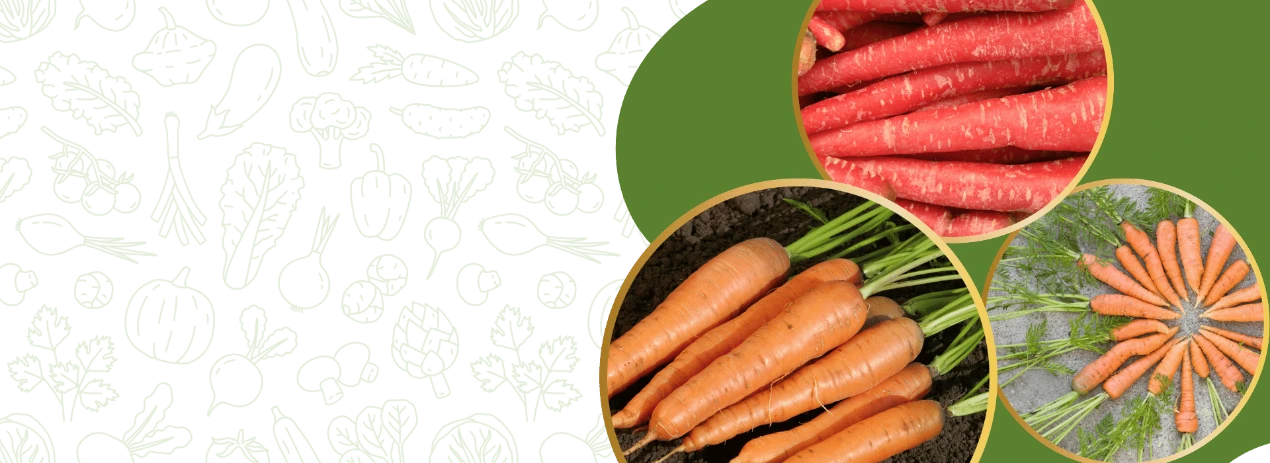
Carrot Varieties
FARMSON BIOTECH Carrot Seeds support healthy root formation, uniform maturity, and attractive root color suitable for commercial production. The varieties are developed for reliable germination, field adaptability, and quality harvest output.
Complete Package of Practices for Carrot Cultivation
Carrot is a popular cool-season root vegetable grown for its sweet, crunchy, carotene-rich root, used fresh, in salads, juice and processing. It is the most demanding of the root crops when it comes to soil: it needs deep, loose, stone-free soil free of fresh manure to produce long, smooth, unforked roots. Success also depends on careful sowing of its tiny, slow-germinating seed, choosing the right type for your climate, and cool weather for deep colour. This guide covers full technical practice plus a country-wise climate and sowing calendar for farmers worldwide.
Quick Navigation
- 01 Crop Overview & Types
- 02 Climatic Requirements
- 03 Soil & Field Preparation
- 04 Seed Rate & Seed Treatment
- 05 Sowing & Germination Care
- 06 Spacing & Thinning
- 07 Nutrient Management
- 08 Irrigation
- 09 Weed & Intercultural Care
- 10 Root Disorders
- 11 Pest Management
- 12 Disease Management
- 13 Harvesting
- 14 Yield & Post-Harvest
- 15 Country-Wise Climate & Sowing Guide
- 16 Frequently Asked Questions
1. Crop Overview & Types
- Common names: Carrot, gajar
- Scientific name: Daucus carota L.
- Crop type: Cool-season biennial root crop, grown as an annual
- Two main groups: Temperate (European) types — orange, sweet, need cooler temperatures (e.g. Nantes / Kuroda style); and Tropical (Asiatic) types — red, more heat-tolerant, popular in South Asia. Choose the group that suits your climate.
- Uses: Fresh, salad, juice, processing, sweets and pickles.
- Nutritional value: Very rich in beta-carotene (vitamin A), fibre and antioxidants.
2. Climatic Requirements
- Temperature: 15–25 °C is ideal; root colour and carotene develop best around 16–21 °C. High heat gives pale, poorly coloured, strong-flavoured roots.
- Type by climate: temperate (European) types need cool conditions or hills; tropical (Asiatic red) types tolerate warmer plains.
- Bolting: long cold spells on young plants can trigger bolting in temperate types — choose suitable types and windows.
- Soil: Deep, loose, friable sandy loam; pH 6.0–7.0. Avoid heavy, stony or compacted soils.
3. Soil & Field Preparation
- Plough deeply and work to a fine, loose, stone-free tilth — any stone, clod or hardpan makes roots fork or split.
- Incorporate well-rotted FYM / compost; never use fresh manure, which causes forked, hairy roots.
- Prepare deep raised beds or ridges with a soft, deep root zone and good drainage.
4. Seed Rate & Seed Treatment
Seed rate
- Direct sowing: 4–6 kg/ha
Seed treatment
- Treat seed with Thiram / Captan @ 2–3 g/kg, or Trichoderma viride @ 4 g/kg, against damping-off.
- Mixing the fine seed with dry sand or sieved soil helps spread it evenly at sowing.
5. Sowing & Germination Care
- Carrot seed is tiny and slow to germinate (about 10–20 days) — sow shallow, only 1–1.5 cm deep, in fine soil.
- Sow in lines and cover very lightly; mix with sand for even spacing.
- Keep the surface moist until emergence with frequent light watering — do not let the soil dry or form a hard crust, which blocks the weak seedlings.
6. Spacing & Thinning
- Spacing: rows 30–45 cm apart; thin plants to 5–8 cm apart.
- Thin early, once seedlings are a few centimetres tall, to give each root room to size up.
- Crowded plants give thin, twisted, poorly coloured roots.
7. Nutrient Management (per hectare)
Indicative dose — adjust to soil test report and local recommendation:
| Nutrient | Dose | Application timing |
|---|---|---|
| Nitrogen (N) | 60–100 kg | Part basal; a top-dress during growth — avoid excess, which causes forking and hairy roots |
| Phosphorus (P2O5) | 50–60 kg | Full basal at sowing |
| Potassium (K2O) | 80–120 kg | Basal — important for root development, sweetness and colour |
| Micronutrients | As recommended | Support healthy root growth |
8. Irrigation
- Keep soil evenly moist — steady moisture gives smooth, crack-free, well-coloured roots.
- Irregular watering (dry then heavy) causes the roots to crack and split.
- Keep the surface moist during the long germination period.
- Avoid waterlogging; drip or careful furrow irrigation works well.
9. Weed & Intercultural Care
- Keep the crop weed-free in the early stages — slow-growing carrot competes poorly with weeds.
- Do shallow weeding; avoid deep cultivation that damages roots.
- Earth up lightly to keep the root shoulders covered and prevent green shoulders (greening of the exposed root top).
10. Root Disorders
- Forking / splitting (the main problem): caused by stones, clods, compacted soil, fresh manure, excess nitrogen, or root-knot nematode — prepare deep, loose, stone-free soil and avoid fresh manure.
- Green shoulders: the exposed root top turns green — earth up to keep shoulders covered.
- Cracking: from irregular irrigation — keep moisture steady.
- Hairy roots: from excess nitrogen, fresh manure or stress.
- Poor colour / strong flavour: from high temperature — grow in the cool season and choose the right type.
- Bolting: from cold spells on young plants — use suitable types and windows.
11. Plant Protection — Pests
| Pest | Symptom | Management |
|---|---|---|
| Carrot fly (temperate regions) | Maggots tunnel into roots; rusty tunnels | Crop rotation; barrier nets / fleece; later sowing; need-based control |
| Root-knot nematode (warm soils) | Galls on roots; forked, stunted roots | Crop rotation; resistant varieties; soil solarization; organic amendments |
| Aphids | Sap-sucking; spread virus | Sticky traps; need-based control |
| Cutworms | Cut young seedlings | Field sanitation; need-based control |
12. Plant Protection — Diseases
| Disease | Symptom | Management |
|---|---|---|
| Leaf blight (Alternaria / Cercospora) (major) | Brown spots and scorching of leaves; defoliation | Crop rotation; resistant varieties; protectant fungicide; field sanitation |
| Powdery mildew | White powdery growth on leaves | Sulphur or recommended fungicide |
| Sclerotinia / soft rot | Watery rot of roots in storage or wet soil | Good drainage; crop rotation; careful handling |
| Damping-off | Seedling collapse in wet soil | Seed treatment; good drainage; avoid over-watering |
13. Harvesting
- Roots are ready about 70–110 days after sowing, depending on type and temperature, when they reach full size and colour.
- Harvest at the tender, well-coloured stage, before roots turn woody or oversized.
- Loosen the soil and lift roots carefully to avoid breakage; water the day before to ease lifting in firm soil.
- Trim the tops, leaving a short stub; wash gently for the fresh market.
14. Yield & Post-Harvest
- Yield: 25–40 t/ha, depending on type, season and management.
- Grade by size and colour; remove forked, cracked or green-shouldered roots.
- Carrots store well cool and humid; remove tops to reduce moisture loss and keep roots firm.
- Handle gently to avoid breakage and skin damage.
15. Country-Wise Climate & Sowing Guide
Carrot is a cool-season root crop — grow it in the cool months for good colour, and match the type (temperate or tropical) to your climate. Windows below are indicative — adjust to local altitude and micro-climate.
| Country / Region | Climate | Best sowing / season | Type & heat caution |
|---|---|---|---|
| TROPICAL & SUBTROPICAL (cool-season crop) | |||
| India | Subtropical | Plains: Aug–Nov (tropical red types). Hills / cool: temperate orange types | Use Asiatic red types in the warm plains; European types in the hills |
| Pakistan / Bangladesh | Subtropical | Autumn–winter | Avoid hot months for good colour |
| Egypt / N. Africa | Arid subtropical | Autumn–winter | Cool-season; irrigation-led |
| Gulf (Saudi / UAE) | Hot arid | Oct–Mar (cool season) | Summer too hot in the open |
| Kenya / E. Africa highlands | Tropical highland | Cool highland window, much of the year | Temperate types do well in the highlands |
| MEDITERRANEAN & TEMPERATE | |||
| Spain / Italy / Turkey | Mediterranean | Autumn and early spring | Avoid mid-summer heat |
| USA / N. Europe | Temperate | Spring and summer sowings; autumn-harvested | Watch carrot fly; cool weather gives sweet roots |
| China | Wide range (major producer) | Spring and autumn | Protected cultivation extends the season |
| Mexico | Subtropical | Autumn–winter | Avoid summer heat |
16. Frequently Asked Questions
Why are my carrots forked, split or hairy?
The main causes are stones, clods, compacted soil, fresh manure, excess nitrogen, or root-knot nematode. Prepare a deep, loose, stone-free seedbed, use only well-rotted manure, and avoid heavy nitrogen for long, smooth roots.
Why is my carrot germination so poor and slow?
Carrot seed is tiny and naturally slow (10–20 days). Sow shallow in fine soil and keep the surface moist with light, frequent watering until emergence — if the soil dries or crusts, the weak seedlings cannot break through.
Which carrot type should I grow?
Match the type to your climate: tropical (Asiatic red) types tolerate warm plains, while temperate (European orange) types need cool conditions or hills for good colour and sweetness.
Why are the tops of my carrots green?
That is green shoulder, from the exposed root top getting light. Earth up lightly during growth to keep the shoulders covered.
What temperature does carrot need?
About 15–25 °C, with the best colour and carotene developing around 16–21 °C. High heat gives pale, strong-flavoured roots.
How much carrot seed is needed per hectare?
About 4–6 kg/ha by direct sowing.
When should I harvest carrots?
About 70–110 days after sowing, when roots reach full size and colour, while still tender — before they turn woody or oversized.
Explore More Farmson Crop Guides
Radish Beetroot Spinach Onion Cultivation Tomato Cultivation View All Vegetable SeedsGrow with Farmson Biotech Carrot Seeds
High-yield carrot varieties — tropical red and temperate orange types for smooth, sweet, well-coloured roots.
Send Export InquiryComplete Package of Practices for Carrot Cultivation
Carrot is a popular cool-season root vegetable grown for its sweet, crunchy, carotene-rich root, used fresh, in salads, juice and processing. It is the most demanding of the root crops when it comes to soil: it needs deep, loose, stone-free soil free of fresh manure to produce long, smooth, unforked roots. Success also depends on careful sowing of its tiny, slow-germinating seed, choosing the right type for your climate, and cool weather for deep colour. This guide covers full technical practice plus a country-wise climate and sowing calendar for farmers worldwide.
Quick Navigation
- 01 Crop Overview & Types
- 02 Climatic Requirements
- 03 Soil & Field Preparation
- 04 Seed Rate & Seed Treatment
- 05 Sowing & Germination Care
- 06 Spacing & Thinning
- 07 Nutrient Management
- 08 Irrigation
- 09 Weed & Intercultural Care
- 10 Root Disorders
- 11 Pest Management
- 12 Disease Management
- 13 Harvesting
- 14 Yield & Post-Harvest
- 15 Country-Wise Climate & Sowing Guide
- 16 Frequently Asked Questions
1. Crop Overview & Types
- Common names: Carrot, gajar
- Scientific name: Daucus carota L.
- Crop type: Cool-season biennial root crop, grown as an annual
- Two main groups: Temperate (European) types — orange, sweet, need cooler temperatures (e.g. Nantes / Kuroda style); and Tropical (Asiatic) types — red, more heat-tolerant, popular in South Asia. Choose the group that suits your climate.
- Uses: Fresh, salad, juice, processing, sweets and pickles.
- Nutritional value: Very rich in beta-carotene (vitamin A), fibre and antioxidants.
2. Climatic Requirements
- Temperature: 15–25 °C is ideal; root colour and carotene develop best around 16–21 °C. High heat gives pale, poorly coloured, strong-flavoured roots.
- Type by climate: temperate (European) types need cool conditions or hills; tropical (Asiatic red) types tolerate warmer plains.
- Bolting: long cold spells on young plants can trigger bolting in temperate types — choose suitable types and windows.
- Soil: Deep, loose, friable sandy loam; pH 6.0–7.0. Avoid heavy, stony or compacted soils.
3. Soil & Field Preparation
- Plough deeply and work to a fine, loose, stone-free tilth — any stone, clod or hardpan makes roots fork or split.
- Incorporate well-rotted FYM / compost; never use fresh manure, which causes forked, hairy roots.
- Prepare deep raised beds or ridges with a soft, deep root zone and good drainage.
4. Seed Rate & Seed Treatment
Seed rate
- Direct sowing: 4–6 kg/ha
Seed treatment
- Treat seed with Thiram / Captan @ 2–3 g/kg, or Trichoderma viride @ 4 g/kg, against damping-off.
- Mixing the fine seed with dry sand or sieved soil helps spread it evenly at sowing.
5. Sowing & Germination Care
- Carrot seed is tiny and slow to germinate (about 10–20 days) — sow shallow, only 1–1.5 cm deep, in fine soil.
- Sow in lines and cover very lightly; mix with sand for even spacing.
- Keep the surface moist until emergence with frequent light watering — do not let the soil dry or form a hard crust, which blocks the weak seedlings.
6. Spacing & Thinning
- Spacing: rows 30–45 cm apart; thin plants to 5–8 cm apart.
- Thin early, once seedlings are a few centimetres tall, to give each root room to size up.
- Crowded plants give thin, twisted, poorly coloured roots.
7. Nutrient Management (per hectare)
Indicative dose — adjust to soil test report and local recommendation:
| Nutrient | Dose | Application timing |
|---|---|---|
| Nitrogen (N) | 60–100 kg | Part basal; a top-dress during growth — avoid excess, which causes forking and hairy roots |
| Phosphorus (P2O5) | 50–60 kg | Full basal at sowing |
| Potassium (K2O) | 80–120 kg | Basal — important for root development, sweetness and colour |
| Micronutrients | As recommended | Support healthy root growth |
8. Irrigation
- Keep soil evenly moist — steady moisture gives smooth, crack-free, well-coloured roots.
- Irregular watering (dry then heavy) causes the roots to crack and split.
- Keep the surface moist during the long germination period.
- Avoid waterlogging; drip or careful furrow irrigation works well.
9. Weed & Intercultural Care
- Keep the crop weed-free in the early stages — slow-growing carrot competes poorly with weeds.
- Do shallow weeding; avoid deep cultivation that damages roots.
- Earth up lightly to keep the root shoulders covered and prevent green shoulders (greening of the exposed root top).
10. Root Disorders
- Forking / splitting (the main problem): caused by stones, clods, compacted soil, fresh manure, excess nitrogen, or root-knot nematode — prepare deep, loose, stone-free soil and avoid fresh manure.
- Green shoulders: the exposed root top turns green — earth up to keep shoulders covered.
- Cracking: from irregular irrigation — keep moisture steady.
- Hairy roots: from excess nitrogen, fresh manure or stress.
- Poor colour / strong flavour: from high temperature — grow in the cool season and choose the right type.
- Bolting: from cold spells on young plants — use suitable types and windows.
11. Plant Protection — Pests
| Pest | Symptom | Management |
|---|---|---|
| Carrot fly (temperate regions) | Maggots tunnel into roots; rusty tunnels | Crop rotation; barrier nets / fleece; later sowing; need-based control |
| Root-knot nematode (warm soils) | Galls on roots; forked, stunted roots | Crop rotation; resistant varieties; soil solarization; organic amendments |
| Aphids | Sap-sucking; spread virus | Sticky traps; need-based control |
| Cutworms | Cut young seedlings | Field sanitation; need-based control |
12. Plant Protection — Diseases
| Disease | Symptom | Management |
|---|---|---|
| Leaf blight (Alternaria / Cercospora) (major) | Brown spots and scorching of leaves; defoliation | Crop rotation; resistant varieties; protectant fungicide; field sanitation |
| Powdery mildew | White powdery growth on leaves | Sulphur or recommended fungicide |
| Sclerotinia / soft rot | Watery rot of roots in storage or wet soil | Good drainage; crop rotation; careful handling |
| Damping-off | Seedling collapse in wet soil | Seed treatment; good drainage; avoid over-watering |
13. Harvesting
- Roots are ready about 70–110 days after sowing, depending on type and temperature, when they reach full size and colour.
- Harvest at the tender, well-coloured stage, before roots turn woody or oversized.
- Loosen the soil and lift roots carefully to avoid breakage; water the day before to ease lifting in firm soil.
- Trim the tops, leaving a short stub; wash gently for the fresh market.
14. Yield & Post-Harvest
- Yield: 25–40 t/ha, depending on type, season and management.
- Grade by size and colour; remove forked, cracked or green-shouldered roots.
- Carrots store well cool and humid; remove tops to reduce moisture loss and keep roots firm.
- Handle gently to avoid breakage and skin damage.
15. Country-Wise Climate & Sowing Guide
Carrot is a cool-season root crop — grow it in the cool months for good colour, and match the type (temperate or tropical) to your climate. Windows below are indicative — adjust to local altitude and micro-climate.
| Country / Region | Climate | Best sowing / season | Type & heat caution |
|---|---|---|---|
| TROPICAL & SUBTROPICAL (cool-season crop) | |||
| India | Subtropical | Plains: Aug–Nov (tropical red types). Hills / cool: temperate orange types | Use Asiatic red types in the warm plains; European types in the hills |
| Pakistan / Bangladesh | Subtropical | Autumn–winter | Avoid hot months for good colour |
| Egypt / N. Africa | Arid subtropical | Autumn–winter | Cool-season; irrigation-led |
| Gulf (Saudi / UAE) | Hot arid | Oct–Mar (cool season) | Summer too hot in the open |
| Kenya / E. Africa highlands | Tropical highland | Cool highland window, much of the year | Temperate types do well in the highlands |
| MEDITERRANEAN & TEMPERATE | |||
| Spain / Italy / Turkey | Mediterranean | Autumn and early spring | Avoid mid-summer heat |
| USA / N. Europe | Temperate | Spring and summer sowings; autumn-harvested | Watch carrot fly; cool weather gives sweet roots |
| China | Wide range (major producer) | Spring and autumn | Protected cultivation extends the season |
| Mexico | Subtropical | Autumn–winter | Avoid summer heat |
16. Frequently Asked Questions
Why are my carrots forked, split or hairy?
The main causes are stones, clods, compacted soil, fresh manure, excess nitrogen, or root-knot nematode. Prepare a deep, loose, stone-free seedbed, use only well-rotted manure, and avoid heavy nitrogen for long, smooth roots.
Why is my carrot germination so poor and slow?
Carrot seed is tiny and naturally slow (10–20 days). Sow shallow in fine soil and keep the surface moist with light, frequent watering until emergence — if the soil dries or crusts, the weak seedlings cannot break through.
Which carrot type should I grow?
Match the type to your climate: tropical (Asiatic red) types tolerate warm plains, while temperate (European orange) types need cool conditions or hills for good colour and sweetness.
Why are the tops of my carrots green?
That is green shoulder, from the exposed root top getting light. Earth up lightly during growth to keep the shoulders covered.
What temperature does carrot need?
About 15–25 °C, with the best colour and carotene developing around 16–21 °C. High heat gives pale, strong-flavoured roots.
How much carrot seed is needed per hectare?
About 4–6 kg/ha by direct sowing.
When should I harvest carrots?
About 70–110 days after sowing, when roots reach full size and colour, while still tender — before they turn woody or oversized.
Explore More Farmson Crop Guides
Radish Beetroot Spinach Onion Cultivation Tomato Cultivation View All Vegetable SeedsGrow with Farmson Biotech Carrot Seeds
High-yield carrot varieties — tropical red and temperate orange types for smooth, sweet, well-coloured roots.
Send Export InquiryAgricultural Advisory Notice
The recommendations and crop guidance provided on this website are intended for informational purposes only and should not be considered a guaranteed agronomic outcome. Local climatic conditions, soil health, cultivation methods, and regional practices may influence actual crop performance. FARMSON BIOTECH PVT LTD recommends farmers seek guidance from authorized agricultural experts or local government agricultural authorities before cultivation decisions.