Premium Onion Seeds
Reliable onion varieties suitable for bulb uniformity, storage quality, and commercial cultivation.
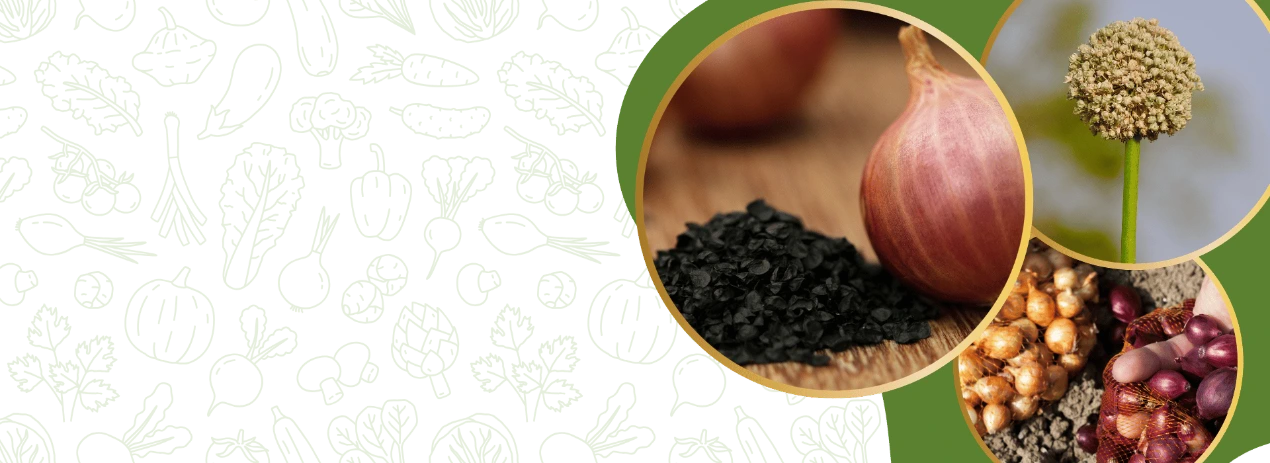
Onion Varieties
These onion seed varieties support healthy bulb formation, attractive skin color, uniform maturity, and reliable field performance.
Complete Package of Practices for Onion Cultivation
Onion is one of the world's most widely grown and traded vegetable crops, valued for its culinary importance, long storage life, and strong export demand. Successful onion farming depends on choosing the right day-length type for the latitude, healthy nursery raising, balanced nutrition with sulphur, careful irrigation, and timely thrips and disease control. This guide covers full technical practice from nursery to storage, plus a country-wise climate and sowing calendar for farmers worldwide.
Quick Navigation
- 01 Crop Overview
- 02 Day-Length & Variety Selection
- 03 Climatic Requirements
- 04 Soil & Field Preparation
- 05 Nursery Raising
- 06 Seed Rate & Seed Treatment
- 07 Transplanting & Spacing
- 08 Nutrient Management
- 09 Irrigation
- 10 Weed & Intercultural Care
- 11 Pest Management
- 12 Disease Management
- 13 Bolting & Bulb Disorders
- 14 Harvesting, Curing & Storage
- 15 Country-Wise Climate & Sowing Guide
- 16 Frequently Asked Questions
1. Crop Overview
- Common names: Onion, bulb onion, common onion
- Scientific name: Allium cepa L.
- Crop type: Cool-season biennial, grown commercially as an annual
- Edible part: Underground bulb (also green / spring onion)
- Uses: Fresh vegetable, cooking, dehydration, pickling, paste, export trade
- Nutritional value: Source of vitamin C, B6, folate, and beneficial sulphur compounds and antioxidants (quercetin)
2. Day-Length & Variety Selection (Read First)
Onion bulb formation is triggered by day length (photoperiod). Choosing the wrong type for the latitude is the single most common cause of crop failure — plants either never bulb or bulb too early. Always match the type to where the crop is grown:
| Type | Day length to bulb | Best latitude / region | Typical season |
|---|---|---|---|
| Short-day | 10–12 hours | Tropics and subtropics (approx 0–30°): India, Egypt, Africa, Gulf, SE Asia, southern USA, Mexico | Autumn / winter |
| Intermediate-day | 12–14 hours | Mid latitudes (approx 30–38°): Spain, Turkey, Iran, mid-USA, parts of China | Spring |
| Long-day | 14–16 hours | Higher latitudes (approx 38°+): Netherlands, N. Europe, N. USA, Canada, Japan, N. China | Spring to autumn harvest |
3. Climatic Requirements
- Temperature: 13–24 °C for vegetative growth; warmer, drier weather (20–30 °C) favours bulb maturity and curing. Extreme early heat causes premature bulbing and small bulbs.
- Climate: Cool, mild weather for leaf growth followed by warm, dry weather at maturity gives the best yield and storage quality.
- Soil: Deep, friable, well-drained sandy loam or loam rich in organic matter. Avoid heavy clay and waterlogged soils.
- Soil pH: 6.0–7.0 ideal (tolerates up to 7.5). Onion is sensitive to acidity and to soil salinity.
- Rainfall: Performs best under controlled irrigation. Heavy rain at maturity damages bulbs and promotes disease and rotting.
4. Soil & Field Preparation
- Plough 2–3 times to a fine tilth; onion has shallow roots and needs a loose, mellow seedbed.
- Incorporate 20–25 t/ha of well-decomposed FYM / compost during land preparation.
- Prepare flat beds, raised beds, or broad-bed-and-furrow for good drainage — essential to avoid bulb rot.
- Level the field so irrigation water spreads evenly and never stagnates.
5. Nursery Raising
- Prepare raised nursery beds about 1 m wide, 10–15 cm high, of convenient length.
- Sow seed thinly in lines 5 cm apart; cover lightly with fine soil / compost and mulch until germination.
- Give light, frequent watering. Keep beds weed-free.
- Apply a starter dose of 19:19:19 or DAP; drench with a fungicide if damping-off appears.
- Seedlings are ready for transplanting in 6–8 weeks, when they reach pencil-thickness (approx 15 cm tall, 3–4 leaves).
6. Seed Rate & Seed Treatment
Seed rate
- Transplanting method: 7–10 kg/ha (hybrids on the lower end)
- Direct seeding: 12–15 kg/ha
- Onion sets: 800–1000 kg/ha (set method)
Seed treatment
- Treat seed with Thiram or Captan @ 2–3 g/kg seed, or Trichoderma viride @ 4 g/kg, to control seed- and soil-borne diseases.
7. Transplanting & Spacing
- Transplant healthy seedlings in the evening or on a cloudy day; irrigate immediately.
- Spacing: 15 x 10 cm or 10 x 10 cm (row x plant). Closer spacing gives more, smaller bulbs for export / pickling grades.
- Plant shallow — 2–3 cm deep. Deep planting delays bulbing and produces thick necks.
- Clip the tips of long seedling leaves slightly to reduce transplant shock.
8. Nutrient Management (per hectare)
Indicative dose — adjust to soil test report and local recommendation:
| Nutrient | Dose | Application timing |
|---|---|---|
| Nitrogen (N) | 100–125 kg | Half basal; balance in 2 splits at 30 and 45–60 days |
| Phosphorus (P2O5) | 50–60 kg | Full basal at planting |
| Potassium (K2O) | 50–80 kg | Full basal at planting |
| Sulphur (S) | 30–45 kg | Basal — improves yield, pungency and storage |
9. Irrigation
- Irrigate immediately after transplanting and again on the 3rd day; thereafter every 7–10 days depending on soil and weather.
- Onion has shallow roots — keep soil consistently moist but never waterlogged.
- Critical stages: establishment and bulb development.
- Stop irrigation 2–3 weeks before harvest to firm up bulbs and improve storage life.
- Drip irrigation gives the best water-use efficiency, uniform bulbs, and fewer foliar diseases.
10. Weed & Intercultural Care
- Onion is a poor competitor against weeds due to its sparse foliage. Keep the field weed-free for the first 45–60 days.
- Do 2–3 hand weedings / light hoeings; avoid deep hoeing that damages shallow roots and bulbs.
- Pre-emergence herbicides (e.g. pendimethalin) can be used as per local registration.
11. Plant Protection — Pests
| Pest | Symptom | Management |
|---|---|---|
| Thrips (major) | Silvery streaks / white blotches on leaves; stunted plants | Blue sticky traps; spray as per local recommendation; rotate insecticide groups to avoid resistance |
| Onion maggot | Maggots bore into base; seedlings wilt and die | Field sanitation; remove crop debris; soil treatment where registered |
| Cutworms / mites | Cut seedlings; leaf damage | Clean cultivation; need-based control |
12. Plant Protection — Diseases
| Disease | Symptom | Management |
|---|---|---|
| Purple blotch (Alternaria) | Purplish sunken spots with concentric rings on leaves | Crop rotation; protectant plus systemic fungicide sprays; sticker for waxy leaves |
| Stemphylium blight | Small yellow-orange spots spreading to leaf blight | As for purple blotch; avoid leaf wetness |
| Downy mildew | Pale, fuzzy violet-grey growth in humid / cool weather | Improve airflow; preventive fungicide in wet seasons |
| Basal rot (Fusarium) | Rotting of basal plate; bulbs collapse | Crop rotation; clean seed; soil drainage; bio-control (Trichoderma) |
| Neck rot (storage) | Soft, sunken neck developing in storage | Proper curing; avoid late N; dry, ventilated storage |
13. Bolting & Bulb Disorders
- Bolting (premature flowering): caused by over-aged seedlings, too-early sowing, or cold spells after transplanting. Use the right sowing window and correctly sized seedlings.
- Bulb splitting / doubles: from irregular irrigation and uneven growth — keep moisture steady.
- Thick necks: from excess late nitrogen or deep planting — stop N after bulbing and plant shallow.
- Small bulbs: from the wrong day-length type, heat, crowding or poor nutrition.
14. Harvesting, Curing & Storage
- Harvest indicator: when 50–70% of the tops (necks) fall over and dry naturally.
- Lift bulbs gently; avoid bruising. Do not harvest when soil is wet.
- Field curing: leave bulbs in windrows with tops covering bulbs for 3–5 days to prevent sunscald.
- Shade curing: then cure under shade with good ventilation for 1–3 weeks until necks are fully dry and outer scales become papery.
- Trim tops to about 2 cm and remove roots before grading and packing.
- Storage: store cured, firm, well-necked bulbs in a cool, dry, well-ventilated space at low humidity (about 65–70%); avoid airtight bags and moisture.
- Yield: a well-managed crop yields 25–40 t/ha.
15. Country-Wise Climate & Sowing Guide
Use the day-length zone to pick the right Farmson variety, then follow the local window below. Windows are indicative — adjust to local altitude, micro-climate and irrigation availability.
| Country / Region | Day-length type | Ideal temp | Best sowing window | Rainy-season caution |
|---|---|---|---|---|
| SHORT-DAY ZONE — Tropics and Subtropics | ||||
| India | Short-day | 15–25 °C | Rabi (main): Oct–Nov. Kharif: Jun–Jul. Late-Kharif: Aug–Sep | Avoid bulb maturity during monsoon; ensure drainage |
| Pakistan | Short-day | 15–25 °C | Sep–Nov (autumn) | Protect from monsoon rains at maturity |
| Bangladesh | Short-day | 15–25 °C | Oct–Nov | Harvest before pre-monsoon showers (Apr) |
| Egypt | Short-day | 15–25 °C | Sep–Nov | Dry climate; irrigation-led, minimal rain risk |
| Sudan | Short-day | 18–28 °C | Oct–Dec (cool dry season) | Avoid hot late-season; irrigate carefully |
| Nigeria / West Africa | Short-day | 20–30 °C | Nov onward (dry season, irrigated) | Do not mature bulbs during the wet season |
| Kenya / East Africa | Short-day | 15–25 °C | Sow at start of dry spell; varies by altitude | Bimodal rains; schedule to dry harvest period |
| Saudi Arabia / UAE / Gulf | Short-day | 15–28 °C | Oct–Feb (cool season) | Negligible rain; manage heat and irrigation |
| Mexico (south) | Short-day | 15–25 °C | Oct–Jan (autumn–winter) | Avoid summer rains at maturity |
| Philippines / Indonesia / Thailand | Short-day | 20–30 °C | Dry season (Nov–Feb) | Strictly avoid wet-season bulbing |
| INTERMEDIATE-DAY ZONE — Mid Latitudes | ||||
| Spain | Intermediate | 13–24 °C | Late winter–spring (Feb–Apr) | Dry summer harvest; low rain risk |
| Turkey | Intermediate | 13–24 °C | Spring (Mar–Apr); some autumn | Manage spring rains; ensure drainage |
| Iran | Intermediate | 13–24 °C | Late winter–spring | Irrigation-led; low monsoon risk |
| Morocco | Intermediate | 13–24 °C | Autumn–winter (Oct–Jan) | Mild rains; ensure good drainage |
| USA (mid-latitude) | Intermediate | 13–24 °C | Late winter–early spring | Match transplant to last frost and spring rains |
| China (central) | Intermediate | 13–24 °C | Spring; autumn in warmer south | Avoid maturity during summer rains |
| LONG-DAY ZONE — Higher Latitudes | ||||
| Netherlands | Long-day | 12–22 °C | Sow Mar–Apr; harvest Aug–Sep | Wet autumn; harvest and cure before heavy rains |
| UK / N. Europe | Long-day | 12–22 °C | Spring (Mar–Apr) | Cure indoors; damp climate |
| Germany / Poland | Long-day | 12–22 °C | Spring (Mar–Apr) | Watch wet late summer at harvest |
| USA (northern) | Long-day | 12–24 °C | Early spring after frost | Match to growing-degree window |
| Canada | Long-day | 12–22 °C | Spring (Apr–May) | Short season; use early-maturing types |
| Japan / Korea | Long-day | 12–22 °C | Autumn sow, overwinter, summer harvest | Drain well in rainy (tsuyu) season |
| N. China / Russia | Long-day | 12–22 °C | Spring (Apr–May) | Short cool season; choose adapted varieties |
16. Frequently Asked Questions
What is the difference between short-day, intermediate-day and long-day onions?
It refers to the daylight hours needed before the plant forms a bulb. Short-day onions bulb at 10–12 hours and suit the tropics; intermediate-day onions bulb at 12–14 hours and suit mid-latitudes; long-day onions need 14–16 hours and suit higher latitudes. Using the wrong type for the latitude is the most common reason onions fail to bulb properly.
What is the ideal temperature for growing onions?
Onions grow best at 13–24 °C during the vegetative stage, with warmer, drier weather (20–30 °C) helping bulbs mature and cure.
How much onion seed is needed per hectare?
About 7–10 kg/ha for the transplanting method and 12–15 kg/ha for direct seeding. Hybrid seed is used at the lower end of the range.
How many days does onion take to mature?
Most onions mature in about 110–150 days from transplanting, depending on variety, day-length type and growing temperature.
Why is sulphur important for onions?
Sulphur improves bulb yield, the characteristic pungency, and storage life. A basal dose of 30–45 kg/ha is recommended for quality onion production.
When should I stop watering before harvesting onions?
Stop irrigation about 2–3 weeks before harvest. This firms up the bulbs, helps the necks dry, and greatly improves storage life.
How do I store onions for a long time?
Cure the bulbs thoroughly after harvest, then store them in a cool, dry, well-ventilated space at low humidity (about 65–70%). Avoid airtight bags and moisture, which cause sprouting and rot.
Explore More Farmson Crop Guides
Spinach Beetroot Carrot Radish Tomato Cultivation View All Vegetable SeedsGrow with Farmson Biotech Onion Seeds
High-quality, climate-matched onion varieties for farmers in 30+ countries.
Send Export InquiryComplete Package of Practices for Onion Cultivation
Onion is one of the world's most widely grown and traded vegetable crops, valued for its culinary importance, long storage life, and strong export demand. Successful onion farming depends on choosing the right day-length type for the latitude, healthy nursery raising, balanced nutrition with sulphur, careful irrigation, and timely thrips and disease control. This guide covers full technical practice from nursery to storage, plus a country-wise climate and sowing calendar for farmers worldwide.
Quick Navigation
- 01 Crop Overview
- 02 Day-Length & Variety Selection
- 03 Climatic Requirements
- 04 Soil & Field Preparation
- 05 Nursery Raising
- 06 Seed Rate & Seed Treatment
- 07 Transplanting & Spacing
- 08 Nutrient Management
- 09 Irrigation
- 10 Weed & Intercultural Care
- 11 Pest Management
- 12 Disease Management
- 13 Bolting & Bulb Disorders
- 14 Harvesting, Curing & Storage
- 15 Country-Wise Climate & Sowing Guide
- 16 Frequently Asked Questions
1. Crop Overview
- Common names: Onion, bulb onion, common onion
- Scientific name: Allium cepa L.
- Crop type: Cool-season biennial, grown commercially as an annual
- Edible part: Underground bulb (also green / spring onion)
- Uses: Fresh vegetable, cooking, dehydration, pickling, paste, export trade
- Nutritional value: Source of vitamin C, B6, folate, and beneficial sulphur compounds and antioxidants (quercetin)
2. Day-Length & Variety Selection (Read First)
Onion bulb formation is triggered by day length (photoperiod). Choosing the wrong type for the latitude is the single most common cause of crop failure — plants either never bulb or bulb too early. Always match the type to where the crop is grown:
| Type | Day length to bulb | Best latitude / region | Typical season |
|---|---|---|---|
| Short-day | 10–12 hours | Tropics and subtropics (approx 0–30°): India, Egypt, Africa, Gulf, SE Asia, southern USA, Mexico | Autumn / winter |
| Intermediate-day | 12–14 hours | Mid latitudes (approx 30–38°): Spain, Turkey, Iran, mid-USA, parts of China | Spring |
| Long-day | 14–16 hours | Higher latitudes (approx 38°+): Netherlands, N. Europe, N. USA, Canada, Japan, N. China | Spring to autumn harvest |
3. Climatic Requirements
- Temperature: 13–24 °C for vegetative growth; warmer, drier weather (20–30 °C) favours bulb maturity and curing. Extreme early heat causes premature bulbing and small bulbs.
- Climate: Cool, mild weather for leaf growth followed by warm, dry weather at maturity gives the best yield and storage quality.
- Soil: Deep, friable, well-drained sandy loam or loam rich in organic matter. Avoid heavy clay and waterlogged soils.
- Soil pH: 6.0–7.0 ideal (tolerates up to 7.5). Onion is sensitive to acidity and to soil salinity.
- Rainfall: Performs best under controlled irrigation. Heavy rain at maturity damages bulbs and promotes disease and rotting.
4. Soil & Field Preparation
- Plough 2–3 times to a fine tilth; onion has shallow roots and needs a loose, mellow seedbed.
- Incorporate 20–25 t/ha of well-decomposed FYM / compost during land preparation.
- Prepare flat beds, raised beds, or broad-bed-and-furrow for good drainage — essential to avoid bulb rot.
- Level the field so irrigation water spreads evenly and never stagnates.
5. Nursery Raising
- Prepare raised nursery beds about 1 m wide, 10–15 cm high, of convenient length.
- Sow seed thinly in lines 5 cm apart; cover lightly with fine soil / compost and mulch until germination.
- Give light, frequent watering. Keep beds weed-free.
- Apply a starter dose of 19:19:19 or DAP; drench with a fungicide if damping-off appears.
- Seedlings are ready for transplanting in 6–8 weeks, when they reach pencil-thickness (approx 15 cm tall, 3–4 leaves).
6. Seed Rate & Seed Treatment
Seed rate
- Transplanting method: 7–10 kg/ha (hybrids on the lower end)
- Direct seeding: 12–15 kg/ha
- Onion sets: 800–1000 kg/ha (set method)
Seed treatment
- Treat seed with Thiram or Captan @ 2–3 g/kg seed, or Trichoderma viride @ 4 g/kg, to control seed- and soil-borne diseases.
7. Transplanting & Spacing
- Transplant healthy seedlings in the evening or on a cloudy day; irrigate immediately.
- Spacing: 15 x 10 cm or 10 x 10 cm (row x plant). Closer spacing gives more, smaller bulbs for export / pickling grades.
- Plant shallow — 2–3 cm deep. Deep planting delays bulbing and produces thick necks.
- Clip the tips of long seedling leaves slightly to reduce transplant shock.
8. Nutrient Management (per hectare)
Indicative dose — adjust to soil test report and local recommendation:
| Nutrient | Dose | Application timing |
|---|---|---|
| Nitrogen (N) | 100–125 kg | Half basal; balance in 2 splits at 30 and 45–60 days |
| Phosphorus (P2O5) | 50–60 kg | Full basal at planting |
| Potassium (K2O) | 50–80 kg | Full basal at planting |
| Sulphur (S) | 30–45 kg | Basal — improves yield, pungency and storage |
9. Irrigation
- Irrigate immediately after transplanting and again on the 3rd day; thereafter every 7–10 days depending on soil and weather.
- Onion has shallow roots — keep soil consistently moist but never waterlogged.
- Critical stages: establishment and bulb development.
- Stop irrigation 2–3 weeks before harvest to firm up bulbs and improve storage life.
- Drip irrigation gives the best water-use efficiency, uniform bulbs, and fewer foliar diseases.
10. Weed & Intercultural Care
- Onion is a poor competitor against weeds due to its sparse foliage. Keep the field weed-free for the first 45–60 days.
- Do 2–3 hand weedings / light hoeings; avoid deep hoeing that damages shallow roots and bulbs.
- Pre-emergence herbicides (e.g. pendimethalin) can be used as per local registration.
11. Plant Protection — Pests
| Pest | Symptom | Management |
|---|---|---|
| Thrips (major) | Silvery streaks / white blotches on leaves; stunted plants | Blue sticky traps; spray as per local recommendation; rotate insecticide groups to avoid resistance |
| Onion maggot | Maggots bore into base; seedlings wilt and die | Field sanitation; remove crop debris; soil treatment where registered |
| Cutworms / mites | Cut seedlings; leaf damage | Clean cultivation; need-based control |
12. Plant Protection — Diseases
| Disease | Symptom | Management |
|---|---|---|
| Purple blotch (Alternaria) | Purplish sunken spots with concentric rings on leaves | Crop rotation; protectant plus systemic fungicide sprays; sticker for waxy leaves |
| Stemphylium blight | Small yellow-orange spots spreading to leaf blight | As for purple blotch; avoid leaf wetness |
| Downy mildew | Pale, fuzzy violet-grey growth in humid / cool weather | Improve airflow; preventive fungicide in wet seasons |
| Basal rot (Fusarium) | Rotting of basal plate; bulbs collapse | Crop rotation; clean seed; soil drainage; bio-control (Trichoderma) |
| Neck rot (storage) | Soft, sunken neck developing in storage | Proper curing; avoid late N; dry, ventilated storage |
13. Bolting & Bulb Disorders
- Bolting (premature flowering): caused by over-aged seedlings, too-early sowing, or cold spells after transplanting. Use the right sowing window and correctly sized seedlings.
- Bulb splitting / doubles: from irregular irrigation and uneven growth — keep moisture steady.
- Thick necks: from excess late nitrogen or deep planting — stop N after bulbing and plant shallow.
- Small bulbs: from the wrong day-length type, heat, crowding or poor nutrition.
14. Harvesting, Curing & Storage
- Harvest indicator: when 50–70% of the tops (necks) fall over and dry naturally.
- Lift bulbs gently; avoid bruising. Do not harvest when soil is wet.
- Field curing: leave bulbs in windrows with tops covering bulbs for 3–5 days to prevent sunscald.
- Shade curing: then cure under shade with good ventilation for 1–3 weeks until necks are fully dry and outer scales become papery.
- Trim tops to about 2 cm and remove roots before grading and packing.
- Storage: store cured, firm, well-necked bulbs in a cool, dry, well-ventilated space at low humidity (about 65–70%); avoid airtight bags and moisture.
- Yield: a well-managed crop yields 25–40 t/ha.
15. Country-Wise Climate & Sowing Guide
Use the day-length zone to pick the right Farmson variety, then follow the local window below. Windows are indicative — adjust to local altitude, micro-climate and irrigation availability.
| Country / Region | Day-length type | Ideal temp | Best sowing window | Rainy-season caution |
|---|---|---|---|---|
| SHORT-DAY ZONE — Tropics and Subtropics | ||||
| India | Short-day | 15–25 °C | Rabi (main): Oct–Nov. Kharif: Jun–Jul. Late-Kharif: Aug–Sep | Avoid bulb maturity during monsoon; ensure drainage |
| Pakistan | Short-day | 15–25 °C | Sep–Nov (autumn) | Protect from monsoon rains at maturity |
| Bangladesh | Short-day | 15–25 °C | Oct–Nov | Harvest before pre-monsoon showers (Apr) |
| Egypt | Short-day | 15–25 °C | Sep–Nov | Dry climate; irrigation-led, minimal rain risk |
| Sudan | Short-day | 18–28 °C | Oct–Dec (cool dry season) | Avoid hot late-season; irrigate carefully |
| Nigeria / West Africa | Short-day | 20–30 °C | Nov onward (dry season, irrigated) | Do not mature bulbs during the wet season |
| Kenya / East Africa | Short-day | 15–25 °C | Sow at start of dry spell; varies by altitude | Bimodal rains; schedule to dry harvest period |
| Saudi Arabia / UAE / Gulf | Short-day | 15–28 °C | Oct–Feb (cool season) | Negligible rain; manage heat and irrigation |
| Mexico (south) | Short-day | 15–25 °C | Oct–Jan (autumn–winter) | Avoid summer rains at maturity |
| Philippines / Indonesia / Thailand | Short-day | 20–30 °C | Dry season (Nov–Feb) | Strictly avoid wet-season bulbing |
| INTERMEDIATE-DAY ZONE — Mid Latitudes | ||||
| Spain | Intermediate | 13–24 °C | Late winter–spring (Feb–Apr) | Dry summer harvest; low rain risk |
| Turkey | Intermediate | 13–24 °C | Spring (Mar–Apr); some autumn | Manage spring rains; ensure drainage |
| Iran | Intermediate | 13–24 °C | Late winter–spring | Irrigation-led; low monsoon risk |
| Morocco | Intermediate | 13–24 °C | Autumn–winter (Oct–Jan) | Mild rains; ensure good drainage |
| USA (mid-latitude) | Intermediate | 13–24 °C | Late winter–early spring | Match transplant to last frost and spring rains |
| China (central) | Intermediate | 13–24 °C | Spring; autumn in warmer south | Avoid maturity during summer rains |
| LONG-DAY ZONE — Higher Latitudes | ||||
| Netherlands | Long-day | 12–22 °C | Sow Mar–Apr; harvest Aug–Sep | Wet autumn; harvest and cure before heavy rains |
| UK / N. Europe | Long-day | 12–22 °C | Spring (Mar–Apr) | Cure indoors; damp climate |
| Germany / Poland | Long-day | 12–22 °C | Spring (Mar–Apr) | Watch wet late summer at harvest |
| USA (northern) | Long-day | 12–24 °C | Early spring after frost | Match to growing-degree window |
| Canada | Long-day | 12–22 °C | Spring (Apr–May) | Short season; use early-maturing types |
| Japan / Korea | Long-day | 12–22 °C | Autumn sow, overwinter, summer harvest | Drain well in rainy (tsuyu) season |
| N. China / Russia | Long-day | 12–22 °C | Spring (Apr–May) | Short cool season; choose adapted varieties |
16. Frequently Asked Questions
What is the difference between short-day, intermediate-day and long-day onions?
It refers to the daylight hours needed before the plant forms a bulb. Short-day onions bulb at 10–12 hours and suit the tropics; intermediate-day onions bulb at 12–14 hours and suit mid-latitudes; long-day onions need 14–16 hours and suit higher latitudes. Using the wrong type for the latitude is the most common reason onions fail to bulb properly.
What is the ideal temperature for growing onions?
Onions grow best at 13–24 °C during the vegetative stage, with warmer, drier weather (20–30 °C) helping bulbs mature and cure.
How much onion seed is needed per hectare?
About 7–10 kg/ha for the transplanting method and 12–15 kg/ha for direct seeding. Hybrid seed is used at the lower end of the range.
How many days does onion take to mature?
Most onions mature in about 110–150 days from transplanting, depending on variety, day-length type and growing temperature.
Why is sulphur important for onions?
Sulphur improves bulb yield, the characteristic pungency, and storage life. A basal dose of 30–45 kg/ha is recommended for quality onion production.
When should I stop watering before harvesting onions?
Stop irrigation about 2–3 weeks before harvest. This firms up the bulbs, helps the necks dry, and greatly improves storage life.
How do I store onions for a long time?
Cure the bulbs thoroughly after harvest, then store them in a cool, dry, well-ventilated space at low humidity (about 65–70%). Avoid airtight bags and moisture, which cause sprouting and rot.
Explore More Farmson Crop Guides
Spinach Beetroot Carrot Radish Tomato Cultivation View All Vegetable SeedsGrow with Farmson Biotech Onion Seeds
High-quality, climate-matched onion varieties for farmers in 30+ countries.
Send Export InquiryAgricultural Advisory Notice
The recommendations and crop guidance provided on this website are intended for informational purposes only and should not be considered a guaranteed agronomic outcome. Local climatic conditions, soil health, cultivation methods, and regional practices may influence actual crop performance. FARMSON BIOTECH PVT LTD recommends farmers seek guidance from authorized agricultural experts or local government agricultural authorities before cultivation decisions.