Premium Spine Gourd Seeds
Quality spine gourd varieties suitable for commercial cultivation and healthy fruit production.
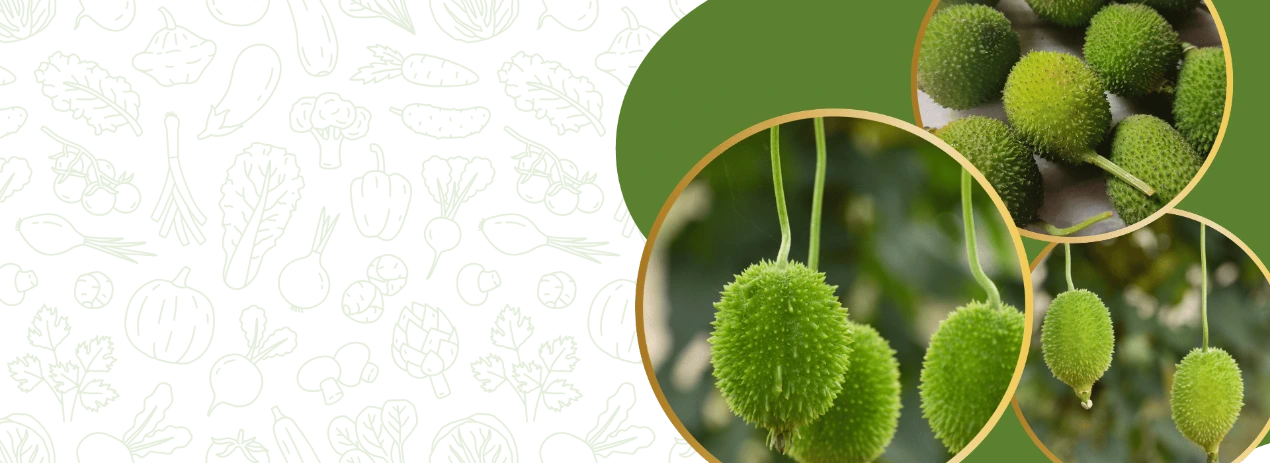
Spine Gourd Varieties
FARMSON BIOTECH Spine Gourd Seeds are selected for vigorous plant growth, quality fruit development, and reliable harvesting performance.
Complete Package of Practices for Spine Gourd Cultivation
Spine gourd is a hardy, warm-season tuberous perennial vine grown for its small, soft-spined green fruit, prized as a seasonal delicacy and valued for its nutrition. It is the most specialised of the gourds: it is dioecious (separate male and female plants), is usually grown from tubers rather than seed, and goes dormant in winter and resprouts from the underground tuber each year, cropping for several seasons. This guide covers full technical practice plus a country-wise climate and planting calendar for farmers worldwide.
Quick Navigation
- 01 Crop Overview & Habit
- 02 Climatic Requirements
- 03 Soil & Field Preparation
- 04 Planting Material: Tubers & Seed
- 05 Planting, Spacing & Sex Ratio
- 06 Trellis Training
- 07 Male & Female Plants, Pollination
- 08 Nutrient Management
- 09 Irrigation & Dormancy Water Care
- 10 Weed, Pruning & Care
- 11 Pest Management
- 12 Disease Management
- 13 Dormancy & Multi-Year Tuber Management
- 14 Harvesting & Post-Harvest
- 15 Country-Wise Climate & Planting Guide
- 16 Frequently Asked Questions
1. Crop Overview & Habit
- Common names: Spine gourd, spiny gourd, teasle gourd, kakrol, kantola
- Scientific name: Momordica dioica
- Crop type: Warm-season, frost-sensitive, tuberous perennial climbing vine
- Identifying feature: small, oval green fruit covered in soft spines; eaten young and tender.
- Habit: dioecious (separate male and female plants); dies back in winter and resprouts from the underground tuber each season, cropping for several years.
- Uses: Seasonal cooking vegetable; valued for its nutrition and traditional health properties.
2. Climatic Requirements
- Temperature: 24–35 °C is ideal; it loves warm, humid conditions and is frost-sensitive.
- Climate: A warm-season and rainy-season crop; the vine naturally goes dormant in the cool, dry winter and resprouts with the return of warmth and rains.
- Soil: Well-drained fertile loam rich in organic matter; pH 6.0–7.0. Good drainage is essential to protect the tuber.
- Rainfall: Thrives in the warm rainy season; the tuber must not sit in waterlogged soil, especially during dormancy.
3. Soil & Field Preparation
- Plough to a fine tilth and ensure excellent drainage, since the tuber is sensitive to waterlogging.
- Dig planting pits and fill with topsoil mixed with well-decomposed FYM / compost.
- Set up a permanent trellis before or at planting, as the crop stays for years.
4. Planting Material: Tubers & Seed
- From tubers (main method): plant healthy tuberous roots — mostly female tubers for fruiting, with a few male tubers for pollination. Tubers establish fast and are true to type (you know the sex), which is why they are preferred.
- From seed (secondary): seed can be used but germinates slowly (hard, dormant seed often needs soaking / scarification) and gives a mix of male and female plants to select from.
- Treat tubers / seed with a fungicide or Trichoderma before planting to prevent rot.
5. Planting, Spacing & Sex Ratio
- Plant at the start of the warm / rainy season into prepared pits; keep soil moist (not wet) until sprouting.
- Spacing: about 1.5–2.0 m between rows and 1.0–2.0 m between plants, along the trellis line.
- Sex ratio: plant mostly female plants with about one male plant for every 9–10 females to ensure pollination of all the fruiting females.
- Train the new shoots up to the trellis as they emerge.
6. Trellis Training
- Grow on a permanent, sturdy trellis or pandal; as a multi-year crop it needs lasting support.
- The trellis keeps the small spiny fruit clean and easy to pick, gives full sun, and improves airflow to reduce disease.
- Spread the vines evenly across the trellis top for the most fruiting surface.
7. Male & Female Plants, Pollination
- Spine gourd is dioecious — only female plants bear fruit, and they need pollen from male plants.
- Keep the planned female-to-male ratio (about 9–10 : 1) so every female has a nearby pollen source.
- Bees do the pollination; encourage them and spray only in the late evening.
- Where pollinators are scarce, hand-pollinate in the morning, transferring pollen from male to female flowers, to boost fruit set.
8. Nutrient Management
As a perennial, spine gourd needs feeding at sprouting and through each fruiting season:
- Apply FYM / compost and a balanced NPK dose at planting and again each year when the vine resprouts.
- Top-dress with nitrogen and potassium during active growth and fruiting.
- Add micronutrients as recommended; drip fertigation suits this long-term crop.
9. Irrigation & Dormancy Water Care
- During active growth and fruiting, keep soil evenly moist; the crop is most productive in the warm, rainy season.
- Critical stages: sprouting, flowering and fruiting.
- During winter dormancy, keep the soil on the dry side — the dormant tuber rots easily in cold, wet soil. Excellent drainage is essential.
- Drip irrigation gives good control of moisture both in season and during dormancy.
10. Weed, Pruning & Care
- Keep the base weed-free; mulch around the pits.
- Train new shoots onto the trellis and thin overcrowded growth for light and airflow.
- Remove old, dried vines at the end of the season as the plant enters dormancy.
11. Plant Protection — Pests
| Pest | Symptom | Management |
|---|---|---|
| Fruit fly | Stings young fruit; maggots; fruit rots and drops | Pheromone / cue-lure traps; bait sprays; collect and destroy fallen fruit |
| Aphids / whitefly | Sap-sucking; spread virus | Sticky traps; need-based control |
| Beetles | Leaf damage | Hand-pick; need-based control |
| Mites | Leaf bronzing and curling | Acaricides as per local recommendation |
12. Plant Protection — Diseases
| Disease | Symptom | Management |
|---|---|---|
| Tuber / root rot (key) | Tuber rots and fails to sprout, especially in wet winter soil | Excellent drainage; keep dormant soil dry; treat tubers before planting |
| Leaf spot | Spots on leaves in wet weather | Airflow; protectant fungicide; field sanitation |
| Powdery mildew | White powdery growth on leaves | Sulphur or recommended fungicide |
| Mosaic virus | Mottled, distorted leaves | Control aphids and whitefly; remove badly affected vines |
13. Dormancy & Multi-Year Tuber Management
- At the end of the warm season the vine naturally dies back and the tuber survives underground in dormancy through the cool, dry months.
- Protect the dormant tuber: keep the soil dry and well-drained — the main cause of losing a plant over winter is the tuber rotting in cold, wet soil.
- When warmth and rains return, the tuber resprouts on its own; top-dress with manure and NPK and resume irrigation to push strong new growth.
- With good dormancy care, the same tubers crop for several years; lift and divide or replace tubers when plants weaken.
14. Harvesting & Post-Harvest
- Fruiting begins in the warm / rainy season once the vine is in active growth.
- Pick fruit young, tender and green, with soft spines, before it matures and the spines and skin harden.
- Pick frequently — every 3–5 days; the plant fruits in flushes, and regular picking keeps it productive.
- Handle gently; grade and pack in ventilated boxes.
- Yield: builds up as the tubers establish over the years, giving good seasonal returns from a long-lived planting.
- Best marketed fresh; it is a valued seasonal speciality.
15. Country-Wise Climate & Planting Guide
Spine gourd is a warm, humid-climate perennial planted at the onset of the warm / rainy season, fruiting in the warm months and resting through cool, dry winters. It is grown mainly across South and Southeast Asia and similar tropical regions. Windows below are indicative — adjust to local conditions.
| Country / Region | Climate | Best planting / season | Dormancy & drainage caution |
|---|---|---|---|
| SOUTH & SOUTHEAST ASIA (main belts) | |||
| India | Tropical / subtropical | Plant at onset of monsoon / warm season (May–Jul); fruits in the rainy season | Keep tubers dry and well-drained through winter dormancy |
| Bangladesh / Nepal | Subtropical / monsoon | Pre-monsoon to early monsoon planting | Protect dormant tubers from waterlogging |
| Pakistan | Subtropical | Warm-season planting | Frost and cold-wet winter harm the tuber |
| SE Asia (Thailand, Myanmar, Indonesia) | Humid tropical | Warm / rainy season | Ensure drainage in heavy rains |
| OTHER WARM / TROPICAL REGIONS | |||
| Tropical Africa | Tropical | Onset of the warm rainy season | Good drainage essential for the tuber |
| Gulf (with irrigation) | Hot arid | Warm season under irrigation | Thrives in heat; protect tuber from over-watering in rest |
| Warm parts of the Americas | Tropical / subtropical | Warm season; grown in Asian-vegetable markets | Frost kills the vine; tuber needs dry, frost-free rest |
| Cool-winter regions | Temperate | Warm season or protected; lift tubers for winter | Tuber will not survive cold, wet or frozen soil outdoors |
16. Frequently Asked Questions
Why is my spine gourd flowering but not fruiting?
Spine gourd is dioecious — only female plants fruit, and they need pollen from male plants. Without enough male plants (about one per 9–10 females) or hand-pollination, the females flower but set little fruit.
Should I grow spine gourd from tubers or seed?
Tubers are the main, reliable method: they establish fast and you know the plant's sex (female for fruit, a few males for pollen). Seed works too but is slow to germinate and gives a mix of male and female plants to select from.
What happens to the plant in winter?
The vine dies back and the tuber goes dormant underground through the cool, dry months, then resprouts when warmth and rains return. Keep the soil dry and well-drained in winter so the tuber does not rot.
How many years does a spine gourd planting last?
Several years from the same tubers, as long as they are brought safely through each dormancy. Top-dress and irrigate when the vine resprouts; replace weak tubers over time.
What ratio of male to female plants do I need?
About one male plant for every 9–10 female plants, so every fruiting female has a nearby pollen source.
When should I harvest spine gourd?
Pick it young, tender and green while the spines are still soft, before the fruit matures and hardens. Harvest every 3–5 days during the fruiting flushes.
What is the biggest cause of losing the crop?
The dormant tuber rotting in cold, wet soil over winter. Excellent drainage and dry dormant-season soil are the key to a plot that resprouts and crops year after year.
Explore More Farmson Crop Guides
Snack Gourd Bitter Gourd Ridge Gourd Sponge Gourd Bottle Gourd View All Vegetable SeedsGrow with Farmson Biotech Spine Gourd Seeds
Quality spine gourd (kakrol / kantola) planting material for tender, soft-spined seasonal fruit.
Send Export InquiryComplete Package of Practices for Spine Gourd Cultivation
Spine gourd is a hardy, warm-season tuberous perennial vine grown for its small, soft-spined green fruit, prized as a seasonal delicacy and valued for its nutrition. It is the most specialised of the gourds: it is dioecious (separate male and female plants), is usually grown from tubers rather than seed, and goes dormant in winter and resprouts from the underground tuber each year, cropping for several seasons. This guide covers full technical practice plus a country-wise climate and planting calendar for farmers worldwide.
Quick Navigation
- 01 Crop Overview & Habit
- 02 Climatic Requirements
- 03 Soil & Field Preparation
- 04 Planting Material: Tubers & Seed
- 05 Planting, Spacing & Sex Ratio
- 06 Trellis Training
- 07 Male & Female Plants, Pollination
- 08 Nutrient Management
- 09 Irrigation & Dormancy Water Care
- 10 Weed, Pruning & Care
- 11 Pest Management
- 12 Disease Management
- 13 Dormancy & Multi-Year Tuber Management
- 14 Harvesting & Post-Harvest
- 15 Country-Wise Climate & Planting Guide
- 16 Frequently Asked Questions
1. Crop Overview & Habit
- Common names: Spine gourd, spiny gourd, teasle gourd, kakrol, kantola
- Scientific name: Momordica dioica
- Crop type: Warm-season, frost-sensitive, tuberous perennial climbing vine
- Identifying feature: small, oval green fruit covered in soft spines; eaten young and tender.
- Habit: dioecious (separate male and female plants); dies back in winter and resprouts from the underground tuber each season, cropping for several years.
- Uses: Seasonal cooking vegetable; valued for its nutrition and traditional health properties.
2. Climatic Requirements
- Temperature: 24–35 °C is ideal; it loves warm, humid conditions and is frost-sensitive.
- Climate: A warm-season and rainy-season crop; the vine naturally goes dormant in the cool, dry winter and resprouts with the return of warmth and rains.
- Soil: Well-drained fertile loam rich in organic matter; pH 6.0–7.0. Good drainage is essential to protect the tuber.
- Rainfall: Thrives in the warm rainy season; the tuber must not sit in waterlogged soil, especially during dormancy.
3. Soil & Field Preparation
- Plough to a fine tilth and ensure excellent drainage, since the tuber is sensitive to waterlogging.
- Dig planting pits and fill with topsoil mixed with well-decomposed FYM / compost.
- Set up a permanent trellis before or at planting, as the crop stays for years.
4. Planting Material: Tubers & Seed
- From tubers (main method): plant healthy tuberous roots — mostly female tubers for fruiting, with a few male tubers for pollination. Tubers establish fast and are true to type (you know the sex), which is why they are preferred.
- From seed (secondary): seed can be used but germinates slowly (hard, dormant seed often needs soaking / scarification) and gives a mix of male and female plants to select from.
- Treat tubers / seed with a fungicide or Trichoderma before planting to prevent rot.
5. Planting, Spacing & Sex Ratio
- Plant at the start of the warm / rainy season into prepared pits; keep soil moist (not wet) until sprouting.
- Spacing: about 1.5–2.0 m between rows and 1.0–2.0 m between plants, along the trellis line.
- Sex ratio: plant mostly female plants with about one male plant for every 9–10 females to ensure pollination of all the fruiting females.
- Train the new shoots up to the trellis as they emerge.
6. Trellis Training
- Grow on a permanent, sturdy trellis or pandal; as a multi-year crop it needs lasting support.
- The trellis keeps the small spiny fruit clean and easy to pick, gives full sun, and improves airflow to reduce disease.
- Spread the vines evenly across the trellis top for the most fruiting surface.
7. Male & Female Plants, Pollination
- Spine gourd is dioecious — only female plants bear fruit, and they need pollen from male plants.
- Keep the planned female-to-male ratio (about 9–10 : 1) so every female has a nearby pollen source.
- Bees do the pollination; encourage them and spray only in the late evening.
- Where pollinators are scarce, hand-pollinate in the morning, transferring pollen from male to female flowers, to boost fruit set.
8. Nutrient Management
As a perennial, spine gourd needs feeding at sprouting and through each fruiting season:
- Apply FYM / compost and a balanced NPK dose at planting and again each year when the vine resprouts.
- Top-dress with nitrogen and potassium during active growth and fruiting.
- Add micronutrients as recommended; drip fertigation suits this long-term crop.
9. Irrigation & Dormancy Water Care
- During active growth and fruiting, keep soil evenly moist; the crop is most productive in the warm, rainy season.
- Critical stages: sprouting, flowering and fruiting.
- During winter dormancy, keep the soil on the dry side — the dormant tuber rots easily in cold, wet soil. Excellent drainage is essential.
- Drip irrigation gives good control of moisture both in season and during dormancy.
10. Weed, Pruning & Care
- Keep the base weed-free; mulch around the pits.
- Train new shoots onto the trellis and thin overcrowded growth for light and airflow.
- Remove old, dried vines at the end of the season as the plant enters dormancy.
11. Plant Protection — Pests
| Pest | Symptom | Management |
|---|---|---|
| Fruit fly | Stings young fruit; maggots; fruit rots and drops | Pheromone / cue-lure traps; bait sprays; collect and destroy fallen fruit |
| Aphids / whitefly | Sap-sucking; spread virus | Sticky traps; need-based control |
| Beetles | Leaf damage | Hand-pick; need-based control |
| Mites | Leaf bronzing and curling | Acaricides as per local recommendation |
12. Plant Protection — Diseases
| Disease | Symptom | Management |
|---|---|---|
| Tuber / root rot (key) | Tuber rots and fails to sprout, especially in wet winter soil | Excellent drainage; keep dormant soil dry; treat tubers before planting |
| Leaf spot | Spots on leaves in wet weather | Airflow; protectant fungicide; field sanitation |
| Powdery mildew | White powdery growth on leaves | Sulphur or recommended fungicide |
| Mosaic virus | Mottled, distorted leaves | Control aphids and whitefly; remove badly affected vines |
13. Dormancy & Multi-Year Tuber Management
- At the end of the warm season the vine naturally dies back and the tuber survives underground in dormancy through the cool, dry months.
- Protect the dormant tuber: keep the soil dry and well-drained — the main cause of losing a plant over winter is the tuber rotting in cold, wet soil.
- When warmth and rains return, the tuber resprouts on its own; top-dress with manure and NPK and resume irrigation to push strong new growth.
- With good dormancy care, the same tubers crop for several years; lift and divide or replace tubers when plants weaken.
14. Harvesting & Post-Harvest
- Fruiting begins in the warm / rainy season once the vine is in active growth.
- Pick fruit young, tender and green, with soft spines, before it matures and the spines and skin harden.
- Pick frequently — every 3–5 days; the plant fruits in flushes, and regular picking keeps it productive.
- Handle gently; grade and pack in ventilated boxes.
- Yield: builds up as the tubers establish over the years, giving good seasonal returns from a long-lived planting.
- Best marketed fresh; it is a valued seasonal speciality.
15. Country-Wise Climate & Planting Guide
Spine gourd is a warm, humid-climate perennial planted at the onset of the warm / rainy season, fruiting in the warm months and resting through cool, dry winters. It is grown mainly across South and Southeast Asia and similar tropical regions. Windows below are indicative — adjust to local conditions.
| Country / Region | Climate | Best planting / season | Dormancy & drainage caution |
|---|---|---|---|
| SOUTH & SOUTHEAST ASIA (main belts) | |||
| India | Tropical / subtropical | Plant at onset of monsoon / warm season (May–Jul); fruits in the rainy season | Keep tubers dry and well-drained through winter dormancy |
| Bangladesh / Nepal | Subtropical / monsoon | Pre-monsoon to early monsoon planting | Protect dormant tubers from waterlogging |
| Pakistan | Subtropical | Warm-season planting | Frost and cold-wet winter harm the tuber |
| SE Asia (Thailand, Myanmar, Indonesia) | Humid tropical | Warm / rainy season | Ensure drainage in heavy rains |
| OTHER WARM / TROPICAL REGIONS | |||
| Tropical Africa | Tropical | Onset of the warm rainy season | Good drainage essential for the tuber |
| Gulf (with irrigation) | Hot arid | Warm season under irrigation | Thrives in heat; protect tuber from over-watering in rest |
| Warm parts of the Americas | Tropical / subtropical | Warm season; grown in Asian-vegetable markets | Frost kills the vine; tuber needs dry, frost-free rest |
| Cool-winter regions | Temperate | Warm season or protected; lift tubers for winter | Tuber will not survive cold, wet or frozen soil outdoors |
16. Frequently Asked Questions
Why is my spine gourd flowering but not fruiting?
Spine gourd is dioecious — only female plants fruit, and they need pollen from male plants. Without enough male plants (about one per 9–10 females) or hand-pollination, the females flower but set little fruit.
Should I grow spine gourd from tubers or seed?
Tubers are the main, reliable method: they establish fast and you know the plant's sex (female for fruit, a few males for pollen). Seed works too but is slow to germinate and gives a mix of male and female plants to select from.
What happens to the plant in winter?
The vine dies back and the tuber goes dormant underground through the cool, dry months, then resprouts when warmth and rains return. Keep the soil dry and well-drained in winter so the tuber does not rot.
How many years does a spine gourd planting last?
Several years from the same tubers, as long as they are brought safely through each dormancy. Top-dress and irrigate when the vine resprouts; replace weak tubers over time.
What ratio of male to female plants do I need?
About one male plant for every 9–10 female plants, so every fruiting female has a nearby pollen source.
When should I harvest spine gourd?
Pick it young, tender and green while the spines are still soft, before the fruit matures and hardens. Harvest every 3–5 days during the fruiting flushes.
What is the biggest cause of losing the crop?
The dormant tuber rotting in cold, wet soil over winter. Excellent drainage and dry dormant-season soil are the key to a plot that resprouts and crops year after year.
Explore More Farmson Crop Guides
Snack Gourd Bitter Gourd Ridge Gourd Sponge Gourd Bottle Gourd View All Vegetable SeedsGrow with Farmson Biotech Spine Gourd Seeds
Quality spine gourd (kakrol / kantola) planting material for tender, soft-spined seasonal fruit.
Send Export InquiryAgricultural Advisory Notice
The recommendations and crop guidance provided on this website are intended for informational purposes only and should not be considered a guaranteed agronomic outcome. Local climatic conditions, soil health, cultivation methods, and regional practices may influence actual crop performance. FARMSON BIOTECH PVT LTD recommends farmers seek guidance from authorized agricultural experts or local government agricultural authorities before cultivation decisions.