F1 Hybrid
Watermelon Seeds
High-performance Watermelon hybrids developed for strong yield potential and excellent fruit quality.
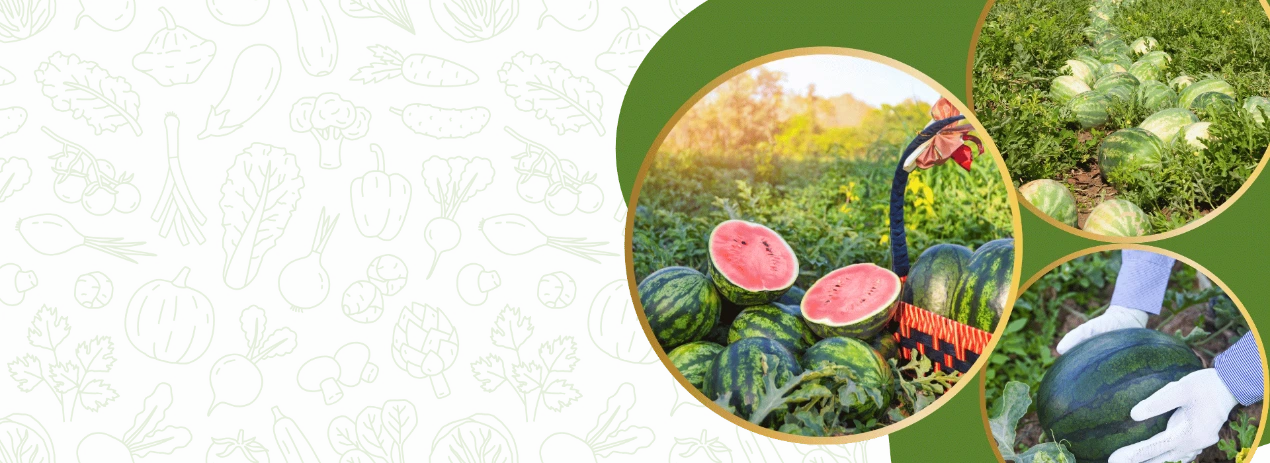
F1 Hybrid Watermelon Varieties
Our Watermelon hybrids are designed for commercial cultivation with strong plant vigor, uniform fruit setting, attractive firmness, and reliable market performance. Suitable for open-field and protected cultivation depending on hybrid selection.
Complete Package of Practices for Watermelon Cultivation
Watermelon is a warm-season, sprawling vine grown for large, sweet, refreshing fruit with strong summer and export demand. The crop is straightforward to grow but profit depends on three things: good pollination and fruit set (seedless types need a seeded pollinizer alongside), building sweetness by managing potassium and easing off water near maturity, and harvesting at the right ripeness — watermelon does not ripen further once picked. This guide covers full technical practice plus a country-wise climate and sowing calendar for farmers worldwide.
Quick Navigation
- 01 Crop Overview & Types
- 02 Climatic Requirements
- 03 Soil & Field Preparation
- 04 Seed Rate & Seed Treatment
- 05 Sowing, Spacing & Thinning
- 06 Pollination & Seedless Pollinizer
- 07 Vine Training & Fruit Care
- 08 Nutrient Management
- 09 Irrigation & Sweetness
- 10 Weed & Intercultural Care
- 11 Pest Management
- 12 Disease Management
- 13 Fruit Disorders
- 14 Ripeness & Harvesting
- 15 Country-Wise Climate & Sowing Guide
- 16 Frequently Asked Questions
1. Crop Overview & Types
- Common names: Watermelon, tarbooj
- Scientific name: Citrullus lanatus
- Crop type: Warm-season, frost-sensitive, sprawling vine
- Types: Large picnic types, small icebox types, and red, yellow or orange flesh; seeded (diploid) and seedless (triploid) varieties.
- Uses: Fresh fruit; some types grown for edible seeds
- Quality traits: sweetness (Brix), flesh colour, crisp texture, rind strength for transport
2. Climatic Requirements
- Temperature: 24–30 °C is ideal; the crop needs a long, warm, sunny season. Germination needs warm soil (about 25–30 °C).
- Climate: Warm, dry weather gives the sweetest fruit; the crop is frost-sensitive and dislikes cold, wet conditions.
- Soil: Well-drained sandy loam is best (warms quickly and drains well); pH 6.0–7.0. Avoid heavy, waterlogged soils.
- Rainfall / humidity: High humidity and rain at fruiting reduce sweetness and increase disease and cracking.
3. Soil & Field Preparation
- Plough to a fine tilth and level the field for good drainage.
- Incorporate 20–25 t/ha of well-decomposed FYM / compost during land preparation.
- Form wide raised beds with channels; raised beds with drip and plastic mulch are ideal — they warm the soil, save water and keep fruit clean.
4. Seed Rate & Seed Treatment
Seed rate
- Hybrid (seeded): 500–800 g/ha
- Open-pollinated varieties: 2.5–3.0 kg/ha
- Seedless (triploid): small, precise quantity — the seed is costly, so it is usually transplanted from pro-trays.
Seed treatment
- Treat seed with Trichoderma viride @ 4 g/kg, or Thiram / Captan @ 2–3 g/kg, to control seed- and soil-borne diseases.
- Seedless seed germinates best with warm temperature and careful, not-too-wet media.
5. Sowing, Spacing & Thinning
- Sow directly by dibbling 2–3 seeds per hill, or transplant pro-tray seedlings (standard for seedless types).
- Spacing: wide — about 1.5–2.0 m between rows and 0.5–1.0 m between plants, as the vines sprawl widely.
- After germination, thin to 1–2 healthy plants per hill.
- Sow into warm, moist soil for quick, even germination.
6. Pollination & Seedless (Triploid) Pollinizer
- Watermelon depends on bees for pollination — good bee activity is essential for fruit set and well-filled fruit.
- Spray pesticides only in the late evening, when bees are inactive, to protect pollinators.
- Seedless (triploid) watermelon cannot pollinate itself — you must plant a seeded (diploid) pollinizer variety alongside (commonly about 1 pollinizer plant for every 2–3 seedless plants) so the seedless fruit sets properly.
7. Vine Training & Fruit Care
- Spread and arrange the trailing vines evenly so they get full sun and do not overlap heavily.
- Place a pad of straw, dry grass or mulch under each developing fruit to prevent ground rot and a large pale ground spot.
- Turn fruit gently once or twice during growth for even colour, and shade exposed fruit (with leaves or straw) to prevent sunburn.
- For premium crops, limit the number of fruit per vine to get larger, sweeter fruit.
8. Nutrient Management (per hectare)
Indicative dose — adjust to soil test report and local recommendation:
| Nutrient | Dose | Application timing |
|---|---|---|
| Nitrogen (N) | 80–100 kg | Half basal; balance in early splits — avoid excess N near fruiting |
| Phosphorus (P2O5) | 50–60 kg | Full basal at planting |
| Potassium (K2O) | 60–100 kg | Basal plus top-dress at fruiting — key for sweetness |
| Micronutrients | As recommended | Support fruit set and quality |
9. Irrigation & Sweetness Management
- Keep soil evenly moist during vining, flowering and early fruit growth — these are the critical stages.
- Reduce irrigation as the fruit nears ripening. This concentrates the sugars and raises the Brix (sweetness); over-watering late dilutes flavour and causes cracking.
- Drip irrigation with mulch gives precise control, saves water and keeps fruit and foliage dry.
- Avoid waterlogging at all stages.
10. Weed & Intercultural Care
- Keep the field weed-free in the early stages, before the vines cover the ground.
- Plastic mulch on beds controls weeds, warms the soil and keeps fruit clean.
- Once vines spread, avoid disturbing or stepping on them.
11. Plant Protection — Pests
| Pest | Symptom | Management |
|---|---|---|
| Fruit fly | Stings young fruit; maggots; fruit rots and drops | Pheromone / cue-lure traps; collect and destroy fallen fruit; bait sprays; evening sprays to protect bees |
| Red pumpkin beetle | Damages seedlings and young leaves | Protect seedlings; collect beetles; need-based control |
| Aphids / whitefly | Sap-sucking; spread mosaic virus | Yellow sticky traps; manage early |
| Thrips / mites | Leaf scarring and bronzing | Need-based control; scout regularly |
12. Plant Protection — Diseases
| Disease | Symptom | Management |
|---|---|---|
| Fusarium wilt (major) | Wilting and yellowing of vines; plant collapse (soil-borne) | Resistant varieties; grafting onto resistant rootstock; long crop rotation; good drainage |
| Downy mildew | Angular yellow patches in humid weather | Airflow; keep foliage dry; preventive fungicide before wet spells |
| Powdery mildew | White powdery growth on leaves | Sulphur or recommended fungicide; resistant varieties |
| Anthracnose / gummy stem blight | Spots on leaves, stems and fruit | Clean seed; crop rotation; protectant fungicide |
| Mosaic virus | Mottled, distorted leaves; poor fruit | Control aphids and whitefly; resistant varieties; rogue out infected plants |
13. Fruit Disorders
- Hollow heart: cracks inside the flesh — linked to uneven growth, poor pollination and temperature swings; keep growth steady.
- Sunburn / sunscald: pale, scalded patch on exposed fruit — keep foliage cover or shade exposed fruit.
- Fruit cracking: from irregular or heavy late irrigation — keep moisture steady and ease off near maturity.
- Poor sweetness: from excess nitrogen, cloudy/cool weather, over-watering late, or harvesting under-ripe.
- Blossom-end rot: sunken patch at the blossom end — from calcium and moisture imbalance.
14. Ripeness & Harvesting
Watermelon does not get sweeter after picking, so harvesting at the right ripeness is the most important skill. Use these signs together:
- Ground spot: the patch where the fruit rests on the soil turns from white to creamy or buttery yellow.
- Tendril: the curly tendril nearest the fruit dries and turns brown.
- Sound: a ripe fruit gives a dull, hollow thump when tapped.
- Surface: the rind becomes dull (not shiny) and hard to scratch with a nail.
- Days from set: typically about 35–45 days after the fruit sets, depending on variety and temperature.
- Cut fruit with a short stalk; do not pull. Handle carefully — bruised fruit does not store or travel well.
- Yield: 25–40 t/ha, depending on variety, season and management.
15. Country-Wise Climate & Sowing Guide
Watermelon needs a long, warm, dry, sunny season and is sown once frost has passed and the soil is warm. Hot, dry conditions at fruiting give the sweetest melons. Windows below are indicative — adjust to local altitude and micro-climate.
| Country / Region | Climate | Best sowing / season | Heat & rain caution |
|---|---|---|---|
| TROPICAL & SUBTROPICAL (main melon belts) | |||
| India | Tropical / subtropical | Summer: Jan–Mar (main, river-bed & field); some autumn | Avoid fruiting in monsoon — rain reduces sweetness and cracks fruit |
| Pakistan / Bangladesh | Subtropical | Spring (Feb–Mar) | Harvest before monsoon |
| Egypt / N. Africa | Arid subtropical | Spring (Feb–Apr) | Hot dry climate is ideal; irrigation-led |
| Gulf (Saudi / UAE) | Hot arid | Oct–Mar / spring | Excellent dry-heat melon climate with irrigation |
| Nigeria / Kenya / E. Africa | Tropical | Dry season with irrigation | Avoid wet-season fruiting |
| SE Asia | Humid tropical | Dry season (Nov–Feb) | Wet season lowers sweetness and raises disease |
| MEDITERRANEAN & WARM TEMPERATE | |||
| Spain / Italy / Turkey | Mediterranean | Spring (Mar–May) | Warm dry summer ripens sweet fruit |
| Mexico | Subtropical (major exporter) | Autumn–winter and spring windows | Major winter exporter to the USA |
| TEMPERATE (warm summer crop) | |||
| USA (south & west) | Warm temperate | Late spring–summer once soil is warm | Needs a long, hot, frost-free season |
| China | Warm temperate to subtropical (top producer) | Spring; protected for early crops | Avoid summer-rain fruiting in the south |
| N. Europe | Cool temperate | Greenhouse / poly-tunnel only | Open field rarely warm enough |
16. Frequently Asked Questions
How do I know when a watermelon is ripe?
Use several signs together: the ground spot turns creamy yellow, the tendril nearest the fruit dries and browns, the fruit gives a dull hollow thump, the rind turns dull, and it is usually about 35–45 days after the fruit set. Watermelon does not ripen after picking, so judge it well.
Why is my watermelon not sweet?
Common causes are too much nitrogen, over-watering near maturity, cool or cloudy weather, or picking under-ripe. Use potassium at fruiting, ease off water as the fruit ripens, and harvest at full maturity. Aim for about 10–12 Brix.
Do seedless watermelons need a pollinizer?
Yes. Seedless (triploid) watermelon cannot set fruit on its own — you must plant a seeded (diploid) pollinizer variety alongside, with active bees, or the crop will not set proper fruit.
What soil is best for watermelon?
Well-drained sandy loam at pH 6.0–7.0. Sandy soils warm quickly and drain well, which watermelon likes; avoid heavy, waterlogged soils.
How much watermelon seed is needed per hectare?
About 500–800 g/ha for seeded hybrids and 2.5–3.0 kg/ha for open-pollinated varieties. Seedless types use a small, precise quantity and are usually transplanted.
Why does the fruit have a pale patch or rot underneath?
That is the ground spot or ground rot from resting on wet soil. Place straw or mulch under each fruit and turn it gently during growth.
What yield can I expect from watermelon?
About 25–40 t/ha, depending on variety, season, spacing and management.
Explore More Farmson Crop Guides
Cucumber Muskmelon Bitter Gourd Bottle Gourd Tomato Cultivation View All Vegetable SeedsGrow with Farmson Biotech Watermelon Seeds
High-Brix F1 hybrid watermelon varieties — seeded & seedless, icebox & large fruit.
Send Export InquiryComplete Package of Practices for Watermelon Cultivation
Watermelon is a warm-season, sprawling vine grown for large, sweet, refreshing fruit with strong summer and export demand. The crop is straightforward to grow but profit depends on three things: good pollination and fruit set (seedless types need a seeded pollinizer alongside), building sweetness by managing potassium and easing off water near maturity, and harvesting at the right ripeness — watermelon does not ripen further once picked. This guide covers full technical practice plus a country-wise climate and sowing calendar for farmers worldwide.
Quick Navigation
- 01 Crop Overview & Types
- 02 Climatic Requirements
- 03 Soil & Field Preparation
- 04 Seed Rate & Seed Treatment
- 05 Sowing, Spacing & Thinning
- 06 Pollination & Seedless Pollinizer
- 07 Vine Training & Fruit Care
- 08 Nutrient Management
- 09 Irrigation & Sweetness
- 10 Weed & Intercultural Care
- 11 Pest Management
- 12 Disease Management
- 13 Fruit Disorders
- 14 Ripeness & Harvesting
- 15 Country-Wise Climate & Sowing Guide
- 16 Frequently Asked Questions
1. Crop Overview & Types
- Common names: Watermelon, tarbooj
- Scientific name: Citrullus lanatus
- Crop type: Warm-season, frost-sensitive, sprawling vine
- Types: Large picnic types, small icebox types, and red, yellow or orange flesh; seeded (diploid) and seedless (triploid) varieties.
- Uses: Fresh fruit; some types grown for edible seeds
- Quality traits: sweetness (Brix), flesh colour, crisp texture, rind strength for transport
2. Climatic Requirements
- Temperature: 24–30 °C is ideal; the crop needs a long, warm, sunny season. Germination needs warm soil (about 25–30 °C).
- Climate: Warm, dry weather gives the sweetest fruit; the crop is frost-sensitive and dislikes cold, wet conditions.
- Soil: Well-drained sandy loam is best (warms quickly and drains well); pH 6.0–7.0. Avoid heavy, waterlogged soils.
- Rainfall / humidity: High humidity and rain at fruiting reduce sweetness and increase disease and cracking.
3. Soil & Field Preparation
- Plough to a fine tilth and level the field for good drainage.
- Incorporate 20–25 t/ha of well-decomposed FYM / compost during land preparation.
- Form wide raised beds with channels; raised beds with drip and plastic mulch are ideal — they warm the soil, save water and keep fruit clean.
4. Seed Rate & Seed Treatment
Seed rate
- Hybrid (seeded): 500–800 g/ha
- Open-pollinated varieties: 2.5–3.0 kg/ha
- Seedless (triploid): small, precise quantity — the seed is costly, so it is usually transplanted from pro-trays.
Seed treatment
- Treat seed with Trichoderma viride @ 4 g/kg, or Thiram / Captan @ 2–3 g/kg, to control seed- and soil-borne diseases.
- Seedless seed germinates best with warm temperature and careful, not-too-wet media.
5. Sowing, Spacing & Thinning
- Sow directly by dibbling 2–3 seeds per hill, or transplant pro-tray seedlings (standard for seedless types).
- Spacing: wide — about 1.5–2.0 m between rows and 0.5–1.0 m between plants, as the vines sprawl widely.
- After germination, thin to 1–2 healthy plants per hill.
- Sow into warm, moist soil for quick, even germination.
6. Pollination & Seedless (Triploid) Pollinizer
- Watermelon depends on bees for pollination — good bee activity is essential for fruit set and well-filled fruit.
- Spray pesticides only in the late evening, when bees are inactive, to protect pollinators.
- Seedless (triploid) watermelon cannot pollinate itself — you must plant a seeded (diploid) pollinizer variety alongside (commonly about 1 pollinizer plant for every 2–3 seedless plants) so the seedless fruit sets properly.
7. Vine Training & Fruit Care
- Spread and arrange the trailing vines evenly so they get full sun and do not overlap heavily.
- Place a pad of straw, dry grass or mulch under each developing fruit to prevent ground rot and a large pale ground spot.
- Turn fruit gently once or twice during growth for even colour, and shade exposed fruit (with leaves or straw) to prevent sunburn.
- For premium crops, limit the number of fruit per vine to get larger, sweeter fruit.
8. Nutrient Management (per hectare)
Indicative dose — adjust to soil test report and local recommendation:
| Nutrient | Dose | Application timing |
|---|---|---|
| Nitrogen (N) | 80–100 kg | Half basal; balance in early splits — avoid excess N near fruiting |
| Phosphorus (P2O5) | 50–60 kg | Full basal at planting |
| Potassium (K2O) | 60–100 kg | Basal plus top-dress at fruiting — key for sweetness |
| Micronutrients | As recommended | Support fruit set and quality |
9. Irrigation & Sweetness Management
- Keep soil evenly moist during vining, flowering and early fruit growth — these are the critical stages.
- Reduce irrigation as the fruit nears ripening. This concentrates the sugars and raises the Brix (sweetness); over-watering late dilutes flavour and causes cracking.
- Drip irrigation with mulch gives precise control, saves water and keeps fruit and foliage dry.
- Avoid waterlogging at all stages.
10. Weed & Intercultural Care
- Keep the field weed-free in the early stages, before the vines cover the ground.
- Plastic mulch on beds controls weeds, warms the soil and keeps fruit clean.
- Once vines spread, avoid disturbing or stepping on them.
11. Plant Protection — Pests
| Pest | Symptom | Management |
|---|---|---|
| Fruit fly | Stings young fruit; maggots; fruit rots and drops | Pheromone / cue-lure traps; collect and destroy fallen fruit; bait sprays; evening sprays to protect bees |
| Red pumpkin beetle | Damages seedlings and young leaves | Protect seedlings; collect beetles; need-based control |
| Aphids / whitefly | Sap-sucking; spread mosaic virus | Yellow sticky traps; manage early |
| Thrips / mites | Leaf scarring and bronzing | Need-based control; scout regularly |
12. Plant Protection — Diseases
| Disease | Symptom | Management |
|---|---|---|
| Fusarium wilt (major) | Wilting and yellowing of vines; plant collapse (soil-borne) | Resistant varieties; grafting onto resistant rootstock; long crop rotation; good drainage |
| Downy mildew | Angular yellow patches in humid weather | Airflow; keep foliage dry; preventive fungicide before wet spells |
| Powdery mildew | White powdery growth on leaves | Sulphur or recommended fungicide; resistant varieties |
| Anthracnose / gummy stem blight | Spots on leaves, stems and fruit | Clean seed; crop rotation; protectant fungicide |
| Mosaic virus | Mottled, distorted leaves; poor fruit | Control aphids and whitefly; resistant varieties; rogue out infected plants |
13. Fruit Disorders
- Hollow heart: cracks inside the flesh — linked to uneven growth, poor pollination and temperature swings; keep growth steady.
- Sunburn / sunscald: pale, scalded patch on exposed fruit — keep foliage cover or shade exposed fruit.
- Fruit cracking: from irregular or heavy late irrigation — keep moisture steady and ease off near maturity.
- Poor sweetness: from excess nitrogen, cloudy/cool weather, over-watering late, or harvesting under-ripe.
- Blossom-end rot: sunken patch at the blossom end — from calcium and moisture imbalance.
14. Ripeness & Harvesting
Watermelon does not get sweeter after picking, so harvesting at the right ripeness is the most important skill. Use these signs together:
- Ground spot: the patch where the fruit rests on the soil turns from white to creamy or buttery yellow.
- Tendril: the curly tendril nearest the fruit dries and turns brown.
- Sound: a ripe fruit gives a dull, hollow thump when tapped.
- Surface: the rind becomes dull (not shiny) and hard to scratch with a nail.
- Days from set: typically about 35–45 days after the fruit sets, depending on variety and temperature.
- Cut fruit with a short stalk; do not pull. Handle carefully — bruised fruit does not store or travel well.
- Yield: 25–40 t/ha, depending on variety, season and management.
15. Country-Wise Climate & Sowing Guide
Watermelon needs a long, warm, dry, sunny season and is sown once frost has passed and the soil is warm. Hot, dry conditions at fruiting give the sweetest melons. Windows below are indicative — adjust to local altitude and micro-climate.
| Country / Region | Climate | Best sowing / season | Heat & rain caution |
|---|---|---|---|
| TROPICAL & SUBTROPICAL (main melon belts) | |||
| India | Tropical / subtropical | Summer: Jan–Mar (main, river-bed & field); some autumn | Avoid fruiting in monsoon — rain reduces sweetness and cracks fruit |
| Pakistan / Bangladesh | Subtropical | Spring (Feb–Mar) | Harvest before monsoon |
| Egypt / N. Africa | Arid subtropical | Spring (Feb–Apr) | Hot dry climate is ideal; irrigation-led |
| Gulf (Saudi / UAE) | Hot arid | Oct–Mar / spring | Excellent dry-heat melon climate with irrigation |
| Nigeria / Kenya / E. Africa | Tropical | Dry season with irrigation | Avoid wet-season fruiting |
| SE Asia | Humid tropical | Dry season (Nov–Feb) | Wet season lowers sweetness and raises disease |
| MEDITERRANEAN & WARM TEMPERATE | |||
| Spain / Italy / Turkey | Mediterranean | Spring (Mar–May) | Warm dry summer ripens sweet fruit |
| Mexico | Subtropical (major exporter) | Autumn–winter and spring windows | Major winter exporter to the USA |
| TEMPERATE (warm summer crop) | |||
| USA (south & west) | Warm temperate | Late spring–summer once soil is warm | Needs a long, hot, frost-free season |
| China | Warm temperate to subtropical (top producer) | Spring; protected for early crops | Avoid summer-rain fruiting in the south |
| N. Europe | Cool temperate | Greenhouse / poly-tunnel only | Open field rarely warm enough |
16. Frequently Asked Questions
How do I know when a watermelon is ripe?
Use several signs together: the ground spot turns creamy yellow, the tendril nearest the fruit dries and browns, the fruit gives a dull hollow thump, the rind turns dull, and it is usually about 35–45 days after the fruit set. Watermelon does not ripen after picking, so judge it well.
Why is my watermelon not sweet?
Common causes are too much nitrogen, over-watering near maturity, cool or cloudy weather, or picking under-ripe. Use potassium at fruiting, ease off water as the fruit ripens, and harvest at full maturity. Aim for about 10–12 Brix.
Do seedless watermelons need a pollinizer?
Yes. Seedless (triploid) watermelon cannot set fruit on its own — you must plant a seeded (diploid) pollinizer variety alongside, with active bees, or the crop will not set proper fruit.
What soil is best for watermelon?
Well-drained sandy loam at pH 6.0–7.0. Sandy soils warm quickly and drain well, which watermelon likes; avoid heavy, waterlogged soils.
How much watermelon seed is needed per hectare?
About 500–800 g/ha for seeded hybrids and 2.5–3.0 kg/ha for open-pollinated varieties. Seedless types use a small, precise quantity and are usually transplanted.
Why does the fruit have a pale patch or rot underneath?
That is the ground spot or ground rot from resting on wet soil. Place straw or mulch under each fruit and turn it gently during growth.
What yield can I expect from watermelon?
About 25–40 t/ha, depending on variety, season, spacing and management.
Explore More Farmson Crop Guides
Cucumber Muskmelon Bitter Gourd Bottle Gourd Tomato Cultivation View All Vegetable SeedsGrow with Farmson Biotech Watermelon Seeds
High-Brix F1 hybrid watermelon varieties — seeded & seedless, icebox & large fruit.
Send Export InquiryAgricultural Advisory Notice
The recommendations and crop guidance provided on this website are intended for informational purposes only and should not be considered a guaranteed agronomic outcome. Local climatic conditions, soil health, cultivation methods, and regional practices may influence actual crop performance. FARMSON BIOTECH PVT LTD recommends farmers seek guidance from authorized agricultural experts or local government agricultural authorities before cultivation decisions.