Premium Peas Seeds
High-quality pea varieties suitable for uniform pod production and commercial cultivation.
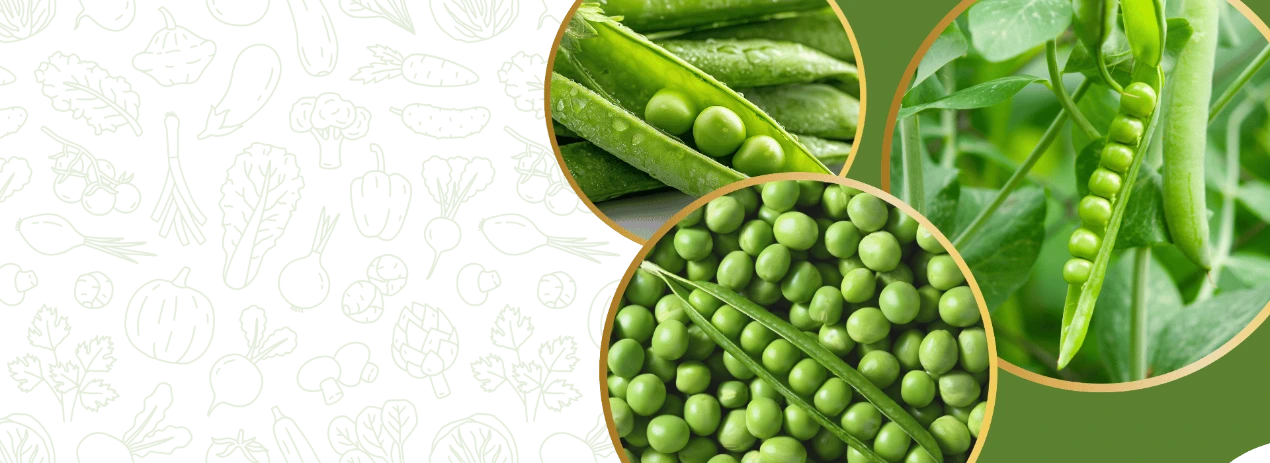
Peas Varieties
FARMSON BIOTECH Pea Seeds are selected for strong plant growth, quality pods, and excellent field adaptability under proper crop management.
Complete Package of Practices for Peas Cultivation
Peas are one of the oldest and most widely grown vegetable legumes, valued for tender sweet green seed (garden pea), crisp edible pod (snap pea) and flat tender pod (snow pea / mangetout). It is a cool-season legume, with all three types belonging to the same species, and success depends on scheduling the crop into the cool window, using Rhizobium seed inoculation for natural nitrogen, providing light tendril support for taller types, and protecting against powdery mildew, pea leaf miner and the root-rot complex. This guide covers complete technical practice from sowing to harvest, plus a country-wise climate and sowing calendar for farmers worldwide.
Quick Navigation
- 01 Crop Overview
- 02 Climatic Requirements
- 03 Soil & Field Preparation
- 04 Sowing & Crop Establishment
- 05 Seed Rate & Seed Treatment
- 06 Spacing & Plant Population
- 07 Trellising & Support
- 08 Nutrient Management
- 09 Irrigation
- 10 Weed & Intercultural Care
- 11 Pest Management
- 12 Disease Management
- 13 Physiological Disorders
- 14 Harvesting & Post-Harvest
- 15 Country-Wise Climate & Sowing Guide
- 16 Frequently Asked Questions
1. Crop Overview
- Common names: Pea, garden pea, matar, vatana, mangetout
- Scientific name: Pisum sativum L.
- Crop type: Cool-season annual legume; frost-tolerant when young; self-pollinated; climbs by tendrils
- End-use types (same species):
- Garden pea / shelling pea / matar — seed eaten; pod is fibrous and discarded; harvested when seeds are well-filled but still tender and sweet
- Snap pea / sugar snap — whole pod and seed eaten; crunchy edible pod with fully developed seeds
- Snow pea / sugar pod / mangetout — flat edible pod harvested before seeds bulge; eaten whole
- Dry / field pea — left to mature for dry grain / split pea / pulse use
- Growth habit: dwarf (30–60 cm, no support), semi-dwarf (60–100 cm, light support helpful) or tall climbing (1.5–2.0 m, must be supported)
- Nutritional value: Rich in protein, fibre, vitamins A, C and K, folate and minerals (especially iron and magnesium)
- Pollination: Strictly self-pollinated; cross-pollination is rare
2. Climatic Requirements
- Temperature: Optimum 13–18 °C; tolerates light frost when young (down to −2 °C briefly); growth slows above 24 °C; pod set fails above 27 °C.
- Heat is the limiting factor — once daytime temperature crosses about 27 °C, flowers drop, peas inside go starchy, and pods become tough.
- Daylength: Quantitative long-day plant — flowering accelerates as days lengthen, but most modern varieties are well-adapted to the chosen season.
- Rainfall: 400–600 mm over the cropping season; sensitive to waterlogging.
- Altitude: Sea level to 3500 m. In the tropics, hill stations crop year-round; in the plains, only the cool rabi (winter) window works.
- Sunshine: Needs full sun — partial shade reduces flowering and pod set.
3. Soil & Field Preparation
- Soil: Well-drained sandy loam to clay loam rich in organic matter; pH 6.0–7.5 (slightly more tolerant of alkaline soils than beans).
- Avoid heavy clay (poor drainage and root rot), saline soils and strongly acidic (<5.5) soils — the Rhizobium symbiosis is weak outside the optimum pH band.
- Plough 2–3 times to a fine tilth and level the field.
- Incorporate 10–15 t/ha well-decomposed FYM or compost at the last ploughing.
- Form ridges or raised beds 15–20 cm high in irrigated systems; ensure free drainage at all times.
- Do not grow peas continuously in the same field — rotate with cereals every 3–4 years to break root-rot and nematode cycles.
4. Sowing & Crop Establishment
- Peas are direct-sown; no nursery is needed.
- Sowing depth: 3–5 cm. Deeper sowing in light dry soil, shallower in heavy or moist soil.
- Method: Dibbling, seed-drill or precision planter; plant 1–2 seeds per hill at the correct spacing.
- Soil moisture: Adequate moisture at sowing is essential — a pre-sowing irrigation 3–4 days before planting gives the best stand.
- Germination: 6–10 days at soil temperature 15–20 °C; slower and patchier below 10 °C.
- For staggered supply, sow in batches at 10–15 day intervals so that the harvest window extends over months — especially useful for fresh-market growers.
5. Seed Rate & Seed Treatment
Seed rate
- Dwarf garden pea: 80–100 kg/ha
- Tall / climbing garden pea: 30–40 kg/ha (wider spacing)
- Snap pea / snow pea: 60–80 kg/ha
- Dry / field pea: 75–100 kg/ha
Seed treatment
- Treat seed with Trichoderma viride @ 4 g/kg or Thiram / Captan @ 2–3 g/kg to control seed rot, damping-off and the root-rot complex.
- Rhizobium inoculation: Inoculate with Rhizobium leguminosarum @ 5–10 g/kg seed just before sowing. This builds nitrogen-fixing nodules and reduces N fertilizer need.
- Add PSB (phosphate-solubilizing bacteria) @ 5 g/kg seed for better phosphorus availability.
- Treat with fungicide first, dry the seed, then inoculate with Rhizobium. Never mix the two in the same step.
- In fields where peas haven't been grown for several years, inoculation is especially important — native rhizobia may be absent.
6. Spacing & Plant Population
| Type | Spacing | Plant population (per ha) | Notes |
|---|---|---|---|
| Dwarf garden pea | 30 × 7–10 cm | 3.0–4.0 lakh | Dense planting on flat beds; no support needed |
| Semi-dwarf garden pea | 30–45 × 10 cm | 2.5–3.0 lakh | Light brushwood support helps |
| Tall / climbing pea | 60–75 × 15–20 cm | 0.8–1.0 lakh | Trellis or pea netting essential |
| Snap / snow pea (tall) | 60 × 15 cm | 1.0–1.2 lakh | Continuous picking over 6–8 weeks |
| Dry / field pea | 30 × 10 cm | 3.5–4.0 lakh | Drilled in rows; left to dry on plant |
- Thin to one plant per hill 10–12 days after emergence.
- Fill gaps within the first week to maintain stand uniformity.
7. Trellising & Support
Peas climb by tendrils, not by twining, so they need a fine, branched or netted support — not the stout poles used for beans. Light support is enough for semi-dwarf types; tall types must have a proper trellis.
- Dwarf types: need no support; plants stand by themselves and lean on each other in dense rows.
- Semi-dwarf types: push twigs / brushwood 50–60 cm tall into the row, or run two strings along the row at 30 and 60 cm height.
- Tall / climbing types: install a pea-netting trellis or wire-and-string trellis 1.5–2.0 m tall, supported by stakes every 3–4 m. Pea netting (10–15 cm mesh) is the standard for commercial growers — cheap, light, reusable.
- Install the support before the crop reaches 15 cm so tendrils latch on early; help the first few tendrils onto the net if needed.
- For greenhouse and net-house cropping, run vertical strings from an overhead wire down to the base of each plant; clip plants up as they grow.
8. Nutrient Management (per hectare)
Indicative dose — adjust to soil test report and local recommendation. Peas fix their own nitrogen, so the N dose is deliberately low:
| Nutrient | Dose | Application timing |
|---|---|---|
| Nitrogen (N) | 25–40 kg | Full basal as a "starter" dose; top-dress only if growth is pale |
| Phosphorus (P2O5) | 60–80 kg | Full basal at sowing — critical for root, nodulation and pod set |
| Potassium (K2O) | 40–60 kg | Full basal; improves pod fill and sweetness |
| Sulphur (S) | 20–30 kg | Basal; supports protein synthesis in seed |
| Manganese (Mn) | As recommended | Foliar spray of 0.2% MnSO4 if "marsh spot" (brown internal seed spot) is a known problem |
| Boron (B) | 0.5–1.0 kg as borax | Basal; reduces hollow heart and flower drop |
| Molybdenum (Mo) | As per soil test | Improves Rhizobium nodulation, especially in acidic soils |
9. Irrigation
- Peas are sensitive to both drought and waterlogging. Maintain even soil moisture, especially at flowering and pod-fill.
- Critical stages: flowering (30–45 DAS) and pod-fill (50–65 DAS). Stress here directly cuts yield and seed weight.
- In the rabi / winter crop: 3–4 irrigations are typically sufficient — at branching, flowering, pod formation and pod-fill.
- Avoid overhead irrigation during flowering — wet flowers drop and wet foliage encourages powdery mildew (counter-intuitively, dry warm air also encourages it) and Ascochyta blight.
- Drip irrigation with mulch on raised beds is ideal — gives even moisture, saves water, and reduces leaf wetness disease.
- Stop irrigation 7–10 days before the last harvest of garden pea / dry pea to help the crop dry down; snap and snow pea types are picked over a long period and need continued moisture.
10. Weed & Intercultural Care
- Keep the field weed-free for the first 30–40 days — this is the most critical period for weed competition in a slow-growing cool-season crop.
- One or two shallow hand-weedings (at 20 and 35–40 DAS) plus inter-row hoeing are usually sufficient.
- Earthing-up at 25–30 days strengthens the base and improves root growth — especially important for dwarf bush types carrying pods.
- Pre-emergence herbicide (e.g. pendimethalin 1.0 kg a.i./ha) can be used as per local recommendation in large-scale plantings.
- Avoid deep cultivation — pea roots and surface nodules damage easily.
11. Plant Protection — Pests
| Pest | Symptom | Management |
|---|---|---|
| Pea leaf miner (Phytomyza horticola) | Serpentine white mines on leaves; serious defoliation | Yellow sticky traps; remove and destroy affected leaves; need-based sprays at early infestation |
| Pea pod borer (Etiella zinckenella, Helicoverpa) | Larvae bore into pods and feed on developing seed | Pheromone traps; HaNPV @ 250 LE/ha; NSKE 5%; need-based sprays at bud and pod stage |
| Pea aphid (Acyrthosiphon pisum) | Colonies on growing tips and pods; honeydew; virus spread (PEMV, BYMV) | Yellow sticky traps; neem oil 1500 ppm; control vector early to prevent virus |
| Stem fly | Wilting of seedlings; tunnels in stem base | Seed treatment; foliar spray at seedling stage; remove crop residue |
| Thrips | Silvering, distortion of leaves and flowers | Blue sticky traps; need-based sprays; avoid during flowering |
| Cutworm | Cuts young seedlings at the soil line | Pre-sowing soil drench; clean field bunds; light traps |
| Pea weevil (Bruchus pisorum) | Holes in stored grain (a major dry-pea problem) | Clean threshing and dry storage at <9% moisture; airtight containers; phosphine fumigation in commercial stores |
12. Plant Protection — Diseases
| Disease | Symptom | Management |
|---|---|---|
| Powdery mildew (Erysiphe pisi) | White powdery patches on upper leaves, then stems and pods — the signature pea disease | Resistant varieties (er-resistance gene); sulphur dust or wettable sulphur; carbendazim / hexaconazole; early sowing to escape late-season infection |
| Downy mildew (Peronospora pisi) | Yellow patches on upper leaf; greyish growth below in cool wet weather | Disease-free seed; metalaxyl + mancozeb sprays; resistant varieties |
| Root rot complex (Fusarium, Pythium, Aphanomyces) | Yellowing, wilting; brown, decayed roots and stem base | Crop rotation (3–4 years); raised beds with drainage; seed treatment with Trichoderma; resistant varieties |
| Ascochyta blight (Ascochyta pisi) | Brown sunken lesions on leaves, stems and pods | Disease-free seed; crop rotation; mancozeb / chlorothalonil sprays; field sanitation |
| Rust (Uromyces pisi) | Reddish-brown pustules on underside of leaves | Resistant varieties; propiconazole; field sanitation |
| White mould (Sclerotinia sclerotiorum) | Cottony white growth and water-soaked rot in cool wet weather | Crop rotation; avoid dense canopy; Trichoderma soil application; carbendazim sprays at flowering if humid |
| Pea enation mosaic virus (PEMV) / Bean yellow mosaic virus (BYMV) | Mosaic, leaf distortion, "windowed" pods, stunting | Resistant varieties; aphid control; rogue out infected plants early |
13. Physiological Disorders
- Flower and young-pod drop: the most common pea complaint — caused by daytime temperature above 27 °C, moisture stress, or strong dry wind at flowering. Schedule flowering into the coolest window of the season.
- Hollow heart: a cavity inside the seed, especially in large-seeded shelling and dry peas — linked to boron deficiency, very rapid pod-fill, and water stress. Apply boron basally and keep moisture even.
- Marsh spot: a brown discoloured spot inside the seed — the classic manganese deficiency disorder of peas, especially on alkaline soils. Spray 0.2% MnSO4 at flowering and at pod-fill.
- Pod splitting: sudden moisture after a dry spell, common in late-irrigated peas — keep watering steady.
- Yellow / starchy seed: over-mature picking, or harvest in too much heat — pick at the right stage and harvest early in the morning.
- Poor nodulation: a pale, yellow crop in spite of good agronomy — caused by no Rhizobium inoculation, low molybdenum, very acidic soil, or carry-over herbicide. Inoculate with Rhizobium and correct soil pH.
14. Harvesting & Post-Harvest
Picking stage (different for each end-use)
- Garden pea (shelling): pods well-filled, bright green, the seeds inside tender and sweet; pods should be plump but not waxy or yellowing. First pick at 55–75 days.
- Snap pea (sugar snap): pods plump, crisp and bright green, with fully formed seeds inside; eat or pick before pods start to lose colour.
- Snow pea (mangetout): flat pods, fully elongated but still tender, picked before the seeds inside bulge; over-mature snow peas turn stringy.
- Dry / field pea: leave on the plant until pods and seeds turn brown and rattle, then harvest the whole crop in one cut.
Picking interval
- Every 2–3 days for fresh market / export; every 4–5 days for local market.
- Pick in the cool morning to preserve sweetness; sugars convert to starch within hours of picking, especially in warm weather.
- Grade by length, colour and shape; pack in ventilated crates or perforated cartons.
Yield
- Garden pea (green pod): 8–12 t/ha (up to 15 t/ha with the best hybrids and management)
- Snap pea / snow pea: 5–10 t/ha
- Dry / field pea: 1.5–2.5 t/ha grain
Storage
- Fresh green peas keep 5–7 days at 0–4 °C and 95% RH; cool quickly after harvest because the sugar-to-starch loss is rapid at room temperature.
- For processing (freezing, canning), peas should reach the factory within hours of picking for best quality.
- Dry peas: store at 9% moisture or below in clean, airtight bins; protect from pea weevil.
15. Country-Wise Climate & Sowing Guide
Peas need a cool window of 13–18 °C with frost-tolerant young growth and pod set before daytime temperatures cross 27 °C. Schedule sowing so flowering falls in the coolest part of your season. Windows below are indicative — adjust to local altitude and micro-climate.
| Country / Region | Climate | Best sowing / season | Heat & rain caution |
|---|---|---|---|
| TROPICAL & SUBTROPICAL (grow only in the cool, dry season) | |||
| India (plains) | Subtropical | Rabi: Oct–Nov — flowering in Dec–Jan, picking through Jan–Mar | Late sowing pushes flowering into Feb–Mar heat — yield collapses |
| India (hills) | Temperate | Mar–Aug (Himachal, Uttarakhand, Nilgiris, Kashmir) — main off-season window for the plains markets | Frost in late autumn ends the crop |
| Pakistan / Bangladesh / Nepal | Subtropical | Oct–Nov (plains); summer crop in hills | Heat in late spring; avoid pod-fill into warm weather |
| Sri Lanka / Indonesia / Philippines | Humid tropical | Cool dry season; mid-elevation areas (1000–1500 m) year-round | Lowland tropics too hot; powdery mildew in dry highland season |
| Gulf (Saudi / UAE / Oman) | Hot arid | Oct–Feb (cool season only) | Summer impossible in open field; protected niche cultivation |
| AFRICA (highland export belts to EU) | |||
| Kenya / Ethiopia | Tropical (highland) | Year-round at 1800–2500 m altitude — major EU export of snow and snap pea | Rainy-season disease pressure; maintain residue compliance |
| Uganda / Tanzania | Tropical (altitude-dependent) | Long rains (Mar–May) and short rains (Sep–Nov) | Avoid pod-fill in heaviest rains |
| Egypt / Morocco | Arid subtropical / Mediterranean | Sep–Feb (winter crop); important EU export window | Drip irrigation essential; manage cool-night frost |
| South Africa / Zimbabwe | Subtropical | Autumn (Feb–Apr) and spring (Aug–Sep) | Avoid mid-summer heat at flowering |
| MEDITERRANEAN & MILD TEMPERATE | |||
| Spain / Italy / Greece | Mediterranean | Autumn (Oct–Nov) and early spring (Feb–Mar) | Manage summer heat with timing; greenhouse extends shoulders |
| Turkey / Iran | Mediterranean / semi-arid | Oct–Nov (autumn) and Feb–Mar (spring) | Frost risk in winter; heat at mid-spring flowering |
| Mexico / Central America | Subtropical / tropical | Autumn–winter (export window to USA) | Avoid summer-rain flowering |
| TEMPERATE (main world producers) | |||
| Canada | Temperate continental | Apr–May, harvest Aug–Sep — world's largest dry-pea exporter (Saskatchewan, Alberta) | One summer cycle per year; manage Ascochyta blight |
| China | Wide range | Spring in the north; autumn in the south — world's largest pea producer | Avoid summer-rain flowering in the south |
| Russia / Ukraine | Temperate continental | Apr–May (spring crop) | One cycle; manage frost at sowing |
| UK / Netherlands / Northern Europe | Cool temperate | Feb–Apr (succession sowings); main fresh and processing crop | Short season; cool summers ideal for pea quality |
| France / Germany / Poland | Temperate | Mar–May | Major processing and dry-pea producers |
| USA | Wide range | Spring (north, Wisconsin / Pacific NW); autumn–winter (California / South) | Match to frost-free window; powdery mildew in late season |
| Australia / New Zealand | Wide range | Autumn (Mar–May, south) and winter (north); spring in the high country | Match to cool window; manage Ascochyta |
16. Frequently Asked Questions
What is the difference between garden pea, snap pea and snow pea?
All three are the same species (Pisum sativum) harvested at different stages and for different end-uses. Garden pea (shelling pea / matar) is grown for the tender sweet seed inside; the pod is fibrous and discarded. Snap pea (sugar snap) is eaten whole, pod and seed, with crunchy fully-developed seeds. Snow pea (mangetout / sugar pod) is eaten as a flat tender pod, harvested before the seeds bulge inside.
Why are my pea flowers and young pods dropping?
The most common cause is heat — pea pod-set fails above about 27 °C. Moisture stress and strong dry winds at flowering also cause drop. Schedule sowing so that flowering falls in the cool 13–18 °C window, keep soil moisture even, and choose heat-tolerant varieties in warmer climates.
How much pea seed is needed per hectare?
About 80–100 kg/ha for dwarf garden pea, 30–40 kg/ha for tall climbing types, 60–80 kg/ha for snap and snow peas, and 75–100 kg/ha for dry / field pea.
How do I control powdery mildew in peas?
Powdery mildew is the signature pea disease, especially in late-season crops when nights cool and days are still dry. Use resistant varieties (those carrying the er gene); sow early so that the crop matures before mildew pressure builds; spray sulphur dust or wettable sulphur at the first sign, or use carbendazim / hexaconazole; and remove dense interior growth to improve airflow.
Do peas need staking?
It depends on type. Dwarf garden peas need no support and stand by themselves. Semi-dwarf types benefit from light brushwood or string support. Tall climbing types must have a proper trellis or pea netting 1.5–2.0 m high to climb on — without it, yield drops sharply and pods get diseased on the ground.
How much nitrogen do peas need?
Only a small starter dose of 25–40 kg N/ha. Peas are legumes and fix their own nitrogen through nodulation with Rhizobium leguminosarum, especially when inoculated. Too much N gives lush vine and few pods. Apply phosphorus and potassium fully — that is what drives yield in peas.
What is "marsh spot" in peas?
A brown discoloured spot inside the seed, especially in large-seeded shelling and dry peas. It is the classic manganese deficiency disorder, particularly on alkaline or limey soils. Apply 0.2% manganese sulphate as a foliar spray at flowering and again at pod-fill.
When should I harvest peas?
Garden peas: when pods are plump and bright green and the seeds inside are tender and sweet — before they go waxy or starchy. Snap peas: when pods are crisp and fully filled. Snow peas: when pods are fully elongated but flat, before seeds bulge. Dry peas: when pods and seeds turn brown and rattle on the plant. Pick fresh peas in the cool morning — sugars convert to starch within hours.
Explore More Farmson Crop Guides
Beans Cultivation Sunflower Sweet Corn Moringa Tomato Cultivation View All Vegetable SeedsGrow with Farmson Biotech Pea Seeds
High-yielding garden, snap, snow and dry pea varieties for fresh-market, export, processing and pulse use.
Send Export InquiryComplete Package of Practices for Peas Cultivation
Peas are one of the oldest and most widely grown vegetable legumes, valued for tender sweet green seed (garden pea), crisp edible pod (snap pea) and flat tender pod (snow pea / mangetout). It is a cool-season legume, with all three types belonging to the same species, and success depends on scheduling the crop into the cool window, using Rhizobium seed inoculation for natural nitrogen, providing light tendril support for taller types, and protecting against powdery mildew, pea leaf miner and the root-rot complex. This guide covers complete technical practice from sowing to harvest, plus a country-wise climate and sowing calendar for farmers worldwide.
Quick Navigation
- 01 Crop Overview
- 02 Climatic Requirements
- 03 Soil & Field Preparation
- 04 Sowing & Crop Establishment
- 05 Seed Rate & Seed Treatment
- 06 Spacing & Plant Population
- 07 Trellising & Support
- 08 Nutrient Management
- 09 Irrigation
- 10 Weed & Intercultural Care
- 11 Pest Management
- 12 Disease Management
- 13 Physiological Disorders
- 14 Harvesting & Post-Harvest
- 15 Country-Wise Climate & Sowing Guide
- 16 Frequently Asked Questions
1. Crop Overview
- Common names: Pea, garden pea, matar, vatana, mangetout
- Scientific name: Pisum sativum L.
- Crop type: Cool-season annual legume; frost-tolerant when young; self-pollinated; climbs by tendrils
- End-use types (same species):
- Garden pea / shelling pea / matar — seed eaten; pod is fibrous and discarded; harvested when seeds are well-filled but still tender and sweet
- Snap pea / sugar snap — whole pod and seed eaten; crunchy edible pod with fully developed seeds
- Snow pea / sugar pod / mangetout — flat edible pod harvested before seeds bulge; eaten whole
- Dry / field pea — left to mature for dry grain / split pea / pulse use
- Growth habit: dwarf (30–60 cm, no support), semi-dwarf (60–100 cm, light support helpful) or tall climbing (1.5–2.0 m, must be supported)
- Nutritional value: Rich in protein, fibre, vitamins A, C and K, folate and minerals (especially iron and magnesium)
- Pollination: Strictly self-pollinated; cross-pollination is rare
2. Climatic Requirements
- Temperature: Optimum 13–18 °C; tolerates light frost when young (down to −2 °C briefly); growth slows above 24 °C; pod set fails above 27 °C.
- Heat is the limiting factor — once daytime temperature crosses about 27 °C, flowers drop, peas inside go starchy, and pods become tough.
- Daylength: Quantitative long-day plant — flowering accelerates as days lengthen, but most modern varieties are well-adapted to the chosen season.
- Rainfall: 400–600 mm over the cropping season; sensitive to waterlogging.
- Altitude: Sea level to 3500 m. In the tropics, hill stations crop year-round; in the plains, only the cool rabi (winter) window works.
- Sunshine: Needs full sun — partial shade reduces flowering and pod set.
3. Soil & Field Preparation
- Soil: Well-drained sandy loam to clay loam rich in organic matter; pH 6.0–7.5 (slightly more tolerant of alkaline soils than beans).
- Avoid heavy clay (poor drainage and root rot), saline soils and strongly acidic (<5.5) soils — the Rhizobium symbiosis is weak outside the optimum pH band.
- Plough 2–3 times to a fine tilth and level the field.
- Incorporate 10–15 t/ha well-decomposed FYM or compost at the last ploughing.
- Form ridges or raised beds 15–20 cm high in irrigated systems; ensure free drainage at all times.
- Do not grow peas continuously in the same field — rotate with cereals every 3–4 years to break root-rot and nematode cycles.
4. Sowing & Crop Establishment
- Peas are direct-sown; no nursery is needed.
- Sowing depth: 3–5 cm. Deeper sowing in light dry soil, shallower in heavy or moist soil.
- Method: Dibbling, seed-drill or precision planter; plant 1–2 seeds per hill at the correct spacing.
- Soil moisture: Adequate moisture at sowing is essential — a pre-sowing irrigation 3–4 days before planting gives the best stand.
- Germination: 6–10 days at soil temperature 15–20 °C; slower and patchier below 10 °C.
- For staggered supply, sow in batches at 10–15 day intervals so that the harvest window extends over months — especially useful for fresh-market growers.
5. Seed Rate & Seed Treatment
Seed rate
- Dwarf garden pea: 80–100 kg/ha
- Tall / climbing garden pea: 30–40 kg/ha (wider spacing)
- Snap pea / snow pea: 60–80 kg/ha
- Dry / field pea: 75–100 kg/ha
Seed treatment
- Treat seed with Trichoderma viride @ 4 g/kg or Thiram / Captan @ 2–3 g/kg to control seed rot, damping-off and the root-rot complex.
- Rhizobium inoculation: Inoculate with Rhizobium leguminosarum @ 5–10 g/kg seed just before sowing. This builds nitrogen-fixing nodules and reduces N fertilizer need.
- Add PSB (phosphate-solubilizing bacteria) @ 5 g/kg seed for better phosphorus availability.
- Treat with fungicide first, dry the seed, then inoculate with Rhizobium. Never mix the two in the same step.
- In fields where peas haven't been grown for several years, inoculation is especially important — native rhizobia may be absent.
6. Spacing & Plant Population
| Type | Spacing | Plant population (per ha) | Notes |
|---|---|---|---|
| Dwarf garden pea | 30 × 7–10 cm | 3.0–4.0 lakh | Dense planting on flat beds; no support needed |
| Semi-dwarf garden pea | 30–45 × 10 cm | 2.5–3.0 lakh | Light brushwood support helps |
| Tall / climbing pea | 60–75 × 15–20 cm | 0.8–1.0 lakh | Trellis or pea netting essential |
| Snap / snow pea (tall) | 60 × 15 cm | 1.0–1.2 lakh | Continuous picking over 6–8 weeks |
| Dry / field pea | 30 × 10 cm | 3.5–4.0 lakh | Drilled in rows; left to dry on plant |
- Thin to one plant per hill 10–12 days after emergence.
- Fill gaps within the first week to maintain stand uniformity.
7. Trellising & Support
Peas climb by tendrils, not by twining, so they need a fine, branched or netted support — not the stout poles used for beans. Light support is enough for semi-dwarf types; tall types must have a proper trellis.
- Dwarf types: need no support; plants stand by themselves and lean on each other in dense rows.
- Semi-dwarf types: push twigs / brushwood 50–60 cm tall into the row, or run two strings along the row at 30 and 60 cm height.
- Tall / climbing types: install a pea-netting trellis or wire-and-string trellis 1.5–2.0 m tall, supported by stakes every 3–4 m. Pea netting (10–15 cm mesh) is the standard for commercial growers — cheap, light, reusable.
- Install the support before the crop reaches 15 cm so tendrils latch on early; help the first few tendrils onto the net if needed.
- For greenhouse and net-house cropping, run vertical strings from an overhead wire down to the base of each plant; clip plants up as they grow.
8. Nutrient Management (per hectare)
Indicative dose — adjust to soil test report and local recommendation. Peas fix their own nitrogen, so the N dose is deliberately low:
| Nutrient | Dose | Application timing |
|---|---|---|
| Nitrogen (N) | 25–40 kg | Full basal as a "starter" dose; top-dress only if growth is pale |
| Phosphorus (P2O5) | 60–80 kg | Full basal at sowing — critical for root, nodulation and pod set |
| Potassium (K2O) | 40–60 kg | Full basal; improves pod fill and sweetness |
| Sulphur (S) | 20–30 kg | Basal; supports protein synthesis in seed |
| Manganese (Mn) | As recommended | Foliar spray of 0.2% MnSO4 if "marsh spot" (brown internal seed spot) is a known problem |
| Boron (B) | 0.5–1.0 kg as borax | Basal; reduces hollow heart and flower drop |
| Molybdenum (Mo) | As per soil test | Improves Rhizobium nodulation, especially in acidic soils |
9. Irrigation
- Peas are sensitive to both drought and waterlogging. Maintain even soil moisture, especially at flowering and pod-fill.
- Critical stages: flowering (30–45 DAS) and pod-fill (50–65 DAS). Stress here directly cuts yield and seed weight.
- In the rabi / winter crop: 3–4 irrigations are typically sufficient — at branching, flowering, pod formation and pod-fill.
- Avoid overhead irrigation during flowering — wet flowers drop and wet foliage encourages powdery mildew (counter-intuitively, dry warm air also encourages it) and Ascochyta blight.
- Drip irrigation with mulch on raised beds is ideal — gives even moisture, saves water, and reduces leaf wetness disease.
- Stop irrigation 7–10 days before the last harvest of garden pea / dry pea to help the crop dry down; snap and snow pea types are picked over a long period and need continued moisture.
10. Weed & Intercultural Care
- Keep the field weed-free for the first 30–40 days — this is the most critical period for weed competition in a slow-growing cool-season crop.
- One or two shallow hand-weedings (at 20 and 35–40 DAS) plus inter-row hoeing are usually sufficient.
- Earthing-up at 25–30 days strengthens the base and improves root growth — especially important for dwarf bush types carrying pods.
- Pre-emergence herbicide (e.g. pendimethalin 1.0 kg a.i./ha) can be used as per local recommendation in large-scale plantings.
- Avoid deep cultivation — pea roots and surface nodules damage easily.
11. Plant Protection — Pests
| Pest | Symptom | Management |
|---|---|---|
| Pea leaf miner (Phytomyza horticola) | Serpentine white mines on leaves; serious defoliation | Yellow sticky traps; remove and destroy affected leaves; need-based sprays at early infestation |
| Pea pod borer (Etiella zinckenella, Helicoverpa) | Larvae bore into pods and feed on developing seed | Pheromone traps; HaNPV @ 250 LE/ha; NSKE 5%; need-based sprays at bud and pod stage |
| Pea aphid (Acyrthosiphon pisum) | Colonies on growing tips and pods; honeydew; virus spread (PEMV, BYMV) | Yellow sticky traps; neem oil 1500 ppm; control vector early to prevent virus |
| Stem fly | Wilting of seedlings; tunnels in stem base | Seed treatment; foliar spray at seedling stage; remove crop residue |
| Thrips | Silvering, distortion of leaves and flowers | Blue sticky traps; need-based sprays; avoid during flowering |
| Cutworm | Cuts young seedlings at the soil line | Pre-sowing soil drench; clean field bunds; light traps |
| Pea weevil (Bruchus pisorum) | Holes in stored grain (a major dry-pea problem) | Clean threshing and dry storage at <9% moisture; airtight containers; phosphine fumigation in commercial stores |
12. Plant Protection — Diseases
| Disease | Symptom | Management |
|---|---|---|
| Powdery mildew (Erysiphe pisi) | White powdery patches on upper leaves, then stems and pods — the signature pea disease | Resistant varieties (er-resistance gene); sulphur dust or wettable sulphur; carbendazim / hexaconazole; early sowing to escape late-season infection |
| Downy mildew (Peronospora pisi) | Yellow patches on upper leaf; greyish growth below in cool wet weather | Disease-free seed; metalaxyl + mancozeb sprays; resistant varieties |
| Root rot complex (Fusarium, Pythium, Aphanomyces) | Yellowing, wilting; brown, decayed roots and stem base | Crop rotation (3–4 years); raised beds with drainage; seed treatment with Trichoderma; resistant varieties |
| Ascochyta blight (Ascochyta pisi) | Brown sunken lesions on leaves, stems and pods | Disease-free seed; crop rotation; mancozeb / chlorothalonil sprays; field sanitation |
| Rust (Uromyces pisi) | Reddish-brown pustules on underside of leaves | Resistant varieties; propiconazole; field sanitation |
| White mould (Sclerotinia sclerotiorum) | Cottony white growth and water-soaked rot in cool wet weather | Crop rotation; avoid dense canopy; Trichoderma soil application; carbendazim sprays at flowering if humid |
| Pea enation mosaic virus (PEMV) / Bean yellow mosaic virus (BYMV) | Mosaic, leaf distortion, "windowed" pods, stunting | Resistant varieties; aphid control; rogue out infected plants early |
13. Physiological Disorders
- Flower and young-pod drop: the most common pea complaint — caused by daytime temperature above 27 °C, moisture stress, or strong dry wind at flowering. Schedule flowering into the coolest window of the season.
- Hollow heart: a cavity inside the seed, especially in large-seeded shelling and dry peas — linked to boron deficiency, very rapid pod-fill, and water stress. Apply boron basally and keep moisture even.
- Marsh spot: a brown discoloured spot inside the seed — the classic manganese deficiency disorder of peas, especially on alkaline soils. Spray 0.2% MnSO4 at flowering and at pod-fill.
- Pod splitting: sudden moisture after a dry spell, common in late-irrigated peas — keep watering steady.
- Yellow / starchy seed: over-mature picking, or harvest in too much heat — pick at the right stage and harvest early in the morning.
- Poor nodulation: a pale, yellow crop in spite of good agronomy — caused by no Rhizobium inoculation, low molybdenum, very acidic soil, or carry-over herbicide. Inoculate with Rhizobium and correct soil pH.
14. Harvesting & Post-Harvest
Picking stage (different for each end-use)
- Garden pea (shelling): pods well-filled, bright green, the seeds inside tender and sweet; pods should be plump but not waxy or yellowing. First pick at 55–75 days.
- Snap pea (sugar snap): pods plump, crisp and bright green, with fully formed seeds inside; eat or pick before pods start to lose colour.
- Snow pea (mangetout): flat pods, fully elongated but still tender, picked before the seeds inside bulge; over-mature snow peas turn stringy.
- Dry / field pea: leave on the plant until pods and seeds turn brown and rattle, then harvest the whole crop in one cut.
Picking interval
- Every 2–3 days for fresh market / export; every 4–5 days for local market.
- Pick in the cool morning to preserve sweetness; sugars convert to starch within hours of picking, especially in warm weather.
- Grade by length, colour and shape; pack in ventilated crates or perforated cartons.
Yield
- Garden pea (green pod): 8–12 t/ha (up to 15 t/ha with the best hybrids and management)
- Snap pea / snow pea: 5–10 t/ha
- Dry / field pea: 1.5–2.5 t/ha grain
Storage
- Fresh green peas keep 5–7 days at 0–4 °C and 95% RH; cool quickly after harvest because the sugar-to-starch loss is rapid at room temperature.
- For processing (freezing, canning), peas should reach the factory within hours of picking for best quality.
- Dry peas: store at 9% moisture or below in clean, airtight bins; protect from pea weevil.
15. Country-Wise Climate & Sowing Guide
Peas need a cool window of 13–18 °C with frost-tolerant young growth and pod set before daytime temperatures cross 27 °C. Schedule sowing so flowering falls in the coolest part of your season. Windows below are indicative — adjust to local altitude and micro-climate.
| Country / Region | Climate | Best sowing / season | Heat & rain caution |
|---|---|---|---|
| TROPICAL & SUBTROPICAL (grow only in the cool, dry season) | |||
| India (plains) | Subtropical | Rabi: Oct–Nov — flowering in Dec–Jan, picking through Jan–Mar | Late sowing pushes flowering into Feb–Mar heat — yield collapses |
| India (hills) | Temperate | Mar–Aug (Himachal, Uttarakhand, Nilgiris, Kashmir) — main off-season window for the plains markets | Frost in late autumn ends the crop |
| Pakistan / Bangladesh / Nepal | Subtropical | Oct–Nov (plains); summer crop in hills | Heat in late spring; avoid pod-fill into warm weather |
| Sri Lanka / Indonesia / Philippines | Humid tropical | Cool dry season; mid-elevation areas (1000–1500 m) year-round | Lowland tropics too hot; powdery mildew in dry highland season |
| Gulf (Saudi / UAE / Oman) | Hot arid | Oct–Feb (cool season only) | Summer impossible in open field; protected niche cultivation |
| AFRICA (highland export belts to EU) | |||
| Kenya / Ethiopia | Tropical (highland) | Year-round at 1800–2500 m altitude — major EU export of snow and snap pea | Rainy-season disease pressure; maintain residue compliance |
| Uganda / Tanzania | Tropical (altitude-dependent) | Long rains (Mar–May) and short rains (Sep–Nov) | Avoid pod-fill in heaviest rains |
| Egypt / Morocco | Arid subtropical / Mediterranean | Sep–Feb (winter crop); important EU export window | Drip irrigation essential; manage cool-night frost |
| South Africa / Zimbabwe | Subtropical | Autumn (Feb–Apr) and spring (Aug–Sep) | Avoid mid-summer heat at flowering |
| MEDITERRANEAN & MILD TEMPERATE | |||
| Spain / Italy / Greece | Mediterranean | Autumn (Oct–Nov) and early spring (Feb–Mar) | Manage summer heat with timing; greenhouse extends shoulders |
| Turkey / Iran | Mediterranean / semi-arid | Oct–Nov (autumn) and Feb–Mar (spring) | Frost risk in winter; heat at mid-spring flowering |
| Mexico / Central America | Subtropical / tropical | Autumn–winter (export window to USA) | Avoid summer-rain flowering |
| TEMPERATE (main world producers) | |||
| Canada | Temperate continental | Apr–May, harvest Aug–Sep — world's largest dry-pea exporter (Saskatchewan, Alberta) | One summer cycle per year; manage Ascochyta blight |
| China | Wide range | Spring in the north; autumn in the south — world's largest pea producer | Avoid summer-rain flowering in the south |
| Russia / Ukraine | Temperate continental | Apr–May (spring crop) | One cycle; manage frost at sowing |
| UK / Netherlands / Northern Europe | Cool temperate | Feb–Apr (succession sowings); main fresh and processing crop | Short season; cool summers ideal for pea quality |
| France / Germany / Poland | Temperate | Mar–May | Major processing and dry-pea producers |
| USA | Wide range | Spring (north, Wisconsin / Pacific NW); autumn–winter (California / South) | Match to frost-free window; powdery mildew in late season |
| Australia / New Zealand | Wide range | Autumn (Mar–May, south) and winter (north); spring in the high country | Match to cool window; manage Ascochyta |
16. Frequently Asked Questions
What is the difference between garden pea, snap pea and snow pea?
All three are the same species (Pisum sativum) harvested at different stages and for different end-uses. Garden pea (shelling pea / matar) is grown for the tender sweet seed inside; the pod is fibrous and discarded. Snap pea (sugar snap) is eaten whole, pod and seed, with crunchy fully-developed seeds. Snow pea (mangetout / sugar pod) is eaten as a flat tender pod, harvested before the seeds bulge inside.
Why are my pea flowers and young pods dropping?
The most common cause is heat — pea pod-set fails above about 27 °C. Moisture stress and strong dry winds at flowering also cause drop. Schedule sowing so that flowering falls in the cool 13–18 °C window, keep soil moisture even, and choose heat-tolerant varieties in warmer climates.
How much pea seed is needed per hectare?
About 80–100 kg/ha for dwarf garden pea, 30–40 kg/ha for tall climbing types, 60–80 kg/ha for snap and snow peas, and 75–100 kg/ha for dry / field pea.
How do I control powdery mildew in peas?
Powdery mildew is the signature pea disease, especially in late-season crops when nights cool and days are still dry. Use resistant varieties (those carrying the er gene); sow early so that the crop matures before mildew pressure builds; spray sulphur dust or wettable sulphur at the first sign, or use carbendazim / hexaconazole; and remove dense interior growth to improve airflow.
Do peas need staking?
It depends on type. Dwarf garden peas need no support and stand by themselves. Semi-dwarf types benefit from light brushwood or string support. Tall climbing types must have a proper trellis or pea netting 1.5–2.0 m high to climb on — without it, yield drops sharply and pods get diseased on the ground.
How much nitrogen do peas need?
Only a small starter dose of 25–40 kg N/ha. Peas are legumes and fix their own nitrogen through nodulation with Rhizobium leguminosarum, especially when inoculated. Too much N gives lush vine and few pods. Apply phosphorus and potassium fully — that is what drives yield in peas.
What is "marsh spot" in peas?
A brown discoloured spot inside the seed, especially in large-seeded shelling and dry peas. It is the classic manganese deficiency disorder, particularly on alkaline or limey soils. Apply 0.2% manganese sulphate as a foliar spray at flowering and again at pod-fill.
When should I harvest peas?
Garden peas: when pods are plump and bright green and the seeds inside are tender and sweet — before they go waxy or starchy. Snap peas: when pods are crisp and fully filled. Snow peas: when pods are fully elongated but flat, before seeds bulge. Dry peas: when pods and seeds turn brown and rattle on the plant. Pick fresh peas in the cool morning — sugars convert to starch within hours.
Explore More Farmson Crop Guides
Beans Cultivation Sunflower Sweet Corn Moringa Tomato Cultivation View All Vegetable SeedsGrow with Farmson Biotech Pea Seeds
High-yielding garden, snap, snow and dry pea varieties for fresh-market, export, processing and pulse use.
Send Export InquiryAgricultural Advisory Notice
The recommendations and crop guidance provided on this website are intended for informational purposes only and should not be considered a guaranteed agronomic outcome. Local climatic conditions, soil health, cultivation methods, and regional practices may influence actual crop performance. FARMSON BIOTECH PVT LTD recommends farmers seek guidance from authorized agricultural experts or local government agricultural authorities before cultivation decisions.