In India, diverse crops are cultivated based on soil type and weather conditions. The adoption of fertilizers has considerably increased over the years, driven by diverse cropping patterns and rising nutrient demand. Every crop needs fertilizer for healthy growth, as it feeds it all the essential nutrients.
India used 601 lakh metric tonnes of fertilizers in 2023–24 (FAI), highlighting how essential they are for sustaining crop productivity. Fertilizers help restore soil nutrients that are lost due to continuous cropping and unpredictable weather.
What Are Fertilizers?
In Indian crops, fertilizers act as growth boosters. After application, fertilizers release nutrients into the soil, and roots absorb these nutrients based on soil moisture and fertilizer type. The fertilizer then supplies nutrients to all parts of the plant.
Nitrogen, phosphorus, and potassium are the three primary macronutrients in fertilizers (NPK). Each plays a specific role in crop growth:
- Nitrogen — keeps leaves greener and more alive
- Phosphorus — enhances strong root development
- Potassium — strengthens the stem and improves grain quality
- Generally, these nutrients work together to improve metabolic functions and boost faster growth. To achieve a healthy yield, soil and crops need a fair balance — that's why choosing the right type of fertilizer is essential for every Indian farm.
Importance of Fertilizers in Agriculture
For Indian farmers, horticulturists, gardeners, and all growers, understanding the importance of fertilizers in plant growth is vital. Supplying fertilizers to crops makes a big difference across our diverse soils and climates. Fertilizers supply nutrients that soil alone cannot provide — the right type promotes yield and replenishes soil fertility, since fertilizer use without organic matter depletes the soil over time.
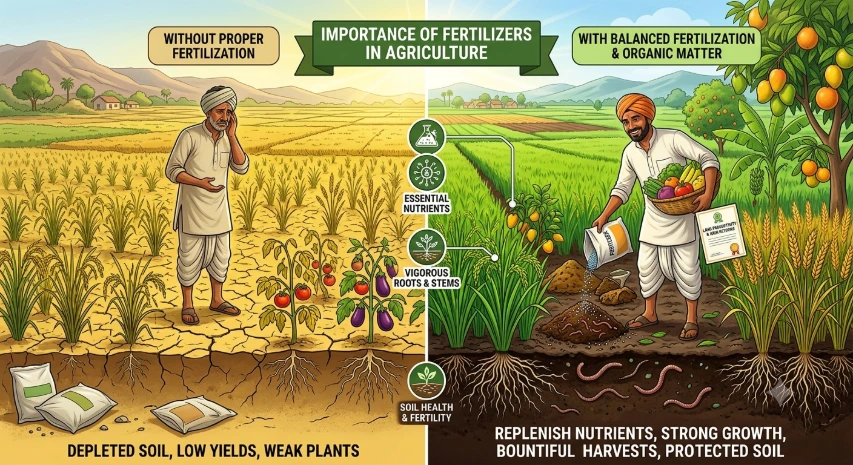
Key benefits of supplying fertilizers to crops:
- Replenish the soil with essential nutrients after continuous cropping, so soil regains health and yields better
- Support vigorous roots, stronger stems, and healthy fruit
- Protect the soil, keep the land productive for future cultivation, and maximize returns
Types of Fertilizers Used in Agricultur
Based on Source
Organic Fertilizers
- Organic fertilizers come from natural sources such as plant and animal matter. They release nutrients slowly as microorganisms break them down, which improves soil structure and long-term fertility.
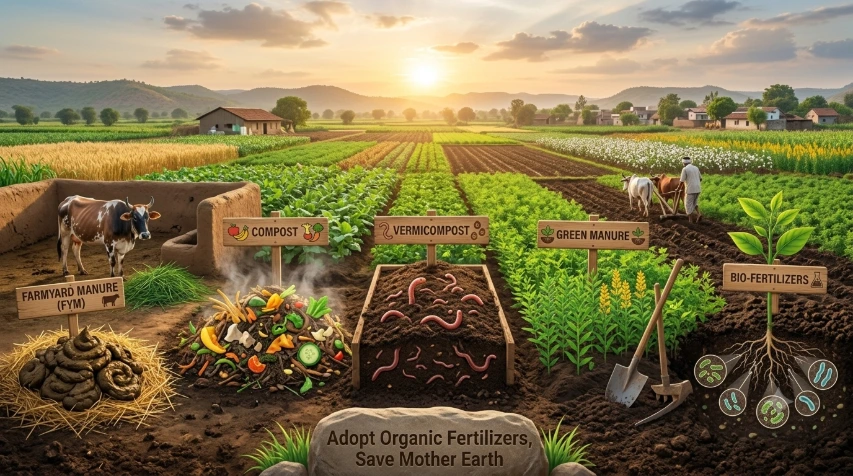
- Farmyard Manure (FYM): A mix of cattle dung, urine, and bedding material, rich in organic matter and micronutrients
- Compost: Decomposed organic waste (crop residue, kitchen waste, green matter) that improves soil texture and water retention
- Vermicompost: Produced using earthworms; nutrient-rich and improves soil microbial activity
- Green Manure: Crops like dhaincha or sunhemp grown and ploughed back into the soil to add nitrogen and organic matter
- Bio-fertilizers: Living microorganisms (e.g., Rhizobium, Azotobacter, phosphate-solubilizing bacteria) that help fix nitrogen or make nutrients more available to plants
Inorganic (Chemical) Fertilizers
- These are manufactured industrially and provide nutrients in concentrated, readily available form. They act faster than organic fertilizers but don't improve soil structure in the same way.
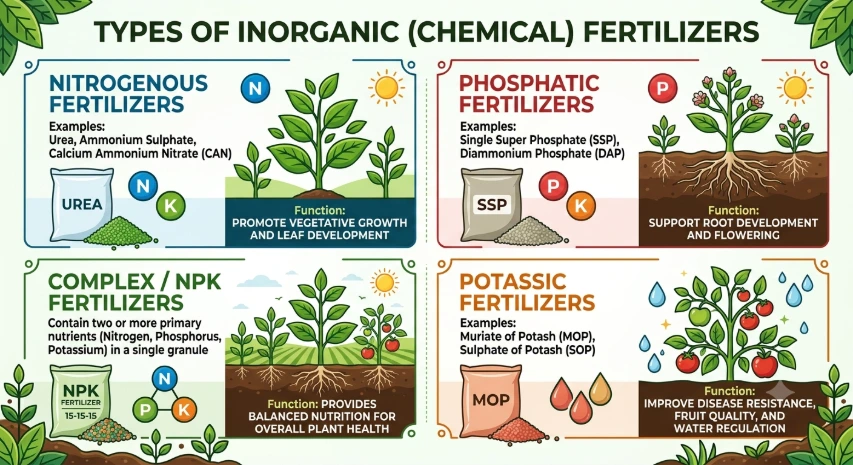
- Nitrogenous Fertilizers: Urea, Ammonium Sulphate, Calcium Ammonium Nitrate (CAN) — promote vegetative growth and leaf development
- Phosphatic Fertilizers: Single Super Phosphate (SSP), Diammonium Phosphate (DAP) — support root development and flowering
- Potassic Fertilizers: Muriate of Potash (MOP), Sulphate of Potash (SOP) — improve disease resistance, fruit quality, and water regulation
- Complex/NPK Fertilizers: Contain two or more primary nutrients (Nitrogen, Phosphorus, Potassium) in a single granule.
Based on Nutrient Content
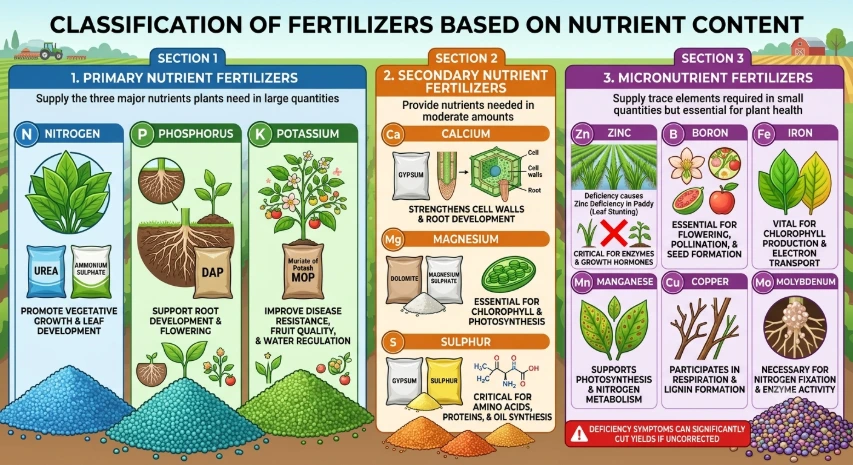
- Primary Nutrient Fertilizers: Supply the three major nutrients plants need in large quantities — Nitrogen (N), Phosphorus (P), and Potassium (K)
- Secondary Nutrient Fertilizers: Provide nutrients needed in moderate amounts — Calcium, Magnesium, and Sulphur — often added through gypsum, dolomite, or magnesium sulphate
- Micronutrient Fertilizers: Supply trace elements required in small quantities but essential for plant health — Zinc, Boron, Iron, Manganese, Copper, and Molybdenum. Deficiency symptoms (like zinc deficiency in paddy) can significantly cut yields if left uncorrected
Based on Physical Form
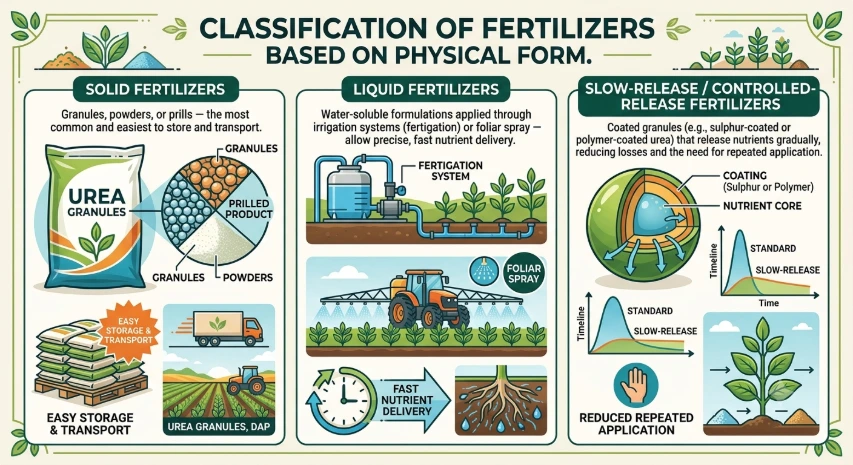
- Solid Fertilizers: Granules, powders, or prills — the most common and easiest to store and transport (e.g., urea granules, DAP)
- Liquid Fertilizers: Water-soluble formulations applied through irrigation systems (fertigation) or foliar spray — allow precise, fast nutrient delivery
- Slow-Release/Controlled-Release Fertilizers: Coated granules (e.g., sulphur-coated or polymer-coated urea) that release nutrients gradually, reducing losses and the need for repeated application.
Based on Method of Application
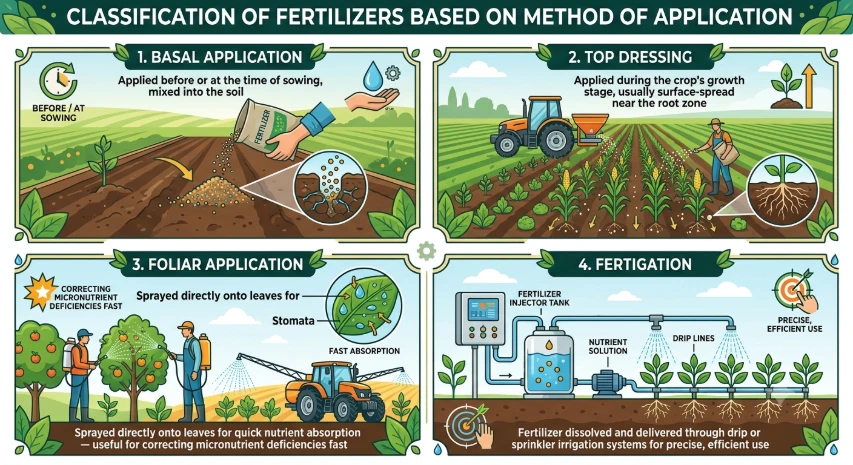
- Basal Application: Applied before or at the time of sowing, mixed into the soil
- Top Dressing: Applied during the crop's growth stage, usually surface-spread near the root zone
- Foliar Application: Sprayed directly onto leaves for quick nutrient absorption — useful for correcting micronutrient deficiencies fast
- Fertigation: Fertilizer dissolved and delivered through drip or sprinkler irrigation systems for precise, efficient use.
Choosing the Right Fertilizer
The right choice depends on several factors:
- Soil test results — knowing existing nutrient levels avoids over- or under-application
- Crop type and growth stage — different crops and stages need different nutrient ratios
- Soil type — sandy soils leach nutrients faster than clay soils
- Cost and availability — balancing input cost against expected yield benefit
Conclusion
No single fertilizer type fits every situation. Most successful farming operations use a combination — organic fertilizers to build long-term soil health, and inorganic fertilizers to meet immediate crop nutrient demands. A soil test before every season remains the most reliable way to decide exactly what your field needs, avoiding both wasted input costs and nutrient deficiencies that hurt yield.
FAQs
Why are fertilizers important for plant growth?
To maintain sustainable farming in every season, fertilizers are important for plant growth. They bring back lost nutrients in the soil after continuous cultivation, nourish the soil, and help plants take up all the required nutrients for healthy growth and better yields.
What are the main types of fertilizers used in agriculture?
The main types of fertilizers can be categorized by source:Organic fertilizer (compost,manure,gre green manure) Inorganic or chemical fertilizers (urea, DAP, MOP),Bio-fertilizers (Rhizobium, Azotobacter, PSB),Micronutrient and specialty fertilizers (zinc, boron, water-soluble fertilizers, coated fertilizers)
What is the difference between organic and inorganic fertilizers?
The primary difference lies in their origin. Organic fertilizers are derived from natural sources — compost, manure, and organic waste release nutrients slowly to crops. Inorganic fertilizers are chemically synthesized substances that produce a quicker response in crops.
What are examples of organic fertilizers?
Organic fertilizers are naturally derived growth boosters for plants. Examples include cow dung manure, vermicompost, green manure, bone meal, and crop residency.