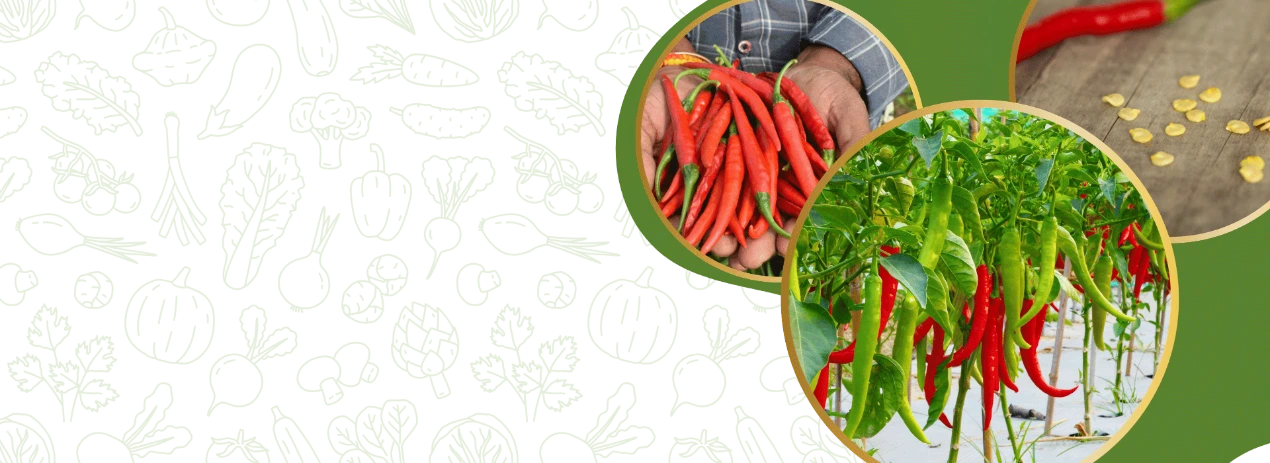
Crop overview
- Crop type: Annual, warm-season spice vegetable crop
- Growth habit: Annual herbaceous plant; bushy and branching
- Economic importance: High-value spice crop for domestic use, export, processing, and the dry chili market
- Nutritional value: Rich in capsaicin (pungency), vitamin C (100–140 mg/100 g), vitamin A, and antioxidants
Agro-climatic requirements
Climate: Optimum temperature 20–30°C; fruit set affected below 15°C and above 35°C
- sensitive to frost and heavy rainfall during flowering
Soil: Well-drained sandy loam to loam soil; pH 6.0–7.5
- avoid waterlogging, salinity, and heavy clay soils
Season of sowing (in India)
- Kharif: May-June
- Rabi: September–October
- Summer: January–February
- Protected cultivation: Year-round
Nursery bed preparation and management
- Solarize nursery soil for one month before sowing
- Prepare raised beds of 80–90 cm width
- Sow seeds thinly and cover lightly and cover beds with nylon net to prevent virus vectors
- Daily light irrigation
- Nutrition: 19:19:19 + micronutrients spray
- If wilt appears, drench Metalaxyl + Mancozeb
- Seedling age: 30-35 days with 4-5 leaves and water beds 24 hours before transplanting
Protected nursery:
- Pro-tray nursery recommended (98-cell trays), coco-peat-sterilized media, insect-proof net (40–50 mesh)
- Required for virus-prone, high incidence of sucking pests and rainy areas and nursery structure are shade-net / polyhouse (50-75%)
- Advantages are healthy seedlings, uniform growth, low disease and reduce damping off
Seed rate
- Hybrid 150–200 g/ha
Open-pollinated varieties 300-350 g/ha
- (Seed rate depends on spacing and germination percentage.)
Seed treatment
- Seed is treated with Trichodermaviride @ 4 g/kg seed OR Carbendazim + Mancozeb (2 g/kg) OR Thiram @ 2–3 g/kg
Field preparation
- Deep ploughing followed by 2–3 harrowing for fine tilth; incorporate well-decomposed FYM @ 20–25 t/ha; form ridges and furrows at recommended spacing
Method of sowing/transplanting
- Pre-soaking irrigation 3–4 days before transplanting; dip seedling roots in fungicide + insecticide solution before planting; transplant preferably in evening hours
Spacing
- Rainfed/normal: 60 × 45 cm
- Irrigated/hybrid: 60 × 60 cm
- High density: 45 × 45 cm
- Protected: 100-120 cm bed, 40-50 cm plants spacing
Nutrient management per hectare
Total recommended nutrients: 150-200: 60-80: 120-150 kg NPK and FYM- 20-25 t/ha
- First dose basal before transplanting: 50% N, 100% P, 50% K
- Second dose one month after first application: 25% N
- Third dose one month after second application: 25% N, 50% K
- Add: 25 kg MgSO₄ if deficiency-prone soils
Irrigation
Light irrigation immediately after transplanting
thereafter irrigation at 5–7 days interval depending on soil type
avoid moisture stress during flowering and fruit development
Critical stages Flowering, fruit set and fruit enlargement
Layout and planting for drip irrigation and fertigation
- Install drip laterals before transplanting and place seedlings near emitters (not directly on them); transplant in the evening and run drip for 30–60 minutes immediately to wet the root zone properly
- Avoid flood irrigation after drip installation to prevent system damage and poor root aeration
Emitter spacing are 30–40 cm (sandy soil), 40–50 cm (loam/clay loam) and discharge is 2–4 LPH per emitter
Fertigation schedule
- 0–20 DAT: 19:19:19 @ 2–3 kg/acre/week, seedling establishment
- 21–40 DAT: Urea + MAP @ 3–4 kg/acre/week, vegetative growth
- 41–60 DAT: Urea + SOP @ 4–5 kg/acre/week, flowering initiation
- 61–90 DAT: SOP + Calcium nitrate @ 5–6 kg/acre/week, fruit set
- 91 DAT onwards: SOP + potassium nitrate @ 5–6 kg/acre/week, fruit development
- Micronutrient mixture at 15 days interval
Intercultural operations
- Mulching: Moisture conservation and weed control using black/silver plastic mulch and clean fruit production
- Training and pruning: Earthing up at 30–35 DAT, light staking in high-yielding hybrids to prevent lodging
Weed management
- Critical period: 20–45 DAT
- two hand weedings at 20 and 40 DAT
- pre-emergence Pendimethalin @ 1.0 kg a.i./ha
- Quizalofop-ethyl for grassy weeds
- ensure adequate soil moisture before application
Growth and micronutrient management
- Spray 1% calcium nitrate at the flowering stage; spray 0.5% urea + 1% KNO₃ at 15-day intervals during fruiting; spray boron 0.2% at flowering to improve fruit set
Physiological disorders
- Blossom End Rot – Calcium deficiency
- Flower drop – High temperature or moisture stress
- Fruit rot – Moisture fluctuation
- Sunscald – Direct sunlight exposure
- Poor fruit set – Boron deficiency
Plant protection—pests
- Fruit borer (Helicoverpa armigera) – Boreholes in fruits; control with pheromone traps, Trichogramma release, neem oil 5%; spray Emamectin benzoate or Spinosad if severe (rotate IRAC groups)
- Thrips – Leaf curling and scarring; manage with blue sticky traps and spray Fipronil or Spinosad
- Aphids – Leaf curling and honeydew; control with ladybird beetles and spray Acephate or Dimethoate
- Mites – Leaf bronzing; spray Abamectin or Propargite
- Whitefly – Virus transmission; use yellow sticky traps and spray Imidacloprid/Thiamethoxam in early stage
Plant protection—Disease
- Anthracnose (Colletotrichum spp.) – Fruit rot; spray Mancozeb or Carbendazim
- Powdery mildew – White powdery growth; spray Wettable Sulphur
- Damping-off – Nursery disease; treat with Trichoderma and drench Captan
- Leaf curl virus – Leaf curling and stunting; manage via whitefly control and resistant hybrids
- Wilt – Soil borne; follow crop rotation and soil treatment
Harvesting
- First picking 60–75 days after transplanting (green stage); for dry chilli harvest at full red maturity; multiple pickings (6–10) at 7–10 days interval
Yield
- Varieties: 20–30 t/ha (green)
- Hybrids: 30–50 t/ha (green)
- Dry chilli: 2–3 t/ha
- Protected: 80–120 t/ha (green)
Storage
- Fresh green chilli: 7–10°C, 85–90% RH (2–3 weeks) and storage life 10-15 days
- Dry chilli: Store at 8–10% moisture in dry, ventilated place
- Avoid high humidity to prevent fungal growth