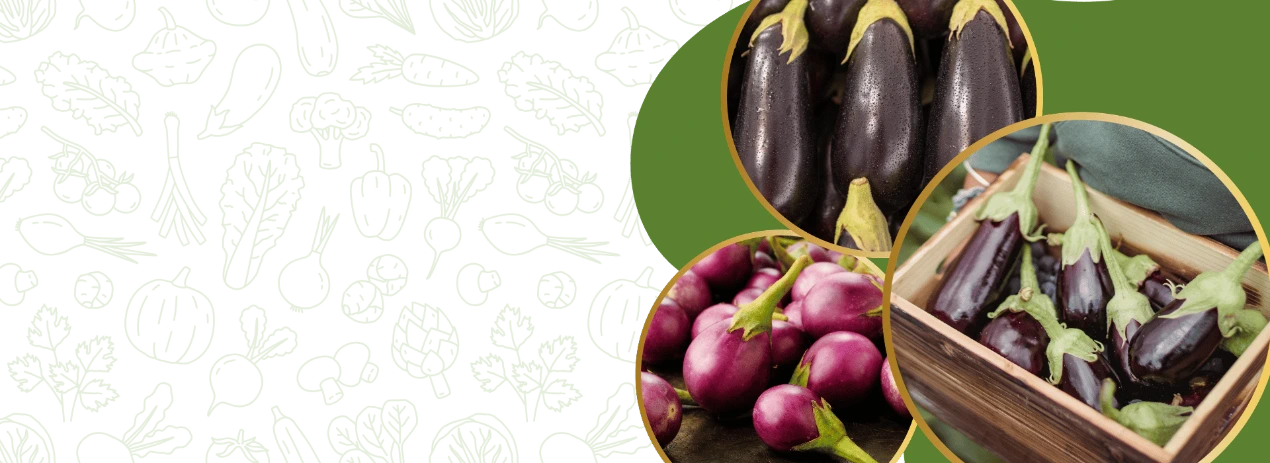
Crop overview
- Crop type: Annual, warm-season fruit vegetable, berry type
- Growth habit: bushy to semi-erect
- Economic importance: Consumed fresh in cooked form; used in curry, bharta, fry and processed products
- Nutritional value: rich in dietary fiber, antioxidants (nasunin), vitamins B1 and B6, and minerals
Agro-climatic requirements
- Climate: Optimum temperature: 25–30°C (day) and 18–22°C (night), frost sensitive, low temperature reduces growth and very high temperature causes flower drop.
- Soil: Well-drained fertile loam, pH: 6.0–7.0; avoid waterlogging and highly saline soil.
Season of sowing (in India)
- Kharif: May-June
- Rabi: September–October
- Summer: January–February
- Protected cultivation: Year-round
Nursery bed preparation and management
- Solarize nursery soil for one month before sowing
- Prepare raised beds of 80–90 cm width
- Sow seeds thinly and cover lightly and cover beds with nylon net to prevent virus vectors
- Daily light irrigation
- Nutrition: 19:19:19 + micronutrients spray
- Seedling age: 25–30 days with 3–4 leaves and water beds 24 hours before transplanting
Protected nursery:
- Pro-tray nursery recommended (98-cell trays), coco-peat-sterilized media, insect-proof net (40–50 mesh)
- Required for virus-prone, high incidence of sucking pests and rainy areas and nursery structure are shade-net / polyhouse (50-75%)
- Advantages are healthy seedlings, uniform growth, low disease and reduce damping off
Seed rate
- Hybrid 150–200 g/ha
Open-pollinated varieties 300–350 g/ha
- (Seed rate depends on spacing and germination percentage.)
Seed treatment
- Seed is treated with Trichodermaviride @ 4 g/kg seed OR Carbendazim + Mancozeb (2 g/kg) OR Thiram @ 2–3 g/kg
Field preparation
- Deep plowing for fine tilth and planking for a uniform field.
- Add incorporated well-decomposed FYM @ 25 t/ha. Furrows opened at recommended spacing
Method of sowing/transplanting
- A pre-soaking irrigation is given 3-4 days prior to transplanting. Before planting, seedlings should be dipped in an insecticide + fungicide solution, and transplanting should preferably be done in the evening.
Spacing
- Determinate type: 60 × 45 cm
- Indeterminate type: 90 × 60 cm
- Protected: 100-120 cm bed, 40-50 cm plants spacing
Nutrient management per hectare
Total recommended nutrients: 150-200 : 80-100 : 150-200 kg NPK and FYM 20-25 t/ha
- First dose basal before transplanting: 50% N, 100% P, 50% K
- Second dose one month after first application: 25% N
- Third dose one month after second application: 25% N, 50% K
Irrigation
Irrigation depends on the soil type.
Light irrigation once in a 3-4 day interval is ideally followed in a well-managed plot.
Ensure sufficient moisture at the root zone, especially during the flowering-fruit-setting stage.
Critical stages Flowering, fruiting
Layout and planting for drip irrigation and fertigation
- Install drip laterals before transplanting and place seedlings near emitters (not directly on them); transplant in the evening and run drip for 30–60 minutes immediately to wet the root zone properly
- Avoid flood irrigation after drip installation to prevent system damage and poor root aeration
- Emitter spacing are 30–40 cm (sandy soil) and 40–50 cm (loam/clay loam) and discharge is 2–4 LPH per emitter
Fertigation schedule
- 0–20 DAT: Water-soluble NPK (19:19:19), seedling establishment
- 21–40 DAT: Urea + MAP, vegetative growth
- 41–60 DAT: Urea + SOP, flowering initiation
- 61–90 DAT: SOP + Calcium nitrate, fruit set
- 91 onwards: SOP + Potassium nitrate, fruit development
- Throughout crop: Micronutrient mixture, fortnightly
Intercultural operations
- Mulching: Moisture conservation and weed control using black/silver plastic mulch or organic residues help improve fruit quality, reduce fruit cracking, and minimize disease incidence.
- Training and pruning: Staking recommended for hybrids; remove lower yellow leaves and diseased branch regularly
Weed management
- The critical weed competition period is 20–45 DAT
- Managed through hand weeding at 20 and 40 DAT
- Pre-emergence application of pendimethalin @ 1.0 kg a.i./ha (carefully used in light sandy soils) and post-emergence use of quizalofop-ethyl for grassy weed control.
- Avoid spraying
after transplanting without moisture
Growth and micronutrient management
- Spray Calcium Nitrate (1% solution) during flowering to enhance fruit set and spray Urea 0.5% & Soluble KNO₃ (1%) at 15-day intervals during harvesting time.
Physiological disorders
- Fruit browning – Ca deficiency
- Poor fruit set– Heat stress and poor pollination
- Yellowing leaves – N or Mg deficiency
- Spongy fruits – water stress
Plant protection—Pest
- Shoot and Fruit Borer (Leucinodes orbonalis)—identified by boreholes on fruits and larvae feeding inside fruits and drooping shoots, and it can be managed through biological control measures like pheromone traps and neem oil 5%, along with chemical control using emamectin benzoate, flubendiamide, and spinosad.
- Whitefly – shows black sooty mold on leaves and also spreads viral diseases, and it can be controlled by spraying Acetamiprid or buprofezin at the recommended dose.
- Aphids – sticky honeydew on leaves and curling of young leaves, and it can be controlled by spraying Dimethoate or Acephate at the recommended dose.
- Jassids (leafhoppers) cause leaf curling and yellowing symptoms and can be controlled by spraying imidacloprid or thiamethoxam.
Plant protection—Disease
- Bacterial Wilt (Ralstonia solanacearum) – auses sudden wilting and brown discoloration of vascular tissue, and can be managed through soil solarization and cultivation of resistant varieties.
- Phomopsis Blight – causes fruit rot and leaf spots, and can be controlled by spraying Mancozeb or Carbendazim.
- Little Leaf (Mycoplasma) – causes small leaves and excessive branching, is transmitted by leaf hoppers, and can be managed through vector control by spraying systemic insecticides like Imidacloprid or Thiamethoxam.
- Alternaria Leaf Spot – causes target-like brown spots on leaves and can be controlled by spraying copper fungicides such as Copper oxychloride.
Harvesting
- First picking 60-70 days after transplanting
- harvest interval 4-5 days
Yield
- Open Polinated Varieties: 30-40 t/ha,
- Hybrids: 50-70 t/ha
- Protected Cultivation: 100-120 t/ha (under good management)
Storage
- Optimal storage: 12–15°C, 85–90% relative humidity
- Storage life: 7–10 days
- Avoid storage below 8°C to prevent chilling injury.